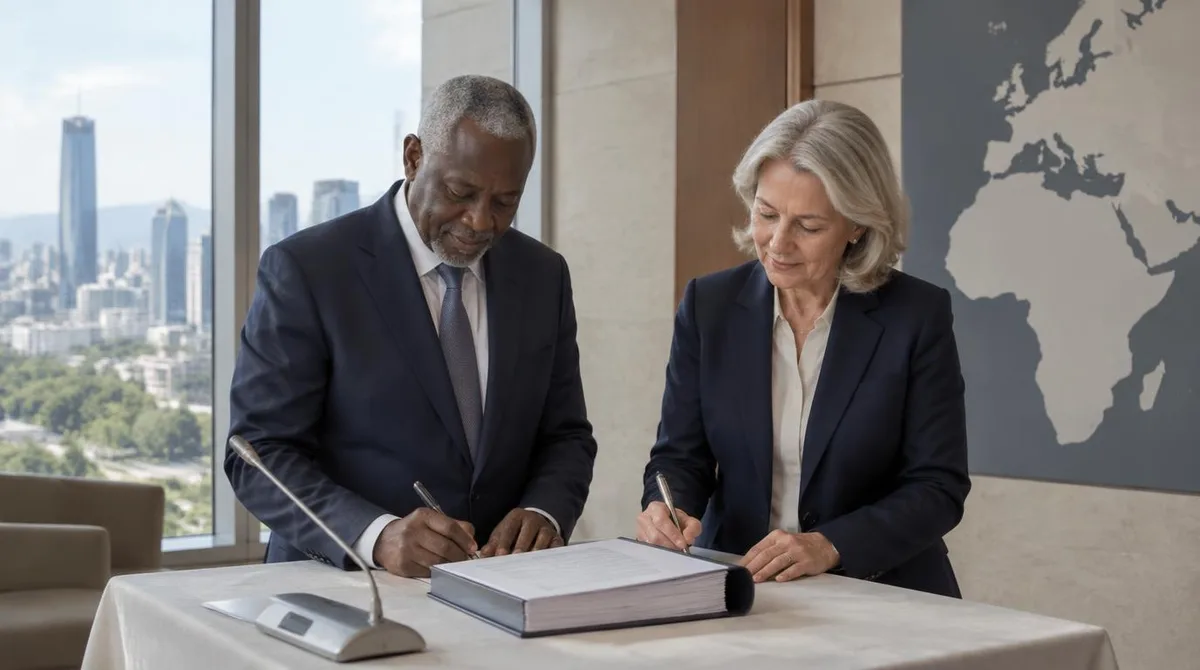
What does "scaling up investment" mean when the African Union and the European Union sit down together? In practice, it means turning twenty-five years of summit declarations into funded projects: roads, power grids, digital networks, and trade rules that both continents can actually use. The most recent step came at a November 2026 senior-officials meeting, co-chaired by Ambassador Willy Nyamitwe of Burundi, chairperson of the AU Permanent Representatives Committee, and Patricia Llombart Cussac, the European External Action Service's managing director for Africa. According to Modern Diplomacy, its headline outcome was an implementation plan built around four priority areas, adopted after a summit in Luanda the year before had promised exactly this kind of follow-through.
The context matters, because the partnership's record is mixed. According to Modern Diplomacy, high-level AU-EU summits have often been perceived as ineffective, limited by structural, historical, and political divides. The 2026 meeting, which drew roughly 400 participants including 77 heads of delegation — 50 from the AU side and 27 from the EU — was designed to close that gap between promise and delivery.
For readers new to the file, this is a story about two continental blocs trying to renegotiate a relationship that history made unequal. Understanding why the 2026 meeting matters requires understanding what went wrong before, and why both sides now talk about scaling up rather than simply restarting.
What is the AU-EU partnership, and why does it carry baggage?
According to Modern Diplomacy, the African Union and the European Union were established through a series of high-level dialogues and negotiations, bringing together two huge regions with enormous resources to pursue complementary development ambitions and engage in profound economic transformations while sustaining Africa's sovereignty. Their partnership formally marked its 25th anniversary at the 7th AU-EU summit in Luanda, Angola, in November 2025.
The baggage is colonial. African leaders frequently criticize the EU for what they see as a patronizing donor-recipient mindset rather than an equal partnership between sovereign states. That grievance shapes nearly every negotiation that follows, from trade terms to migration policy.
There is also a structural mismatch in what each side expects. Summits have tended to produce grand declarations and vague financial pledges from Brussels, while African nations want concrete movement on debt relief, technology transfer, and fair trade. The EU, for its part, has often used financial leverage to seek alignment on European geopolitical or migration priorities. Anyone who has read Why Diplomatic Summits Matter — Summit Season: Why Big Meetings Rarely Change Much will recognize the pattern: communiqués are easy, delivery is not. This connects to our earlier piece, Why Diplomatic Summits Matter — Summit Season: Why Big Meetings Rarely Change Much. This connects to our earlier piece, Why Diplomatic Summits Matter — Summit Season: Why Big Meetings Rarely Change Much.
Why is the EU no longer Africa's default partner?
Because African countries have options now. The EU is no longer Africa's exclusive or dominant partner: African states have increasingly turned to China, Russia, and the expanded BRICS bloc for infrastructure financing, trade, and security cooperation. That competition reduces the relative leverage of EU-led frameworks — and it gives African negotiators an argument they did not have a generation ago.
The African Union's own internal divisions compound the problem. Vast disparities in economic stability, governance, and institutional strength among AU member states make it difficult to enforce continental policies or present cohesive demands. A bloc that cannot always speak with one voice negotiates from a weaker position, however large its combined market.
Finally, there are genuine political disagreements. Tensions flare over democratic backsliding, coups, and human rights abuses. The AU's adherence to non-interference often clashes with the EU's preference for political conditions and sanctions — a clash familiar to readers of How Sanctions Work — The Rise of Economic Statecraft: Sanctions as Strategy. For related coverage, see How Sanctions Work — The Rise of Economic Statecraft: Sanctions as Strategy. For related coverage, see How Sanctions Work — The Rise of Economic Statecraft: Sanctions as Strategy.
What did the November 2026 meeting actually decide?
Three things stand out from the record of the meeting, which was convened to facilitate dialogue on shared priorities and coordinate the two sides on common economic interests.
- An implementation plan. Senior officials adopted an AU-EU Partnership Implementation Plan structured around priority areas including prosperity (trade, economic integration, the African Continental Free Trade Area, and sustainable value chains), peace, security and governance, and people (health, education, and social development).
- A follow-up mechanism. The meeting established a new mechanism to monitor progress, improve institutional coordination, and strengthen accountability. The two sides also released a Joint Monitoring Report reviewing achievements from 2022 to 2025 — an unusual admission that delivery needed measuring.
- Investment focus. Discussions highlighted the Global Gateway Africa-Europe Investment Package, directed at transport, energy, digital transformation, and infrastructure.
On digital policy, Ethiopia — acting through Prime Minister Abiy Ahmed as the AU Champion for AI and digital health — presented the AU common position, emphasizing universal digital literacy, cyber infrastructure, and startup ecosystems.
What did Africa push back on?
Trade rules, specifically. The AU side raised critical challenges regarding EU trade measures, requesting adjustments or relief concerning the EU Deforestation-Free Regulation and the Carbon Border Adjustment Mechanism. Both affect key African agricultural and commodity exports. This is where the partnership's underlying tension shows itself: Europe sets standards for its own market, and African exporters bear the compliance cost whether or not they helped write the rules.
What does "scaling up" really signal here?
The phrase itself is doing diplomatic work. Scaling up implies something already exists and needs to grow; it is a quieter word than "reset" or "new deal," and both sides chose it deliberately. Whether the new mechanism changes anything depends on the thing summits historically failed at — follow-through. The Joint Monitoring Report and the follow-up mechanism exist precisely because previous pledges did not convert into visible results. The test of the 2026 plan will not be its adoption but its delivery, and the next monitoring cycle will show whether scaling up was a plan or a phrase.