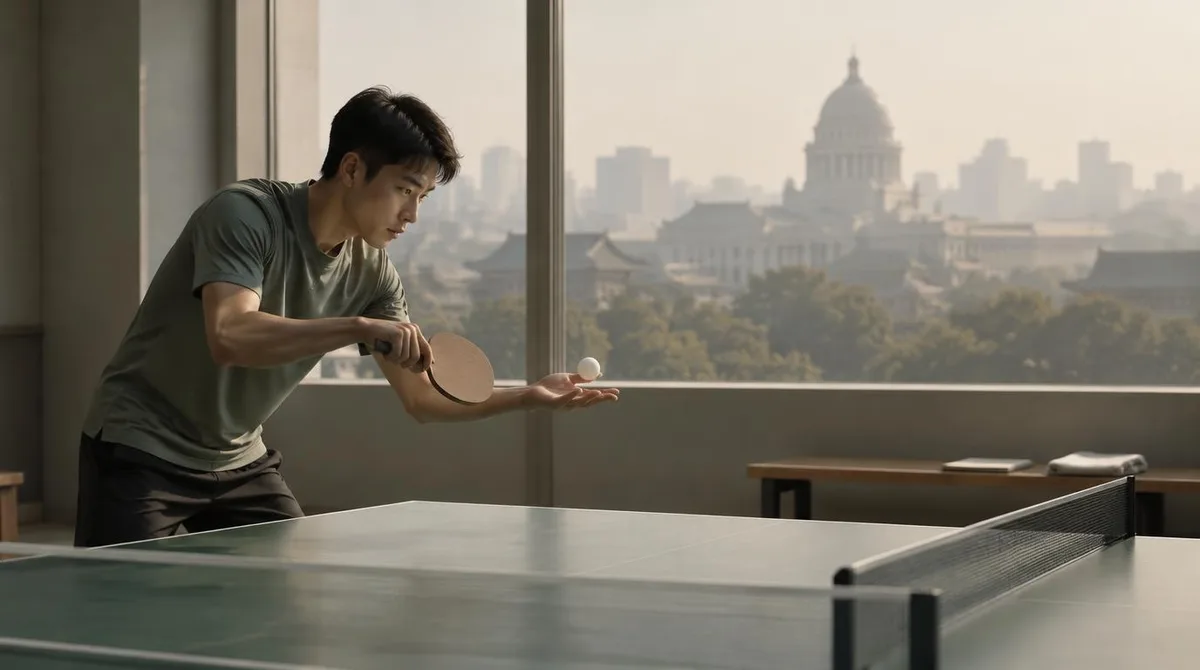
Matches have opened doors that formal talks left shut. The best-known case came in April 1971, when the United States table tennis team accepted a Chinese invitation to play in a country most Americans were still barred from visiting. Friendship tours, joint parades, one shared Olympic roster, and goodwill visits have all eased relations that envoys alone could not move.
The U.S. State Department’s history office keeps the record. After American and Chinese players mixed and mingled at a competition in Japan, China invited the U.S. team in April 1971. A return tour followed in April 1972. Per the department’s account, this informal Ping Pong Diplomacy provided a public face for more serious diplomatic negotiations.
How Did Ping Pong Reach Beijing First?
The sequence moved quickly once it began. Players from the two sides met at an international tournament in Japan, and the images circulated widely. The Chinese invitation arrived in April 1971. Travel rules that had kept Americans out of mainland China were lifted that same year, per the State Department’s history office, and the team traveled.
Events then ran ahead of ceremony. Henry Kissinger, then the national security adviser, flew to Beijing twice during 1971, with the first trip kept secret until a speech by President Nixon. In 1972, Nixon traveled to the PRC and met with leaders Mao Zedong and Zhou Enlai, and the two governments negotiated the Shanghai Communiqué. The matches had set the stage before any of it happened.
Why Can Athletes Reach Where Envoys Cannot?
Games change the setting. Envoys meet across long tables in guarded rooms, while athletes meet on courts and rinks in front of crowds. The scoreboard treats both sides as equals by design. That visible balance gives two publics a way to see each other as people rather than as postures.
Symbols also travel faster than treaties. A handshake at midfield needs no translation and no communiqué. It cannot settle a border or lift a sanction. It can lower the temperature enough for negotiators to work, and that is often the scarce resource in a frozen dispute.
What Made PyeongChang 2018 Different?
Korea turned the idea into one shared team. In 2018, the Democratic People’s Republic of Korea and the Republic of Korea entered a unified women’s ice hockey team at the Winter Olympics, per the International Olympic Committee’s account. The two countries had paraded together at earlier Games. They had never before competed as one roster.
The arrangement was specific rather than vague. South Korea’s women had already qualified for the tournament as hosts, and three players from the north joined them, again per the IOC. It was the first time in Olympic history that both nations competed as a single team under one flag. The experiment lasted one tournament; the image lasted longer.
Can a Match Really Change Policy?
The honest answer is: not by itself. Ping pong did not normalize relations; negotiations did. The games supplied timing and cover, a public story that made private contacts easier to explain. The State Department’s own wording is careful, calling the matches a public face for more serious negotiations.
The record offers sports diplomacy examples in both directions. East and West Germany once competed together, and Egypt and Syria entered the Olympics as a single country called the United Arab Republic, per the same account. Shared teams did not dissolve either division. What they did was keep a channel visible while politics did the slow work. This connects to our earlier piece, Small Country Diplomacy — Small Nations, Big Tables: How Microstates Punch Above Their Weight.
Conclusion: Open Doors, Then Walk Through
Sports did not invent diplomacy, and they cannot replace it. What matches do is open doors. A shared team can stand in for a relationship that does not yet exist on paper. A handshake in front of a crowd can license talks that cabinets hesitate to announce. Readers following this should also see Bilateral Diplomacy — Bilateral vs. Multilateral Talks: When Diplomats Choose One-on-One Over the Table.
The lesson from 1971 and from 2018 is similar. Play first, talk second. The scoreboard never settles anything, but it has repeatedly given governments a door worth walking through. The next frozen relationship will probably thaw the same way: slowly, formally, and with a game going on somewhere in the background.