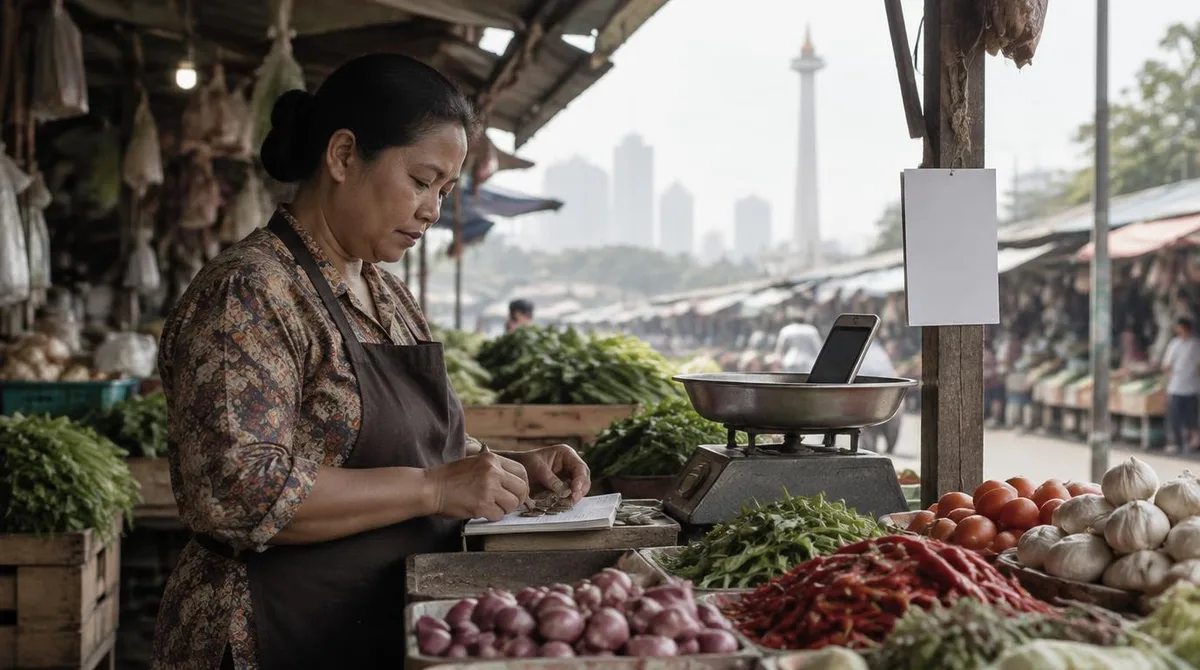
A market vendor in Indonesia can spend an entire day taking QR payments and still be turned down for a bank loan. Her sales are real; her credit file is empty. On 26 October 2026, Bank Indonesia said it plans to use transaction histories from QRIS, the national QR payment standard, as one reference for judging creditworthiness among micro, small and medium-sized enterprises. By the third quarter of 2026, QRIS had reached 49.4 million merchants, roughly 97 percent of them MSMEs, according to Modern Diplomacy.
The plan matters less as a payments story than as a data story. It asks whether the digital exhaust of ordinary commerce can do what collateral documents never did for the informal economy. The honest answer, on the evidence so far, is that payment records can open the door to credit. Whether walking through it leaves anyone better off is a separate question — one that a decade of microcredit research answers with a shrug. For related coverage, see Bilateral Diplomacy — Bilateral vs. Multilateral Talks: When Diplomats Choose One-on-One Over the Table.
This is analysis of an idea arriving at a combustible political moment, and the numbers deserve a colder read than the announcement received.
Why did Indonesia reach for payment data now?
Timing explains more than technology does. In August 2025, protests over lawmakers' allowances in Indonesia escalated after a motorcycle-taxi driver was struck and killed by a police vehicle. In Nepal, a social media ban ignited demonstrations also shaped by anger over corruption and thin opportunity. Young Moroccans protested inadequate public services and work prospects; demonstrations in Madagascar over water and electricity shortages grew into a national political crisis, per the same report.
None of these movements was simply a revolt against inequality, and the piece is careful not to claim otherwise. What they exposed, it argues, is how fragile public trust becomes when economic progress feels disconnected from daily life. The UN World Social Report 2025 warned that economic insecurity and persistent inequality were eroding social cohesion. Credit cannot repair a failed public service. But it speaks to the question underneath much of the frustration: whether working hard today still buys a better tomorrow.
What does the evidence say payment data can actually do?
The strongest finding comes from China. A 2022 Bank for International Settlements study of roughly half a million Chinese firms found that QR payment records helped merchants obtain credit from the platform processing their transactions, with positive spillovers to bank credit. Access to platform credit also improved business sales, including through the COVID-19 shock. In the Philippines, Maya's Paleng-Kita program uses merchant QR histories alongside alternative data to assess loans for vendors and drivers.
Both cases establish the value of payment data. Neither establishes an inevitable development outcome, and the differences matter. China's model is platform-controlled; a potential Indonesian arrangement would be built around a national payment standard. Those are different machines with different incentives attached.
Where does the loan-versus-wealth distinction bite?
Consider two borrowers the report sets side by side. A tailor borrows to buy a machine and wins larger orders. A shopkeeper borrows to keep buying stock as sales decline. Both gain access to credit; only one may build wealth. A 2015 synthesis of six randomized microcredit evaluations found generally modest rather than transformative welfare gains. Those studies examined microcredit, not QR-based scoring for established merchants — but their relevance is the gap between getting a loan and benefiting from one.
Credit access, wealth creation and wealth distribution are three different outcomes. An innovation can expand the first without moving the other two. That distinction should govern how financial inclusion is judged, especially when access to the enabling technology is itself unevenly spread.
How does the AI divide compound the financing gap?
A March 2026 ILO working paper by Paweł Gmyrek, Mariana Viollaz and Hernan Winkler examined generative AI exposure across 135 countries. It found lower aggregate automation exposure in developing economies than in advanced ones, and warned that conventional exposure measures often overstate likely impacts in poorer countries. Yet connectivity gaps mean some workers could face disruption before others can capture any productivity benefit. The paper analyses jobs, not merchant financing.
A further possibility follows from this evidence rather than being established by it. A business with a thin digital payment history may struggle to finance itself; without affordable capital, it may also struggle to buy the software, equipment or training that would make AI useful. A better-resourced competitor moves sooner. Credit innovation could ease one barrier to technological adaptation and would leave inadequate connectivity, skills and demand untouched. For more on how economic tools become statecraft, see How Sanctions Work — The Rise of Economic Statecraft: Sanctions as Strategy. This connects to our earlier piece, How Sanctions Work — The Rise of Economic Statecraft: Sanctions as Strategy.
What do Indonesia's own lending numbers show?
The domestic arithmetic is unglamorous. Indonesia already subsidizes MSME lending through Kredit Usaha Rakyat and the Financial Services Authority's credit information system, SLIK; QRIS histories could complement them for businesses with sparse formal borrowing records. The uneven pace shows in OJK's September 2026 report: bank credit to MSMEs grew 2.32 percent year on year in August, against 13.65 percent for total bank credit. That suggests sluggish MSME credit growth, though the figures alone cannot separate weak demand from restricted supply.
The shadow side grew faster. Outstanding regulated online peer-to-peer lending stood at Rp106.94 trillion, up 22.07 percent year on year, and its 90-day delinquency measure, TWP90, rose from 4.32 percent in July to 4.73 percent in August. Gross non-performing loans in banking stood at 2.11 percent — a figure that measures a different borrower population and should not be set directly against the P2P number. None of these figures describes QRIS-based credit, because none of it exists yet at scale. The cautionary reading, in the spirit of economic statecraft generally, is that instruments announced with inclusion in mind can drift toward whatever the infrastructure makes easy.
What would a fair test of QRIS credit look like?
It would track the three outcomes separately: who gets loans, who builds wealth, who does not. It would watch whether scoring rewards continuity of turnover while penalizing the vendor whose sales dip for reasons no payment record captures — an expense, a liability, a sick week. And it would ask the political question the announcement invites but cannot answer: whether a QR code, however widely adopted, can substitute for the public services and governance that the 2025–2026 protest wave was actually about.
The evidence establishes that payment data works as an underwriting signal. What remains unknown is whether credit, distributed by scan, changes the distribution of opportunity — or merely digitizes the queue for it.