Remittances — the money migrant workers send home — reached roughly 685 billion dollars flowing to low- and middle-income countries in 2024, per the World Bank's Migration and Development Brief, a figure that exceeds foreign direct investment excluding China and stands at more than three times official development assistance; including high-income recipients, global flows passed 900 billion. For dozens of economies the arithmetic is existential: remittances exceed 20 per cent of GDP in Tajikistan, Tonga, Lebanon and Nicaragua at various recent readings, and the Philippines, India — the world's largest recipient at well over 100 billion dollars — Mexico, Egypt and Pakistan anchor corridors whose monthly pulse matters more to household welfare than any aid program. This is the largest poverty-reduction mechanism on earth, and it runs on fees.
Why are transfer fees still so high?
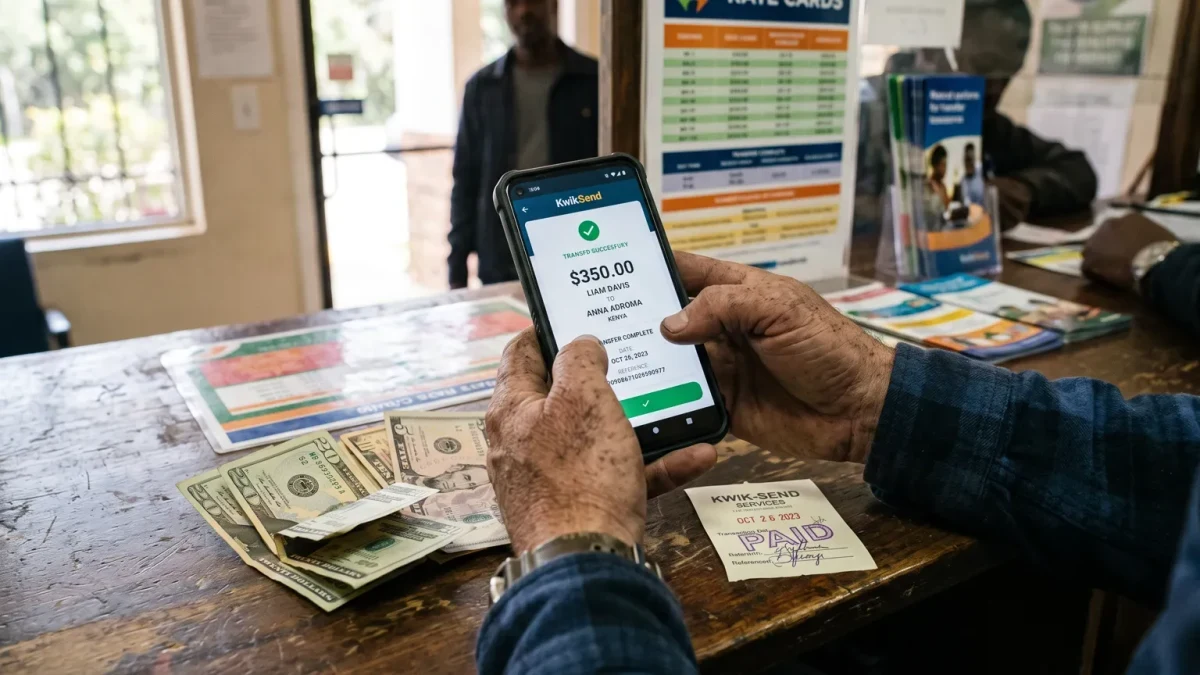
Structure, not technology alone. The World Bank's Remittance Prices Worldwide data shows the global average cost of sending 200 dollars stuck near 6 per cent for years — against the SDG target of 3 per cent — with sub-Saharan Africa's averages highest and cash-to-cash corridors worst, while digital and mobile channels run far cheaper. The persistence is an access problem dressed as a price problem: exclusive partnerships between banks and money-transfer operators that close markets, de-risking's loss of correspondent lanes, licensing regimes that keep fintech competitors out of receiving markets, and the cash economies of the poorest corridors that mobile money has penetrated unevenly. The economics of scale do the rest — a corridor with dense volume supports thin margins; a thin corridor charges what scarcity bears.
What do remittances do that aid doesn't?
They arrive countercyclically and unconditionally. Aid flows are procyclical — donors cut in recessions, exactly when needs rise — while remittances historically rise after home-country shocks: hurricanes, conflicts, currency crashes, as documented in the World Bank's studies of Mexico, Haiti and Nepal post-disaster. They go directly to households without administrative layers, and the micro evidence — the migration-and-development literature's careful studies — finds them spent substantially on food, schooling and health with measurable child-education and health effects. The counterpoint, honestly stated: remittances are private income, not public investment — they do not build roads or institutions, they can appreciate exchange rates in the Dutch-disease pattern documented for several recipients, and their brain-drain externality, the emigration of the sender, is part of the ledger. But as social insurance for a hundred million families, they outperform every program designed by any ministry.
Who controls the corridors?
A duopoly plus rising challengers. Western Union and MoneyGram's historic networks — the agent storefronts that still define cash corridors — face digital-first competitors: Wise and Remitly in rich-to-middle corridors, and above all mobile-money ecosystems — Kenya's M-Pesa rails, Wave in West Africa undercutting fees to under one per cent in Senegal and Côte d'Ivoire, GCash and the Gulf-Asia fintech stack. Governments have entered directly: India's use of its rupee arrangements to cheapen Gulf corridor flows, Pakistan's and Bangladesh's worker-export bureaucracies that manage labor migration as an export industry, complete with pre-departure training and bilateral labor agreements with the Gulf states that host the workers. The Gulf corridor system — millions of South Asian workers whose remittances anchor national economies at both ends — is the world's largest single remittance complex, and its labor politics are therefore macroeconomics for half a dozen countries.
Can states tax or capture remittances?
They try, and the record counsels humility. Direct taxes on remittances push flows informal — the lesson of every attempted levy from Latin America's 2010s experiments onward — so the modern instruments are indirect: diaspora bonds, which Ethiopia, Israel and India have issued with mixed success; matching-fund programs like Mexico's Tres por Uno, which matched collective hometown-association remittances for infrastructure; and exchange-rate incentives that capture flows through formal channels with better rates rather than compulsion. The policy art is channeling without grabbing — every basis point of formal-channel cost pushes a household back to hawala-style informal systems that no statistics see and no regulator can reach, which is also why remittance numbers everywhere are floors, not ceilings.
What should readers watch?
Three series. The Migration and Development Brief's annual numbers — where growth is slowing as host-country labor markets cool, a leading indicator of household stress from Manila to Dhaka. The fee tables — each corridor where a fintech license or a mobile-money expansion cuts cost by half is a measurable transfer to the poor, larger than most aid restructurings. And the de-risking file, because every correspondent lane lost in Nairobi or Dhaka shows up within months as fee increases in the world's most welfare-critical market. The development story of the century's first half is being written in these transfers — private, unglamorous, and already larger than everything the official world sends.