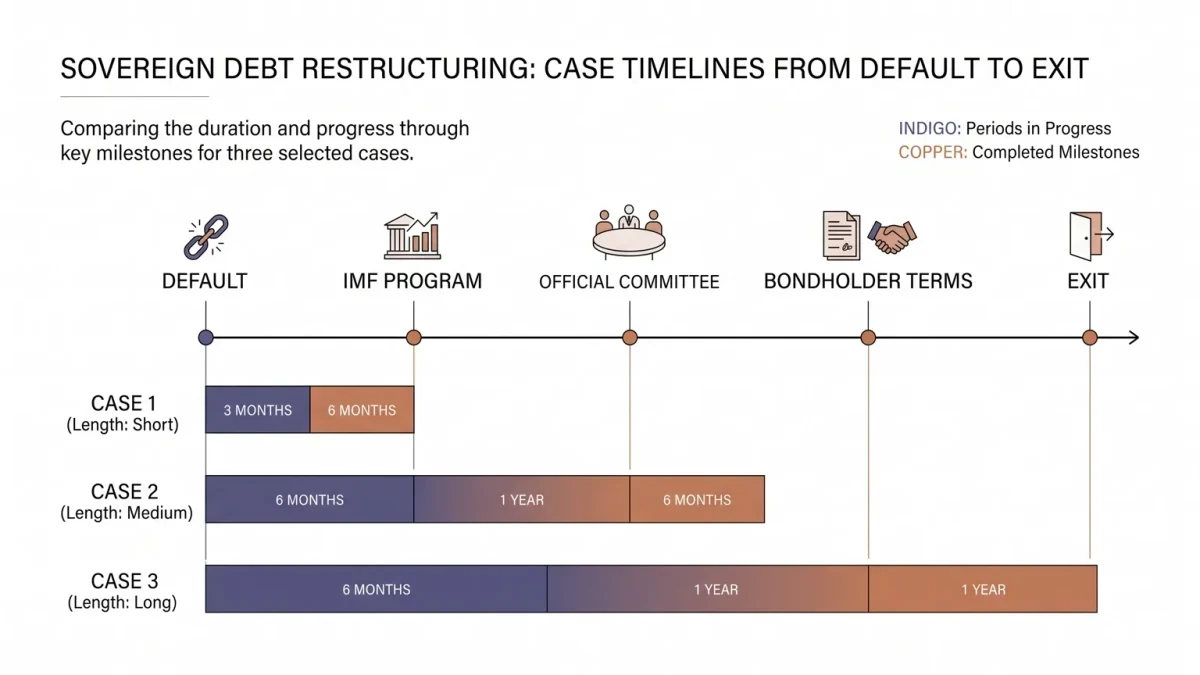
Sovereign debt restructuring runs on the G20's Common Framework — the 2020 process agreed by the Paris Club of traditional creditor governments, China and other official bilateral lenders with the IMF, World Bank and private-creditor participation — and its record is measured in calendars: Zambia defaulted in November 2020 and completed its restructuring in 2024, three and a half years later; Ghana's 2022 default reached agreement terms within about a year, faster; Sri Lanka's 2022 default took two years to its 2024 private-creditor deal; Chad and Ethiopia's processes ran slower and thinner. The developing-world debt overhang behind the machinery is documented by the UN's trade and development analyses: dozens of low-income countries in or near debt distress through the 2020s' high-rate decade, with debt service absorbing record shares of export and fiscal revenue. The playbook exists. Its problem is that every player at the table is sovereign, and sovereigns do not move to anyone's schedule.
How does a restructuring actually proceed?
In sequence, with no court to compel it. A country, insolvent in foreign currency, stops paying and opens an IMF program — which requires debt sustainability analysis, the negotiation of how much relief is 'needed'. Official bilateral creditors — Paris Club members, China and its policy banks, Saudi Arabia, India and others — form a committee to agree comparability of treatment, the Common Framework's core promise: no creditor gets a better deal. Private bondholders, organized through committees and advised by the legal industry's sovereign-workout bar, negotiate exchange terms under restructuring clauses; since 2003's collective-action-clause architecture, and its strengthened 2022+ versions, supermajorities can bind holdouts — the mechanism that tamed the litigation wave of the 2000s' pari passu wars. Creditors sign, guarantees issue, and the country re-enters markets — the genre's full arc, from default to relisting, at its best in two years and at its worst in five.
Why is China the hinge?
Scale and novelty. China became the world's largest official bilateral creditor across the 2010s — its Belt-and-Road lending having supplanted the Paris Club's share in dozens of countries — and the Common Framework exists mainly to co-opt Beijing into a process it did not design. The friction is structural: China has argued multilateral development banks should also take haircuts, a demand Paris Club orthodoxy rejects; its policy banks negotiate bilaterally and slowly, as Zambia's sequence showed; and its domestic approval chains — the famous requirement that credits escalate within institutions that do not publish their terms — set the pace for everyone else's comparability calculations. The 2024-2025 rounds showed adaptation — Chinese participation in the Ghana and Zambia deals functioning, if grudgingly — and the underlying asymmetry persists: the largest creditor is outside the club whose rules it is being asked to honor.
What do the delays cost?
Years of foregone everything. The economic literature on restructuring delays — the 'too little, too late' analyses associated with the decades-long sovereign-debt research program of Carmen Reinhart, Christoph Trebesch and colleagues — finds that prolonged default processes depress growth, investment and market access for years beyond the default itself; a country in negotiation limbo cannot borrow, cannot plan capital budgets and watches the social costs compound. Zambia's three-plus-year process, Ghana's compressed timeline and Sri Lanka's complicated domestic-debt dimension — the local-currency restructuring that hit pension funds — each illustrate the user experience of the machinery: executives fly to committee meetings while hospitals await imported supplies. The delay's causes are the delay's lesson: comparability disputes, IMF sustainability-analysis revisions, and holdout dynamics that the new clauses narrowed but did not abolish.
Is reform coming?
In pieces, and slowly. The Global Sovereign Debt Roundtable — the IMF-World Bank-G20 forum created in 2023 to unblock exactly the disputes that stalled Zambia — meets and clarifies; the strengthened collective-action clauses spread through new issuance; the IMF's willingness to lend into arrears, long the official creditors' leverage question, is refined case by case; and proposals for a sovereign-debt workout mechanism — the standing machinery the UNCTAD tradition has demanded for decades — circulate again with each crisis. The system's defenders make the honest defense: sovereigns cannot be liquidated, so restructuring is diplomacy by other means, and diplomacy is slow. Its critics answer with the arithmetic of who waits: the creditor committees' lawyers bill by the hour, and the debtor's schoolchildren wait by the year.
What should readers watch?
Three lines. The IMF's debt-distress dashboard — the countries moving from 'high risk' to default are the pipeline. The comparability disputes — each public quarrel between Beijing and the Paris Club sets precedent for the next case. And the clause language in new bond issues — the collective-action architecture quietly being built into every fresh issuance is the closest thing the system has to constitutional repair, one prospectus at a time.