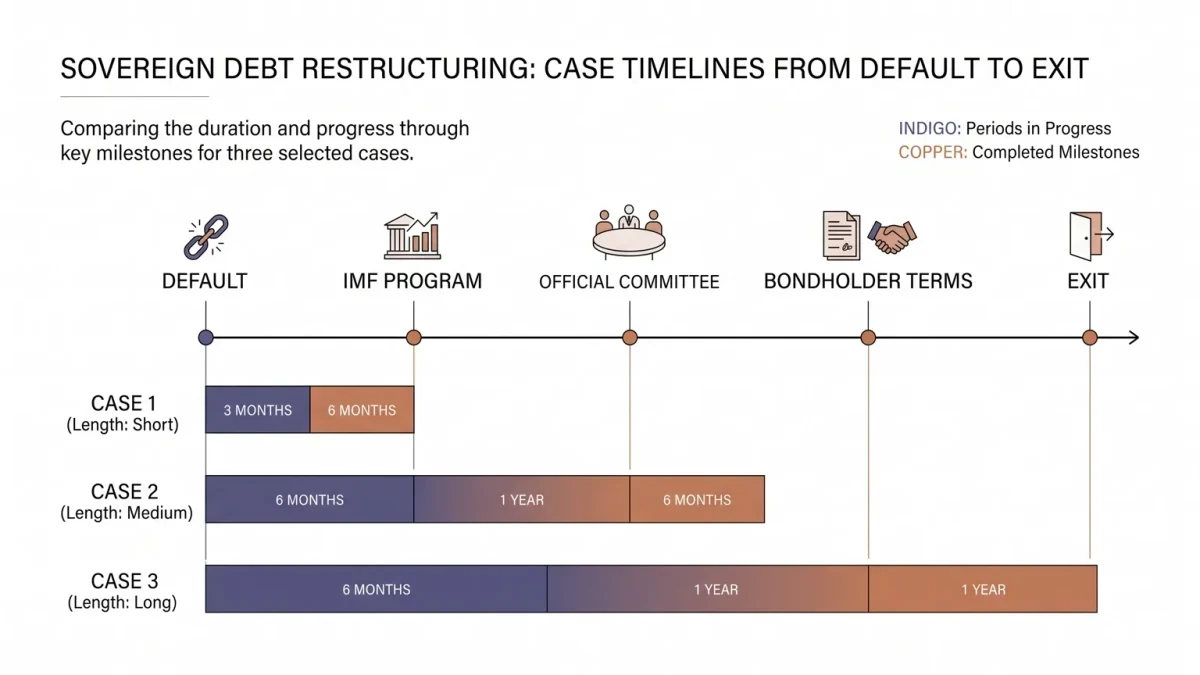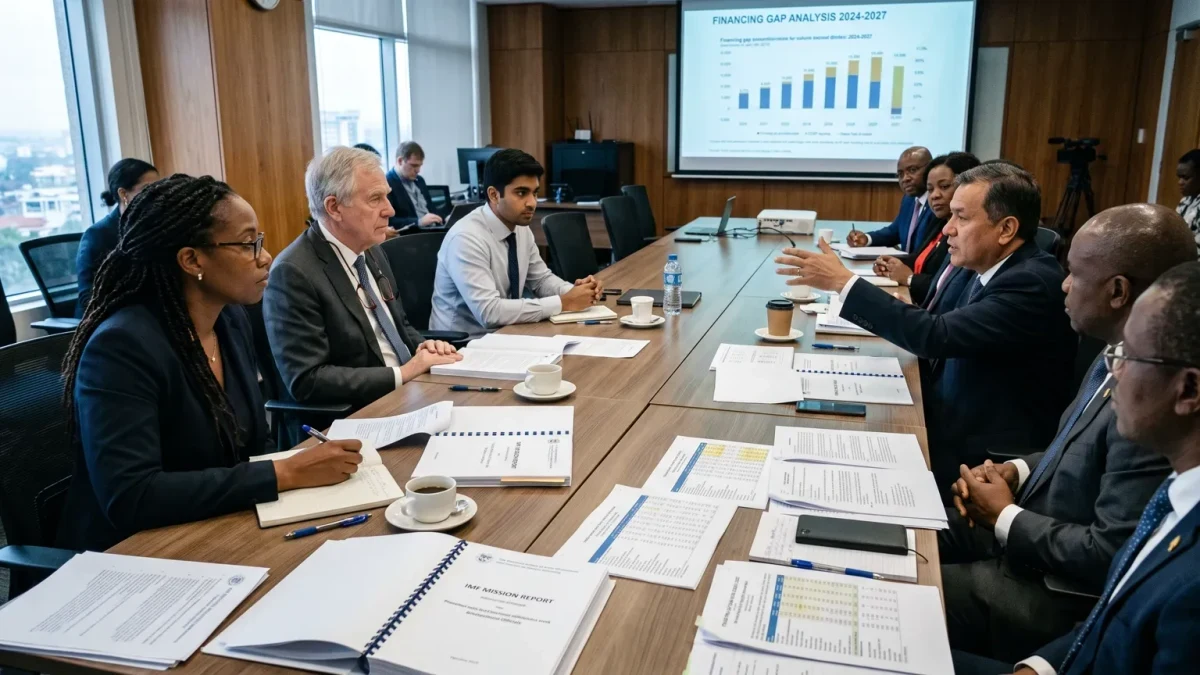
An IMF rescue program is sized against a country's balance-of-payments gap — the difference between what a economy will earn and owe in foreign currency over the program period, plus reserve targets and debt-service needs — and then capped by access rules tied to the borrower's quota, the subscription share that determines both voting power and borrowing limit. Argentina's 2018 program, at 57 billion dollars the largest in IMF history, was justified by exactly such gap arithmetic; Sri Lanka's 2023 program, roughly 3 billion, and Egypt's successive expanded arrangements, at 8 billion by 2024, were sized the same way. The arithmetic, however, rests on forecasts — growth, exports, remittances, market rollover rates — which is why program size is better understood as a judgment about a country's future dressed in spreadsheet form, and why program sizes so often change after the fact.
What are quotas, and why do they dominate everything?
Because they are the IMF's constitution compressed into numbers. A member's quota determines its subscription, its voting share — American veto power rests on its roughly 16.5 per cent of votes against the 85 per cent supermajority required for major decisions — and its normal borrowing ceiling, expressed in multiples of quota under access limits. The 16th general review of quotas concluded in December 2023 delivered a 50 per cent equiproportional increase without changing shares, postponing yet again the reallocation — demanded by Brazil, India, African members and the African bloc's 25-percent-share demand — that would shift voting power toward emerging economies. Quota reallocation is therefore the IMF's permanent constitutional crisis: lending capacity, governance legitimacy and national prestige all route through a formula that has moved only at the speed of the US Congress's willingness to ratify.
How do programs actually disburse?
In tranches against performance criteria, the mechanism that gives 'conditionality' its content. A program sets quarterly and semiannual targets — reserve floors, deficit ceilings, sometimes exchange-rate or structural commitments — and reviews by the executive board release each tranche when met, are waived when missed but forgiven, or interrupt the program when missed and unwaived. The device protects both sides: the fund's shareholders against lending into non-reform, and the borrower against political blame for austerity it can attribute to the program. It also creates the IMF's characteristic procedural drama — the completed review, the delayed review, the waiver-stacked review — which financial journalists read the way sports writers read standings. Egypt's successive reviews, Ghana's 2023 program approvals, Argentina's permanently renegotiated 2018-2021 reviews: each tranche release is a verdict on a government's fiscal nerve.
What is the surcharge fight about?
Money and mandate. The IMF levies surcharges on large and prolonged borrowing, which fell hardest on Argentina, Ecuador and Egypt precisely when their need was greatest; debtor states, joined by academic critics and a coalition campaign in 2023-2024, argued the fund was profiting from crisis at the margin — the IMF's own accounting showed billions in surcharge income — while the fund and its major shareholders defended the disincentive structure and income base. A partial easing took effect in 2024, trimming marginal surcharge rates, and the argument continues in the 2025 review cycle, now entangled with the wider debate over the fund's role as middle-income countries' creditor of last resort in a higher-rate world.
Does IMF lending work?
For its purpose — restoring external viability — the evidence is genuinely mixed in a way partisans on both sides understate. Program countries typically see current accounts stabilize and market access return within the program horizon; growth recoveries are slower and more uneven, and the social-cost literature — the famous debates over austerity effects on health spending and inequality — documents real harm in particular episodes, most sharply in the Asian-crisis and Greek programs of two different eras. The honest ledger was written by the fund's own Independent Evaluation Office, whose reviews of program forecasting found persistent optimism bias in growth projections, a structural feature of negotiations in which borrowers and staff alike need the arithmetic to close. Sizing a rescue is estimating a country's future; the fund's critics and its shareholders disagree about almost everything except that the estimates should be honest, and the IEO exists because they so often were not.
What should a reader watch when a program is announced?
Three numbers and one sentence. The access figure as a multiple of quota — exceptional access above the normal limits signals systemic stakes and hard conditions. The maturity of the debt-restructuring track — whether the program assumes private creditors take haircuts, as in Sri Lanka's and Ghana's defaulted-debt programs. The review calendar — density of reviews maps to the fund's trust in the government's numbers. And the sentence in the staff report about debt 'sustaining with high probability', the phrase whose exact confidence the whole architecture secretly rests on.