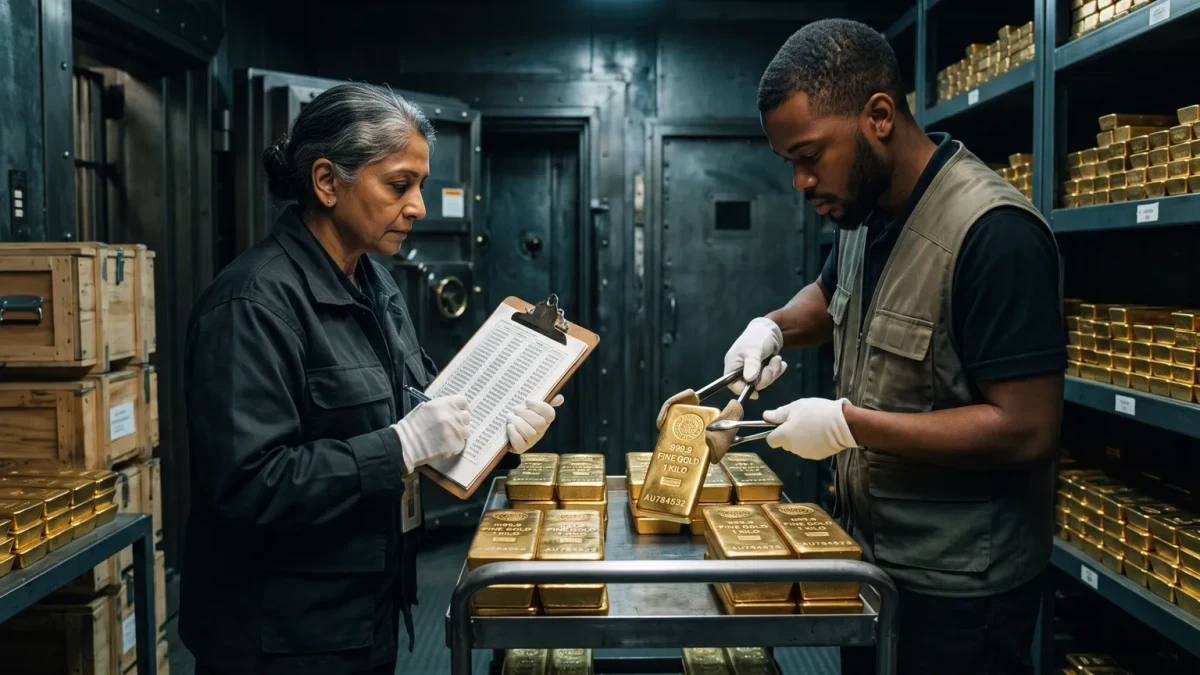
The world's central banks hold roughly 36,000 tonnes of gold — the US Treasury's 8,133 tonnes the largest single hoard, Germany's Bundesbank second at over 3,300, the IMF itself a holder of some 2,814 tonnes — and the system's accounting rests on a chain of trust with a documented failure history. Gold is the one reserve asset whose audit cannot be outsourced to a market price: it must be counted, weighed and assayed where it lies, and where it lies is usually another institution's vault. The trust problem is therefore structural: the entity claiming the asset, the entity storing it, and the entity verifying it are different players with different incentives — and the genre's classic controversies, from the Fort Knox audit mythology to the Bundesbank's repatriation-era recount, are what happens when the chain is asked to show its work.
How is central bank gold actually accounted for?
In three tiers of rigor. Bookkeeping: each holder publishes reserve data monthly in the IMF's international reserves template — allocated gold in own vaults, gold held abroad at named counterparties or 'unallocated' claims. Verification: annual reports by external auditors — the Bundesbank's auditors and the US Office of Inspector General's Treasury audits — test existence through physical inspection of samples: bar lists, weight counts, assays of drilled samples in periodic programs. And cross-verification: the London bullion market's chain of custody, with bars tracked by serial number through the LBMA's Good Delivery system, makes ownership-only transfers auditable without movement. The craft's honest limit: no central bank audits every bar every year; sampling protocols and lead-seal discipline substitute for total counts, which is where conspiracy markets flourish — the recurring demands for a full Fort Knox physical audit have been answered by partial inspections, sealed-compartment verification and, in 2017, a Treasury-directed review of US gold certificates, all of which satisfied auditors and none of which satisfies the internet.
What was the Bundesbank episode about?
Verification by relocation. German public skepticism about foreign-held gold — stoked by a 2012 federal audit court remark that the Bundesbank had never audited its New York and Paris holdings in kind — met the post-crisis political mood, and the bank responded with a public repatriation program: over half its reserves moved home by 2017, completed ahead of schedule, with every transported bar melted and re-assayed in Germany — the industry's largest modern physical verification exercise, which found exactly what the ledgers said. The episode's lesson cuts both ways: the audit-by-withdrawal satisfied the domestic constituency, and it demonstrated the system's quiet dependence — that a friendly custodian's word is normally the whole of the verification, until politics demands more.
Can gold reserves be double-counted or leased away?
The shadow questions, with real but bounded answers. Leasing: central banks have historically lent gold to bullion banks to earn yield, creating paper claims on the same metal — the practice that peaked in the 1990s-2000s and that the World Gold Council's attribution analyses track; leased gold appears in reports as 'on loan,' and the system's 2008-2020 stress reduced the fashion for it. Rehypothecation chains in the unallocated London market theoretically multiply claims on underlying bars — the reason post-2010 reforms pushed central banks toward allocated accounts where specific bar lists attach to specific owners. And the sovereign's moral hazard: where a central bank is not independent of its government, gold has been sold secretly — the Banca d'Italia's 1980s reserve-management controversies historical, and the modern cases of pledged or collateralized national gold in distressed borrowing, documented in IMF program data, showing the asset leaving the country's control without any announcement. The audit trail ends where sovereignty begins.
Why does the trust question matter more now?
Because the 2022 sanctions freezes repriced custodial risk for every reserve manager — the lesson that legal title held in another jurisdiction is only as good as that jurisdiction's politics — and the response, record central-bank buying and repatriation, makes physical custody the fashion again. It also makes verification a market: independent vault-audit specialists now market bar-by-bar programs to central banks modernizing their storage, and the LBMA's responsible-sourcing regime has extended chain-of-custody audit from ownership to provenance — newly mined versus recycled metal — which matters as sanctioned gold seeks laundering channels. The gold standard is gone; the gold-audit standard, run by mortals with clipboards and drills, is what the system actually has.
What should readers watch?
Three series. The monthly reserve templates — each central bank's allocated-abroad lines moving home or not. The audit reports — the rare physical-inspection publications that follow political pressure. And the buying data — the World Gold Council's quarterly totals that tell whether the world's central banks are still voting, tonne by tonne, for the one reserve asset nobody else has to promise to honor.