Trade corridors are infrastructure declarations before they are infrastructure: the India-Middle East-Europe Economic Corridor, announced at the 2023 G20 in Delhi by a dozen partners including the US, EU, India, Saudi Arabia and the UAE, exists so far as a memorandum of understanding and port-capacity plans; the Middle Corridor — the Trans-Caspian route from Turkey through Georgia, Azerbaijan and Kazakhstan — exists as a functioning railway-and-ferry line whose freight volumes roughly tripled after 2022 as sanctioned trade and diversification pushed cargo off the northern Russian route; and China's Belt and Road, the genre's pioneer, has spent over a trillion dollars across a decade and a half building ports, rails and the debt disputes that accompany them. Corridors are the twenty-first century's canal-and-railroad politics: geography, negotiated in communiqués, monetized in freight rates.
Why did the Middle Corridor finally move?
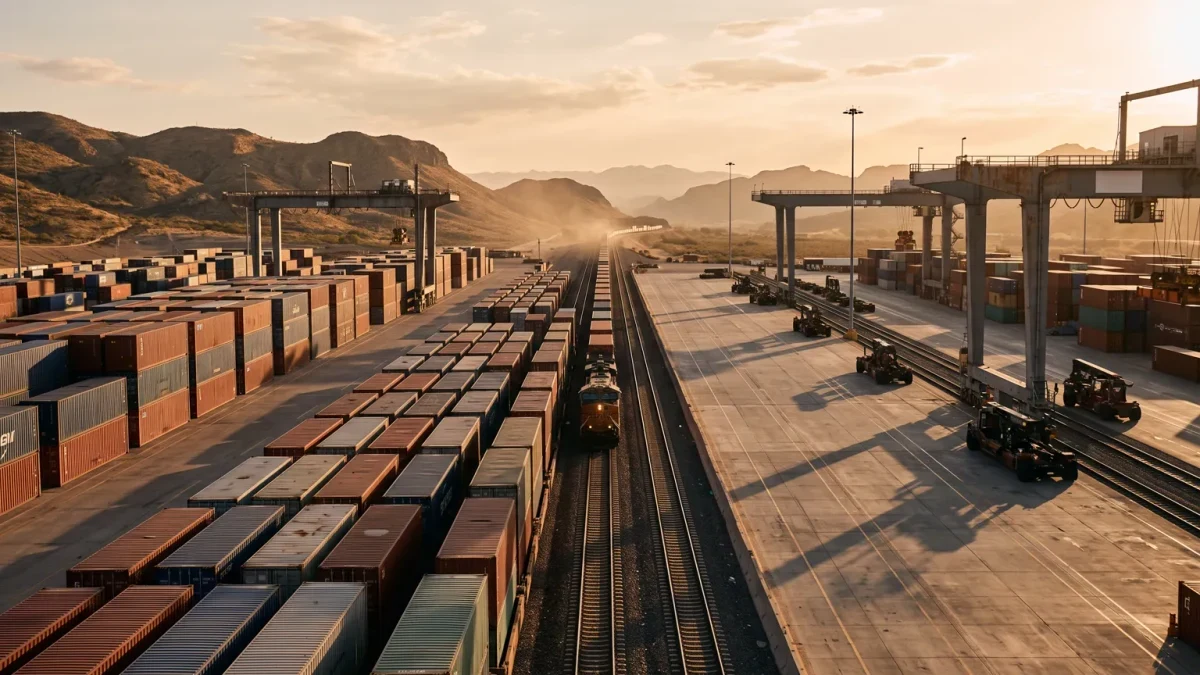
War, which is the corridor business's reliable demand shock. Before 2022 the Trans-Caspian route was a boutique alternative to the fast, cheap northern landbridge through Russia; after the invasion, sanctions exposure and risk repricing pushed Western-allied cargo south, and volumes responded — from tens of thousands of containers annually to hundreds of thousands on the combined rail-ferry-rail chain, with Kazakhstan, Azerbaijan, Georgia and Turkey investing in rolling stock, port berths and gauge-change capacity to absorb it. The corridor's structural limits are equally documented: bottlenecks at the Caspian ferry crossings, the multi-day transshipment penalty versus the northern route's transit times, and freight costs that remain a multiple of sea alternatives — which is why the corridor's realistic future is high-value, time-sensitive and politically-routed cargo rather than bulk world trade.
What is IMEC actually meant to be?
A container and energy corridor linking Indian ports to Gulf rail, Gulf rail to Levantine ports, and the Mediterranean to Europe — explicitly framed at its 2023 launch as a rail-and-shipping route complementary to Suez and, in every participant's subtext, a rival to Chinese corridor logic. Its 2024-2025 progress has been institutional rather than physical: working-group meetings, port letters, the war in Gaza complicating the very Levantine geography the route crosses. The genre's honest appraisal: corridors announced by summit communiqué take a decade to move their first scheduled freight train — the Middle Corridor took a war, and China's flagship China-Laos railway took years of construction and debt renegotiation to reach operation. IMEC's declaration was the signal; the ground truth will be berths laid in Haifa and cranes in Mundra.
What did the Belt and Road teach the genre?
Three lessons every successor absorbed. Finance shapes power: China's state-bank lending bought infrastructure and leverage both, and the debt-restructuring files — Sri Lanka's 2017 port concession episode, Zambia's and Ghana's renegotiations, the 2020s' wave of write-downs under the G20 Common Framework and bilateral rounds — recast corridor deals as debt diplomacy's raw material. Governance sells routes: the EU's Global Gateway, launched as the democratic answer with 300 billion euros of mobilized financing, the G7's Partnership for Global Infrastructure and Investment, and India's compact connectivity doctrine in its neighborhood all market transparency and local benefit as differentiators. And volumes are the verdict: China's own BRI freight on the China-Europe rail lines peaked and rebalanced after 2022, and the corridor race's scoreboard is not announcements but twenty-foot-equivalent units per month.
Do corridors change trade patterns or just headlines?
The honest answer splits by margin. Ocean shipping still carries over 80 per cent of world merchandise trade, and no land corridor competes with a container ship's unit economics on the main east-west arteries — which is why corridor promoters' real market is the traffic where speed, politics or risk justifies premiums: sanctioned-adjacent flows, Central Asian and Caucasus landlocked economies whose only alternatives run through a single neighbor, and the strategic goods — critical minerals, semiconductors, defense logistics — that governments now route as policy. The Red Sea crisis of 2024 demonstrated the ceiling from the other side: when attacks pushed traffic around the Cape, the world paid roughly ten extra days per voyage rather than rerouting overland — because the overland alternatives, corridor brochures notwithstanding, could not absorb more than a sliver of the volume.
What should readers watch?
Three numbers per corridor: freight volumes, transit times and financing closes. Volumes separate routes from rhetoric; times separate engineering from geography; and the financing news — which bank, which currency, whose export credit — tells you whose sphere the steel will belong to. The maps will keep being redrawn in declarations, because declaring corridors is cheap. The freight will keep telling the truth, because moving it is not.