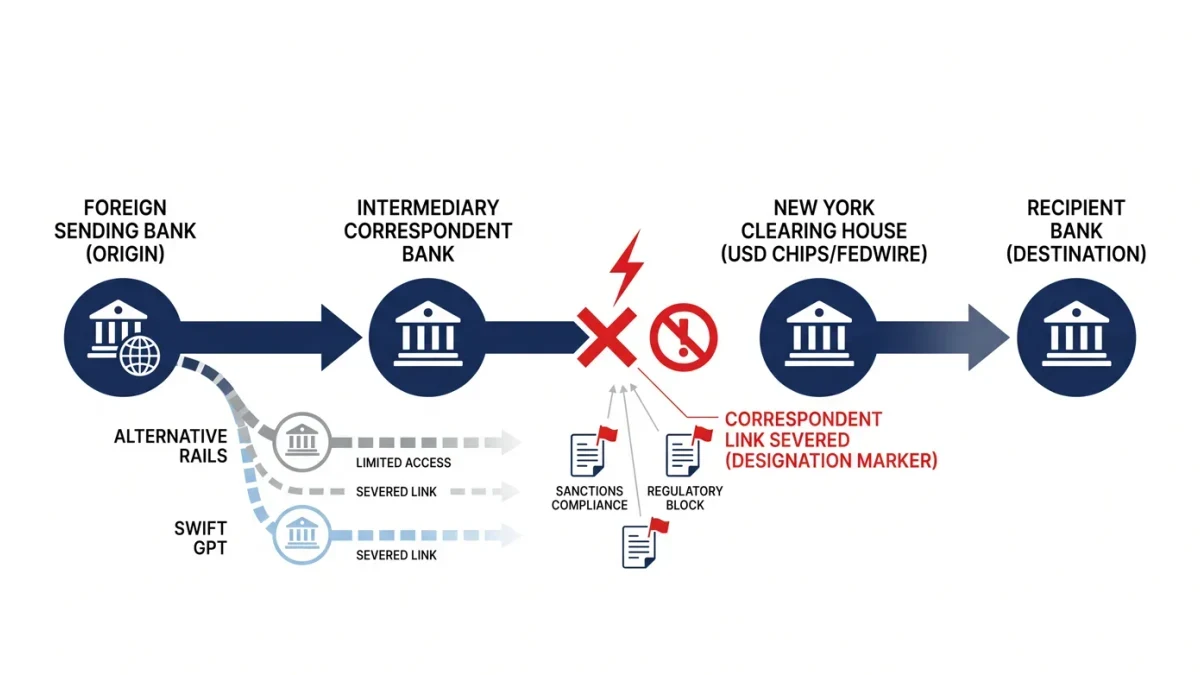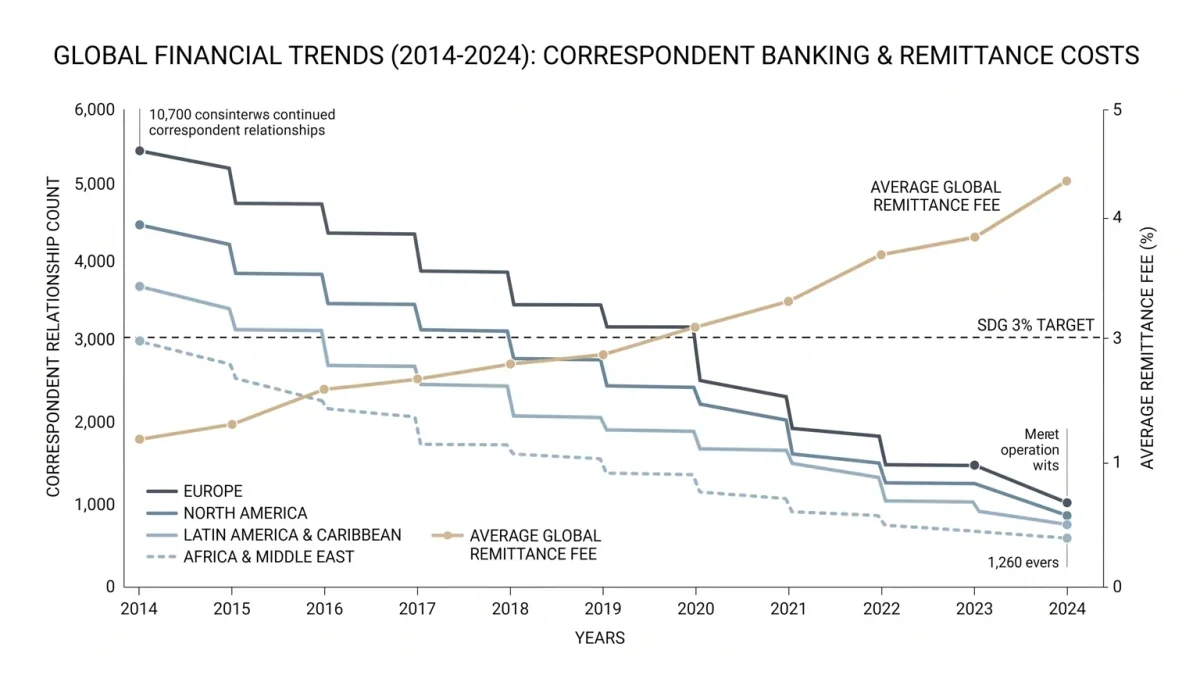
De-risking is the quiet exit of large banks from correspondent relationships — the arrangements by which a bank in Nairobi or Kabul accesses dollars through an account at Citibank, JPMorgan or a European clearing bank — and its documented victims are entire regions: the World Bank's periodic surveys and the FATF's own reviews have recorded, since the mid-2010s, the loss of correspondent relationships concentrated in the Caribbean, Sub-Saharan Africa, Central Asia and the Pacific, with some jurisdictions losing over half their dollar-clearing lanes in a decade. The mechanics are rational at every node and brutal in aggregate: post-9/11 and post-2012 enforcement — the record fines against BNP Paribas of nearly 9 billion dollars in 2014 for sanctions violations, Standard Chartered's and others' multi-billion settlements — taught risk officers that a small correspondent's business earns fees measured in thousands while its violations cost billions. So the many are severed for the sins of the few, and nobody announces an embargo; the ledger simply reads 'relationship terminated for business reasons.'
What is a correspondent relationship, exactly?
The plumbing of cross-border money. A local bank without a New York license holds a dollar account at a US bank, which executes its international wires — that is the correspondent-respondent structure, repeated across currencies and clearing centers, on which trade finance, remittances, aid disbursements and central-bank operations run. Correspondents' obligations under anti-money-laundering law — know-your-customer's-customer, in practice — require them to police the downstream use of their rails, which is where the cost asymmetry lives: monitoring thousands of small respondents is expensive, and a single missed sanctions breach among them is catastrophic. When the fees do not cover the tail risk, the account closes, and the responding bank's country loses a dollar artery it cannot replace.
What are the measurable consequences?
Cost and thickness in exactly the corridors that can least afford either. Remittance fees — tracked publicly by the World Bank's Remittance Prices Worldwide tables — run highest in the corridors where banking access has thinned, with sub-Saharan Africa's averages long hovering near 8 per cent against the UN's SDG target of 3 per cent; money-transfer operators pass on the higher compliance overhead their banking partners charge them, or lose accounts outright, as Somali remitters' recurring near-loss of UK banking showed. Aid agencies lose banking channels for crisis operations; humanitarian organizations' access problems in Somalia, Afghanistan and Yemen have been documented in joint statements calling finance-blockade a man-made obstacle to relief. And small trade-oriented economies lose letters of credit, forcing importers into cash markets and premium pricing. The Caribbean's central bankers have made the case loudly — the region's loss of correspondent lanes threatens not just commerce but financial-inclusion gains — and the Community of Latin American and Caribbean States and the Pacific Islands Forum have issued formal appeals.
Is de-risking a compliance failure or a policy choice?
Both readings have merit and the regulatory world has acknowledged the contradiction. The FATF, whose standards created the enforcement climate, has repeatedly stated that de-risking is not what it intends — its 2020s guidance urges risk-proportionate correspondent oversight — and the World Bank and IMF have built technical-assistance programs to help respondent banks document their controls to correspondents' satisfaction. Bank regulators in the US and UK have issued joint statements clarifying that maintaining relationships in high-risk jurisdictions, properly managed, is expected rather than penalized. Yet the incentives have barely moved, because the fine statistics have not: no guidance letter changes the fact that a correspondent's worst case is a deferred-prosecution agreement and a nine-figure penalty. De-risking is thus best understood as an emergent embargo — the sum of thousands of private compliance decisions that individually are prudent and collectively constitute a financial siege of the poor and the politically toxic, without any decision-maker intending that result or being accountable for it.
What are the workarounds — and their risks?
A growing parallel stack. Regional clearing and settlement systems — the pan-African PAPSS, Gulf and Asian alternatives — net payments inside their regions to minimize dollar hops. Local-currency settlement between central banks, as India's rupee-trade arrangements and the mBridge-type multi-CBDC experiments explore. Mobile-money and fintech rails that substitute for banks in remittances, now carrying a rising share of corridors that banks abandoned. And, at the margins, the crypto channels regulators watch most warily. Each workaround buys resilience at a cost: fragmentation of the payment system into currency blocs, higher internal costs than dollar clearing at scale, and a slow erosion of the very transparency the sanctions regime was built for — money that leaves the correspondent system leaves its audit trail as well. The ironic end-state of over-enforcement is thus a world with less visibility, not more compliance.
What should readers watch?
The renewal notices. Correspondent banking's health is measured in relationship counts — the annual correspondent-banking surveys and the BIS's triennial statistics on payment geography — and each year's net decline or stabilization tells whether the siege is tightening or lifting. Watch also the enforcement calendar: every nine-figure settlement re-prices thousands of quiet exits. And watch the workarounds' market share, because the day regional and local-currency rails carry a substantial fraction of what the correspondent system once did, the dollar's quiet embargo will have succeeded at something no one planned: building its competition.