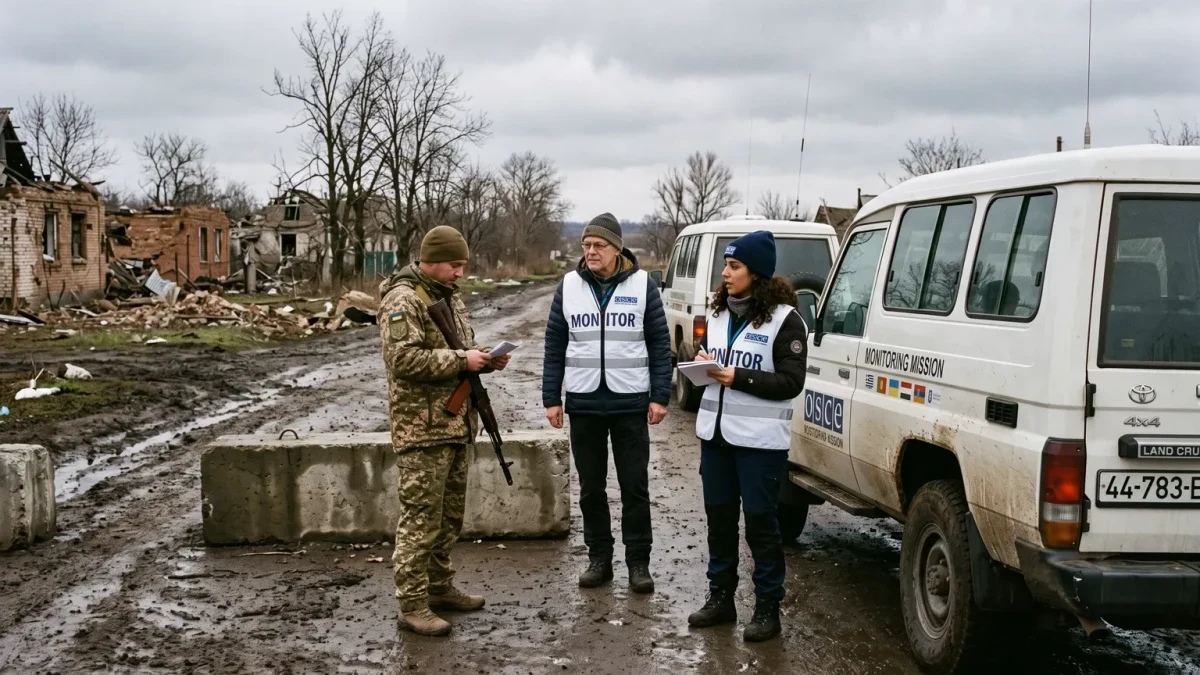
Ceasefire monitoring is the discipline of proving a negative: monitors establish whether the guns are quiet, where and when they are not, and who is moving what near the line — work done by unarmed observers, cameras, drones and a reporting chain designed to be too boring to dispute. The OSCE's Special Monitoring Mission to Ukraine, deployed in 2014 and closed by consensus withdrawal in March 2022 after Russia's full-scale invasion, was the largest such operation in the organization's history: roughly 1,000 monitors at its peak, producing daily situation reports and, from 2017, the automated camera-and-drone-verified tallies of ceasefire violations along the contact line in Donbas that ran to thousands per day in hot periods. Its records remain the single most granular public dataset of a live ceasefire's behavior ever assembled — including the weeks before the 2022 invasion, when its cameras logged the buildup that followed.
What does a monitoring mission actually verify?
A defined baseline, set by the agreement it serves. Monitors patrol to geographic reference points, observe troop positions and weapon withdrawals against agreed lines and storage zones, staff checkpoints, visit sites of reported shelling within hours to record craters, damage and residue — from which direction a round came can be read from impact geometry — and publish reports that name locations, times and observed facts while avoiding attribution, the deliberate omission that keeps both sides reading. The OSCE's Donbas reports hewed strictly to this: violations counted, triggers logged, responsibility not assigned — an epistemic modesty that was the mission's core design choice and its most-criticized limit, since a dataset that cannot say who fired serves truth and propaganda equally.
Who decides where monitors can go?
The host state and, in practice, whoever holds the ground. OSCE monitors operate under mandates agreed by all 57 participating states, with unrestricted-movement language that armed formations ignore at will: the Donbas mission's patrols were blocked, threatened and shot at throughout its tenure, and its drones were jammed or shot down recurrently — dozens lost — before the 2021 expulsion of Polish, Irish and other nationals from the mission's ranks signaled the endgame. UN peacekeeping monitors face a different bargain: they deploy with host consent under Security Council mandates, and where consent withers — as the UN's own reviews of mission after mission record — monitoring degrades into garrison observation. Monitoring, in short, is a guest's craft; the host's door decides the sample.
What technology has changed?
Precision and exposure, in both directions. Seismic and acoustic sensors can triangulate artillery in real time; satellite imagery — now commercial and near-daily — reveals trench evolution, craters and vehicle tracks at sub-meter resolution, a capability openly used by bellingcat-style open-source analysts and by governments in briefing wars; drone fleets map lines faster than patrols ever could. The OSCE mission pioneered camera networks at flashpoints that produced machine-checkable violation counts. What technology has not solved is attribution politics: better data makes violations undeniable and still leaves the whose-guns question formally open, which is why the classic monitoring compromise — precise observation, withheld attribution — survives every sensor upgrade.
Do ceasefires with monitors last longer?
The research literature says measurably yes, with the honest caveat about selection: stronger agreements invite monitors. Studies of post-1946 ceasefire agreements — the dataset maintained in the peacekeeping-research tradition associated with Uppsala and the 'Power to Protect' literature — find that agreements with verification provisions and third-party monitors endure at substantially higher rates than naked bilateral truces, because monitoring converts violations into documented, sanctionable facts and creates a standing channel through which incidents are adjudicated before escalation. The Donbas case sits awkwardly inside that finding: the monitored line held for eight years as a managed conflict rather than a peace, which monitors would answer is exactly the service rendered — a war held at simmer instead of boil — and critics would answer is the pathology of perpetual truce.
What happens when monitors leave?
Darkness, in the technical sense: violation counts stop, crater-reading ceases, and the information space reverts to claims by the belligerents alone — the immediate condition of Ukraine's fronts after March 2022 and of every unmonitored line from Sudan to Myanmar. That is why the first demand in nearly every ceasefire proposal — Gaza, Lebanon, Nagorno-Karabakh's 2020 armistice with its Russian-mission successor, Korea's DMZ observers under the Neutral Nations Supervisory Commission, a survivor since 1953 — is third-party eyes. The monitors themselves will keep doing what they have always done: drive to the line, count what they can see, write it down, and leave the arguing to the ones with the guns.