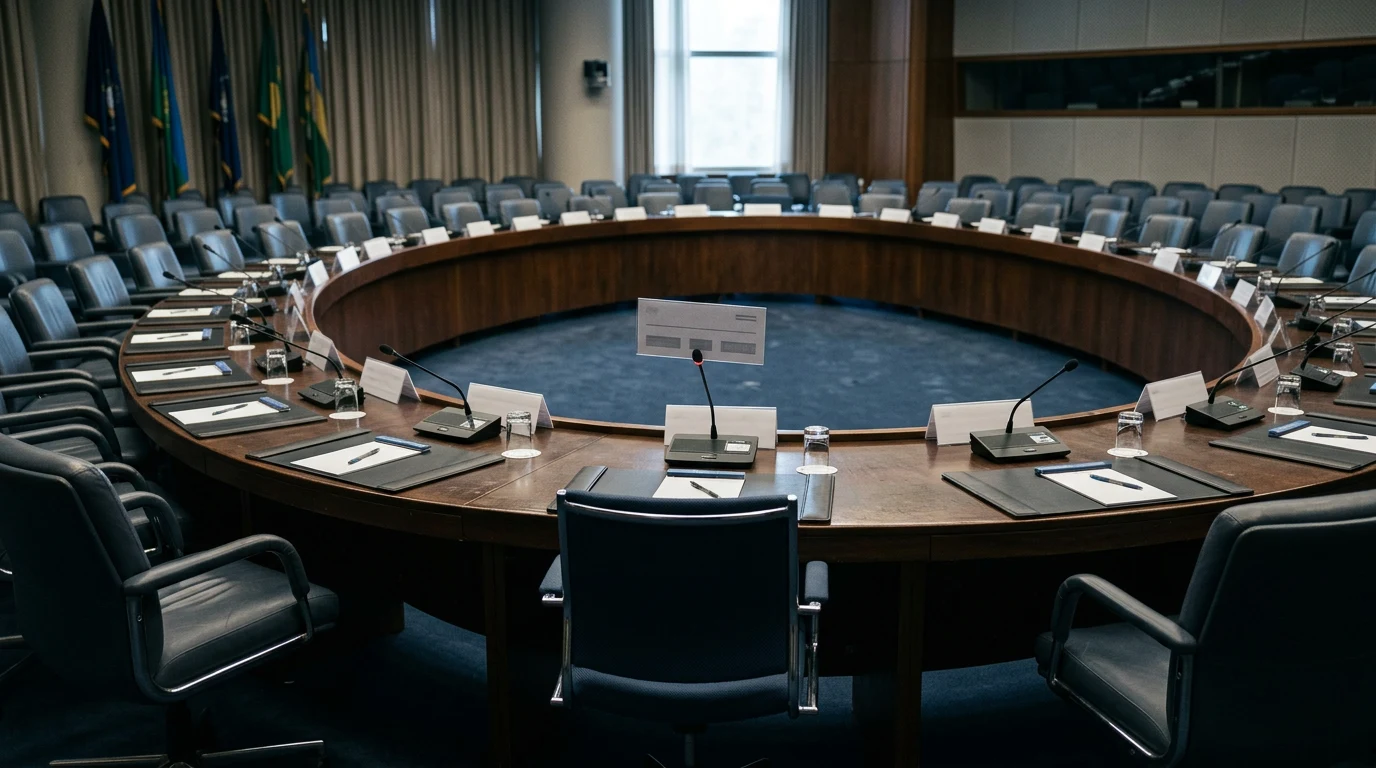
A veto at the UN Security Council is a single negative vote cast by any of its five permanent members — the United States, the United Kingdom, France, Russia, and China — that blocks a resolution outright, no matter how many of the other members support it. Article 27(3) of the UN Charter requires the "concurring votes" of all permanent members on any non-procedural matter before it can pass.
What does the Charter actually require?
The rule is short and has not changed since the Charter was signed in 1945. Article 27(1) gives each Security Council member one vote, elected or permanent alike. Article 27(2) settles procedural matters — questions about agenda or scheduling — by an affirmative vote of nine of the council's fifteen members, with no special role reserved for the five permanent seats. Article 27(3) is the operative clause: decisions on "all other matters," meaning substantive resolutions, require nine affirmative votes that must include the concurring votes of the permanent members, according to the Charter text published by the United Nations.
That single paragraph is the entire legal basis for the veto. There is no separate clause elsewhere in the Charter labeled "veto"; the power exists because a no vote from a permanent member on a substantive question means the resolution has failed to secure the concurrence Article 27(3) demands. In long-standing council practice, a permanent member that abstains or is absent does not block adoption, but a recorded no vote does — the distinction between silence and refusal is where most of the clause's real weight sits.
Why do only five countries hold this power?
The Charter names the United States, the United Kingdom, France, Russia — as the Soviet Union's successor state — and China as the council's permanent members, and Article 27(3) ties the veto to that same list. The arrangement was written into the Charter's founding text in San Francisco rather than added later by amendment, which is why proposals to expand or curb it require reopening the Charter itself rather than a simple council vote. Any of the council's ten elected, rotating members can vote against a resolution, but that no vote carries no special weight beyond its own single count; only a permanent member's refusal invokes Article 27(3).
How is a veto challenged after it is cast?
Since 2022, a veto no longer ends the conversation at the United Nations. On 26 April 2022, the General Assembly adopted a resolution, introduced by Liechtenstein on behalf of 83 co-sponsoring states, that requires the full Assembly to convene automatically within ten days of any Security Council veto, according to the United Nations. The vetoing country receives priority speaking time to explain its position, but the Assembly's own vote afterward carries no power to reverse the veto — the mechanism is scrutiny, not override. The measure passed without a vote, meaning it was adopted by consensus among the member states present, and it followed a Russian veto cast weeks after Russia's invasion of Ukraine, a sequence the sponsors cited directly in proposing it.
The distinction between debate and override matters. A vetoing state still loses nothing procedurally — its no vote still kills the resolution — but it now does so knowing that within ten days its reasoning will be read into the record before every other UN member state, on a schedule it does not control. Supporters of the measure framed that visibility itself as the point; it does not claim to solve the underlying disagreement that produced the veto.
What does the veto look like in practice?
The clause plays out most visibly on the council's most contested files. On 20 November 2024, the United States cast the sole veto against a draft resolution demanding an immediate and unconditional ceasefire in Gaza and the release of hostages; fourteen of the council's fifteen members voted in favor, according to the United Nations. Deputy US Ambassador Robert Wood told the council the resolution had abandoned the link between a ceasefire and the release of hostages held by Hamas, and that adopting it would send what he called a dangerous message that such negotiations were unnecessary, the BBC reported. The vote illustrates the clause at its starkest: fourteen governments in stated agreement, one permanent member's objection, and no resolution — the arithmetic Article 27(3) was written to produce.
Nothing in that sequence was procedurally unusual. The council counted votes, one permanent member declined to concur, and the draft failed under the same paragraph that has governed every substantive Security Council decision since 1945. What changed in 2022 is what happens next: under the accountability resolution, a veto cast on a file this contested is now followed, within days, by a General Assembly chamber where the vetoing government must restate its case to the rest of the membership.
Does the veto still shape world affairs?
Eighty years after the Charter's signing, the same clause in Article 27(3) still decides whether the council's most consequential drafts live or die. The 2022 accountability measure has not altered that arithmetic — a vetoing state still faces a debate, not a reversal — but it has made each veto a matter of public record and public argument in a chamber of the UN's full membership, rather than a decision made and left unexamined inside the council's own room. Whether that visibility changes outcomes is a separate question from whether it changes the terms on which the veto is exercised; the sources available establish the second, not the first.
Frequently Asked Questions
- What exactly counts as a veto under the Charter? A recorded no vote by any of the five permanent members on a non-procedural Security Council matter, which blocks adoption regardless of how the other members voted, under Article 27(3) of the UN Charter.
- Do procedural matters require the permanent members' agreement? No. Article 27(2) settles procedural questions with nine affirmative votes from any members, and the veto described in Article 27(3) does not apply to them.
- What happens at the UN after a veto is cast? Since April 2022, the General Assembly must convene within ten days to debate the veto, under a resolution adopted by consensus; the debate does not reverse the veto but puts the vetoing state's reasoning on the record before the wider membership.
- Has the veto blocked a Gaza ceasefire resolution? Yes. On 20 November 2024, the United States vetoed a draft demanding an immediate ceasefire and hostage releases; fourteen of fifteen council members had voted in favor.