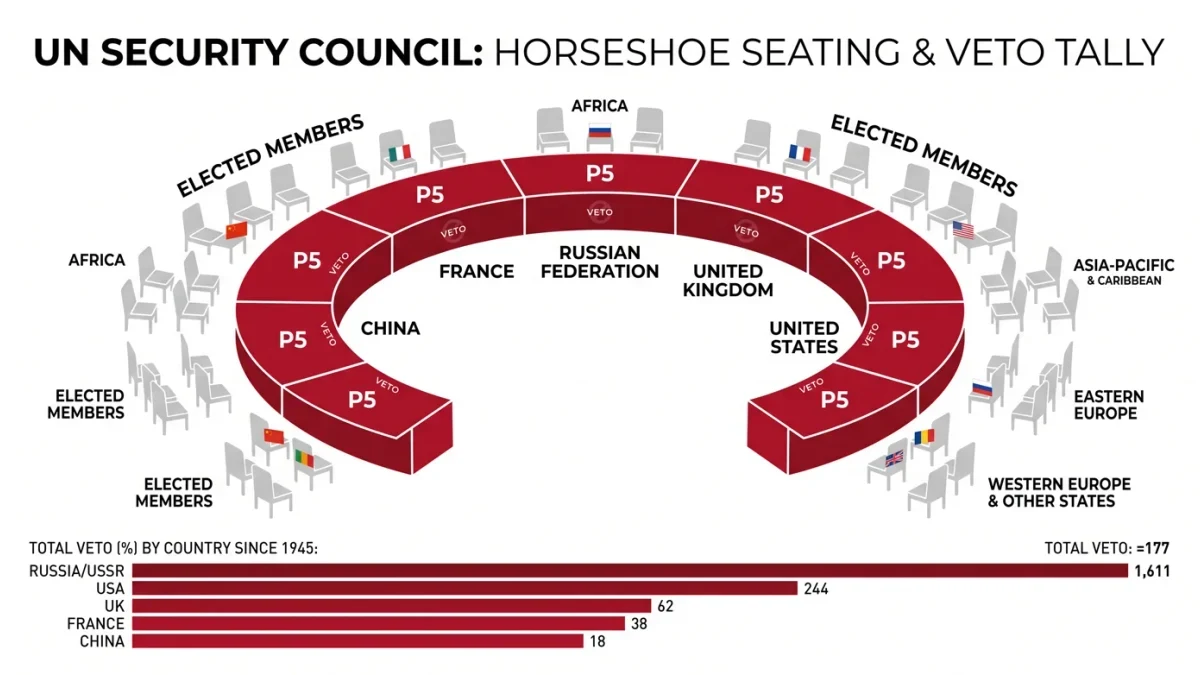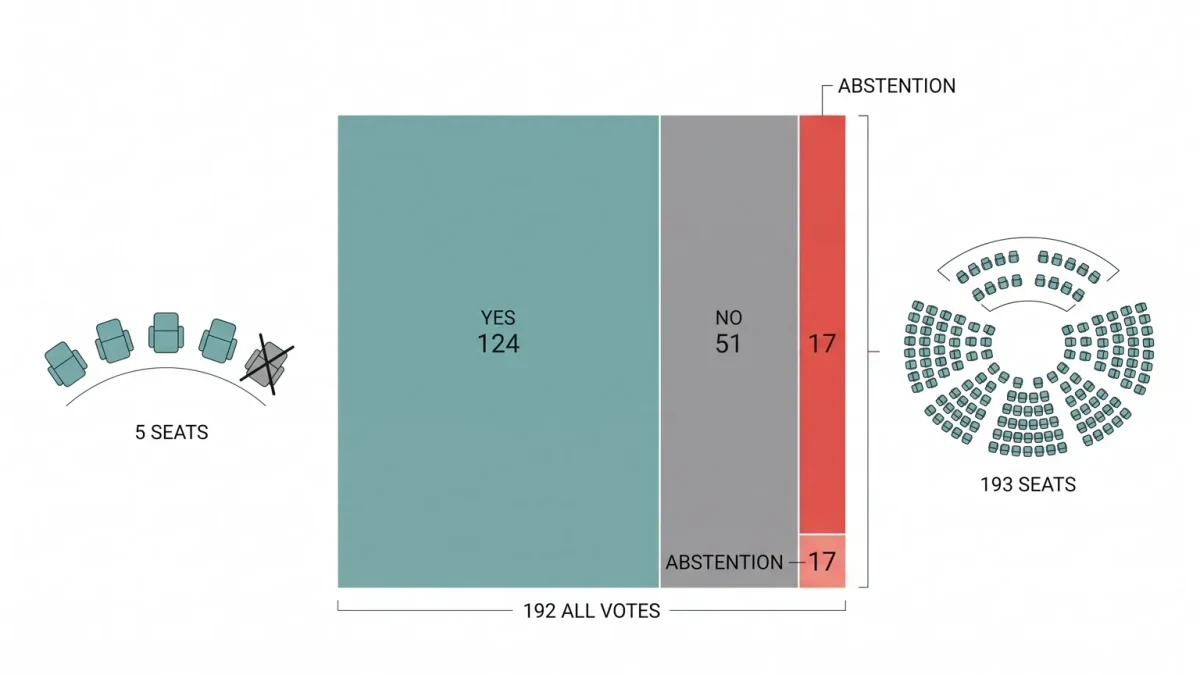
Emergency special sessions of the UN General Assembly exist because of a paradox the founders built in: the assembly represents all members, but the Security Council's five permanent members hold vetoes over the binding decisions — so in 1950, with the Council paralyzed on Korea by Soviet vetoes, the assembly adopted resolution 377A, 'Uniting for Peace', letting it convene within 24 hours of a blocked Council and recommend collective measures including force. The mechanism was used sparingly for half a century — Suez and Hungary in 1956, the Middle East, Congo, Afghanistan after 1980 — and then found its modern career: the 11th emergency special session, convened on Ukraine in February-March 2022, has been resumed repeatedly across the war's years, adopting the resolutions that deplored the invasion, suspended none but condemned annexations, and — in February 2023, on the anniversary — gathered 141 votes for withdrawal of Russian forces. It is the assembly's loudest instrument, and its power is exactly as large and as small as a recommendation can be.
How does a session get convened?
Two triggers. A Council vote — any nine of fifteen members can call an emergency special session even if a permanent member vetoes the underlying resolution, as happened in February 2022 when the vetoed draft on Ukraine was followed by the enabling vote — or a majority of assembly members requesting it. Once convened, the session does not close: it suspends and resumes, which is why the 11th session has 'met' on and off for years, each resumption a political decision to re-open the file. The procedure's design lesson is deliberate asymmetry: a single veto cannot stop the world's parliament from speaking, but nothing it says binds anyone.
What can these sessions actually achieve?
Legitimacy arithmetic, mainly. The assembly's emergency resolutions establish whether the global majority lines up behind or against a proposition — the 141-5-35 pattern of the 2022 votes became the reference statistic for the war's diplomatic geometry — and that number shapes behavior indirectly: abstention lists, aid positions, sanctions comfort and the political costs of alignment. Uniting for Peace also authorizes collective-measure recommendations, and its historical tail includes the 1950 authorization for the UN flag to fly over the Korea coalition — a use impossible in the modern charter politics. The honest institutional record: symbolic force with measurable second-order effects, which is why states fight over the votes harder than the resolutions' non-binding nature would predict, and why the 2020s' Great-Power politics — Ukraine, and proposals regarding Gaza that the US veto blocked in the Council, followed by assembly special sessions and the 2024-2025 votes on Palestinian membership and the ceasefire demand — have made the mechanism busier than at any time since the 1950s.
Why doesn't the veto-holding side simply ignore it?
It does ignore the resolutions — and works the numbers instead. Russia's delegation campaigns systematically against emergency-session texts, winning abstentions from India, China's alignment, much of Africa's non-aligned bloc; the US has done equivalent work on Middle East texts. The voting is therefore the real contest: each side tests whether it can hold or shrink the other's majority, and the sessions function as periodic referendums on the world's diplomatic weather. The assembly has added teeth-adjacent instruments over the years — the 2022-2023 innovations requiring the veto's user to justify it before the assembly under the 2022 veto-initiative resolution, and the standing veto-use debate format — which institutionalize the naming-and-shaming that Uniting for Peace formalized.
Is the mechanism a Cold War relic or a growth industry?
A growth industry, for structural reasons. The Council's permanent-member division has deepened across the 2010s and 2020s — Syria, Ukraine, Gaza — and every Council deadlock raises the assembly's comparative advantage: it cannot be vetoed. Institutional designers have noticed: proposals to expand assembly powers, from binding-uniting-for-peace variants to weighted voting, circulate in the reform debate that each decade's crises renew. The counter-trend is equally structural: the assembly's resolutions' non-binding nature is not a bug the powerful will agree to fix, and the 141-vote majorities of 2022 softened in later resumed votes on related texts — majorities, like coalitions, decay. The mechanism's future is therefore more of its present: a world parliament that cannot legislate, convening whenever the oligarchic chamber above it freezes, and converting blocked force into counted opinion at a speed the founders would recognize.