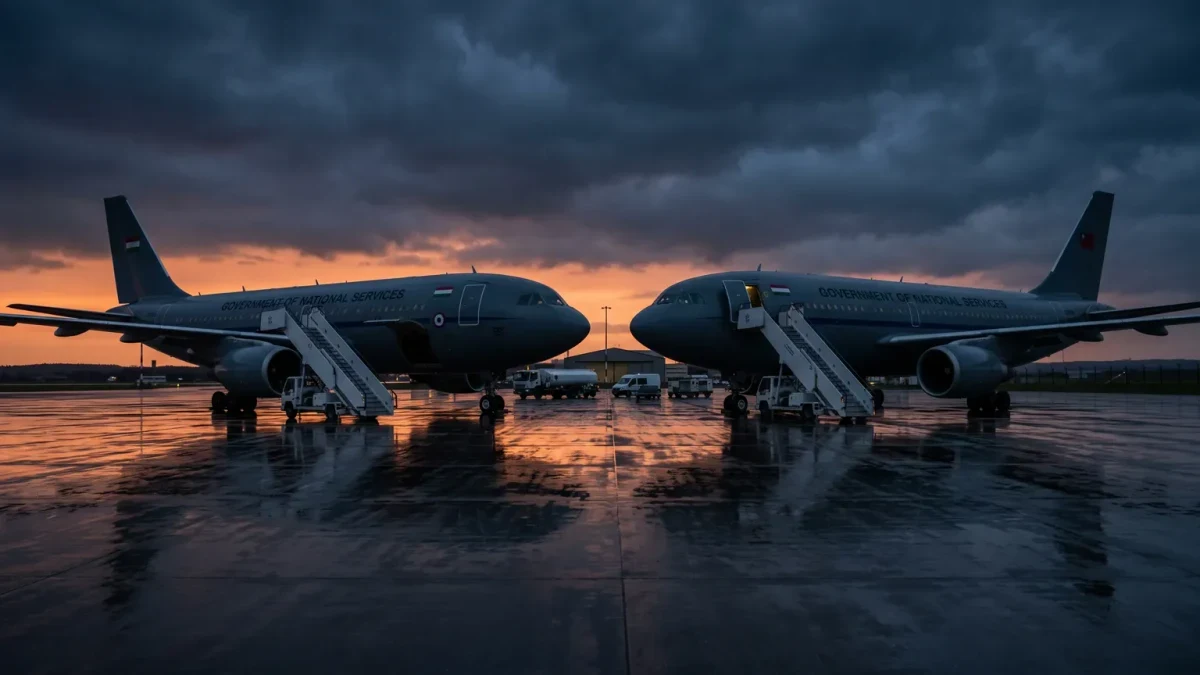
Prisoner swaps between adversaries are negotiated the way the largest one in recent memory was: through intelligence-service channels and neutral intermediaries, over months or years, on the arithmetic of lists — not through foreign ministries announcing positions. The August 2024 exchange at Ankara airport freed 24 people across seven countries, including 'Wall Street Journal' reporter Evan Gershkovich, Russian opposition figure Vladimir Kara-Murza and others traded for Russians held in the West, with Turkey and Saudi Arabia mediating; per BBC and Reuters accounts of the negotiations, the deal took shape through contacts that survived every public rupture of the period. That is the genre's first lesson: the channels that trade humans are quiet, personal and almost never diplomatic in the public sense.
Who actually negotiates a swap?
Three casts, in shifting combinations. Intelligence officers — because the currency on both sides is often a convicted spy, a sleeper or an asset, and because spy channels operate in a register embassies cannot: deniable, personal, continuing across crises. Special envoys — presidents' personal representatives, as Richard Nixon-era and later administrations used for named Americans; the 2024 exchange was steered at the political-director level across several capitals simultaneously. And professional intermediaries — most prominently Qatar and Oman in the Middle East file, Turkey and Saudi Arabia in the great-power file, and historically the Swiss and the International Committee of the Red Cross, whose visiting role gives it registration of detainees that no other actor holds. The intermediary's asset is simple: it can carry proposals that neither government can be seen to have made.
How are the lists built?
Unsentimentally. Each side inventories what it holds that the other values — intelligence officers, political prisoners the other side calls hostages, criminals with extradition value — and what it wants: its own detained nationals, unjustly held journalists, or third-country nationals whose freedom a domestic constituency demands. The negotiation is then a relative-value problem complicated by asymmetry: one side's espionage convict is a hero to be recovered; the other's is a bargaining chip whose release carries domestic political cost. Multi-party constructions — the 2024 seven-country format — exist precisely to square these valuations: country A releases someone country B wants, country C pardons someone country A wants, and the chain closes in a single execution window so no link can defect. Germany's reluctant release of a Russian intelligence prisoner in the 2024 deal, widely reported as the hinge concession, shows the mechanism's politics: a democracy commuting a homicide-for-hire sentence paid an internal price that only a multinational package could justify.
What is the legal fiction that makes it work?
Pardon-plus-expulsion, usually. A state cannot simply trade a convict it holds under its own laws without a legal instrument — pardon, commutation, or release on humanitarian or treaty grounds — so each transfer is dressed in domestic legality while everyone acknowledges the exchange logic. For the released westerner, the exit is often formalized as deportation or expulsion; for the returning intelligence officer, a hero's welcome that confirms what the conviction said. States that deny holding anyone to trade — hostaging denied as prosecution — use sentencing dates, appeal outcomes and remission decisions as negotiation signals, a semiotics that professional watchers of these files read fluently: a suddenly scheduled court date is an opening position.
Does trading encourage more hostage-taking?
The honest debate. The deterrence argument — every payment, human or monetary, raises the market price of taking hostages — has the economics right and the politics incomplete, because no government can visibly abandon a named citizen and survive the domestic politics. The United States formalized the tension in its own law: executive order and statutes since 2015 drew a line between families' efforts to negotiate hostages' release and criminalized ransom payments to designated terrorists, while presidential action still frees detainees by exchange when the price is tolerable. The working compromise across democracies is a vocabulary of denial: releases happen, but governments avoid confirming ratios, avoid calling the trade a precedent, and police the line that 'we do not pay' with careful words — hostage diplomacy, as practiced against several Western nationals by Russia, China, Iran and North Korea in recent years, is priced exactly at what that vocabulary will bear.
Why do the deals keep getting bigger?
Because the inventory has grown and the multilateral structure scales. The Cold War's classic exchanges — Francis Gary Powers for Rudolf Abel on the Glienicke bridge in 1962 — were bilateral because the confrontation was. Today's files are multipolar: Americans held in Russia, Russians in German, Belgian and American prisons, Belarusian dissidents as a side-payment, and regional powers brokering for standing. The airport-runway handshake has replaced the bridge in the middle, and the choreography — planes nose to nose, simultaneous walks, no faces together — is a protocol evolved to let sovereign enemies complete a transaction without ever conceding that they were counterparties. It is one of the oldest crafts in diplomacy, currently enjoying a renaissance nobody wanted and everyone keeps practicing.