Why are groceries so expensive? Because the price on the shelf is not one price. It is a stack of costs — growing, processing, trucking, storing, stocking, and selling — and each layer adds a margin, absorbs a shock, or passes one along. When any layer wobbles, the sticker moves, usually upward, because food retail runs on thin margins that cannot quietly absorb much.
The honest answer also includes a qualification: no single villain explains a grocery bill. Energy prices, weather, labor costs, packaging, and the structure of the food industry all press on the same number at once. Understanding the stack is the only way to see which pressure is doing the work in any given month.
Start with the least glamorous layer, distribution. The food economy runs on intermediaries whose entire business is keeping other businesses stocked, and they are easy to overlook. As Baldwin Supply, an independent industrial distributor serving operations from aggregate pits to large-scale farms, describes its own role, the point of a distributor is to be "close when it counts" and stocked with what customers need to stay running. That logic — proximity, inventory, reliability — is exactly what a grocery supply chain sells, and reliability is never free.
What does the farm actually get paid?
The farmer's share of a grocery dollar is small, and the reason is structural rather than sinister. A head of lettuce in the store carries the cost of seed, water, labor, fuel, cold storage, and transport before anyone in the store touches it. The farm gate price — what the grower receives — covers only the first of those layers. Everything after the farm gate is handling, and handling compounds.
This is why farm income and shelf prices can move in opposite directions. A bumper harvest can push what growers earn down while processing and retail costs hold steady, leaving the sticker unchanged. Consumers experience the sticker; growers experience the gate price. The gap between the two is where most confusion about food pricing lives.
Commodity crops complicate this further. Grains and oilseeds trade on global markets, so a war, a drought, or an export restriction anywhere in the world can lift the price of wheat flour in a supermarket thousands of miles from the event. Perishables behave differently: they are priced locally, by regional supply, and spoilage risk is baked into every crate.
Who are the middlemen, and what do they actually do?
"Middleman" is a term of abuse in grocery conversations, but the functions are real. Wholesalers aggregate supply from many farms so a retailer can buy everything in one place. Processors turn raw commodities into shelf-stable goods. Distributors hold inventory close to demand so a store never runs dry. Cold-chain operators keep meat, dairy, and produce alive between points. Each step exists because doing it yourself would be worse for everyone.
The costs stack in predictable ways. Every handler adds a margin to cover its own labor, facilities, fuel, insurance, and the risk that goods spoil or demand shifts. Nobody in the chain sets prices from malice; each sets prices to survive its own cost structure. The aggregate effect, though, is that a raw ingredient can leave the farm cheap and arrive at the shelf several times more expensive.
Where the chain consolidates — a few dominant processors, a few dominant retailers — the margins at each step tend to be fatter and more durable. Concentration does not create every price increase, but it can make increases stick, because the remaining players have less reason to compete them away. That is a structural feature of the modern food economy, documented across many markets, and it is distinct from the day-to-day shocks.
How do shocks travel from the field to the sticker?
A shock anywhere in the chain propagates by one of two routes: the cost route or the scarcity route. The cost route is simple — fuel gets dearer, so freight gets dearer, so everything moved by freight gets dearer. Energy is the master input here, touching tractors, fertilizer, trucks, refrigeration, and the store's own lights.
The scarcity route is harsher. When a harvest fails or a export corridor closes, the physical supply of a crop drops, and prices rise until demand adjusts. Food demand is famously stubborn — people still eat — so scarcity shocks hit food prices disproportionately hard. This is also why grocery inflation tends to arrive in waves tied to identifiable events: a bad harvest season, a shipping disruption, a regional conflict that interrupts grain movement.
The reader can see this logic in adjacent coverage: our analysis of how a war gets priced into shipping insurance traces the same mechanism through the freight layer, and the piece on grain, war and grocery bills follows it to the border. Food prices are world prices wearing a local costume. Readers following this should also see How a War Gets Priced Into Your Shipping Insurance.
What does the retailer add — and keep?
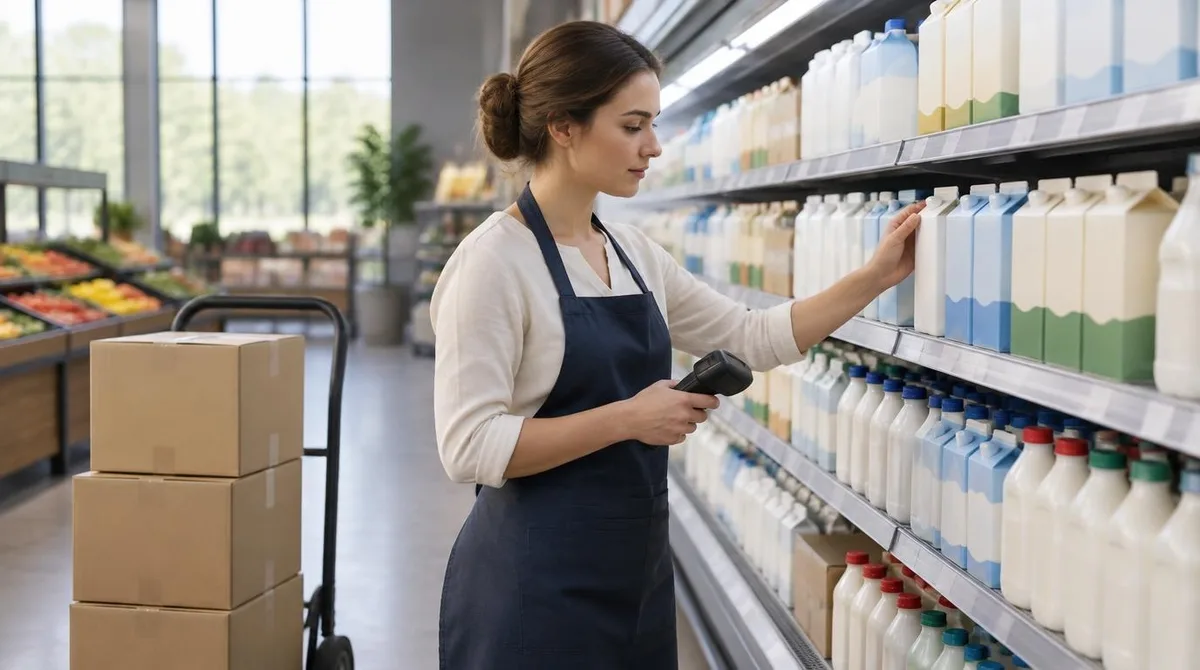
The store is the most visible layer and the most misunderstood. Retail grocery is a high-volume, low-margin business; the store's profit on a typical basket is a thin slice, and much of what the shopper pays never becomes store profit. Rent, refrigeration, staffing, shrinkage — the polite word for theft and spoilage — and waste all come off the top before any margin appears.
Retailers do, however, hold pricing power at the final step, and they use it unevenly. Private-label products let a store control more of the chain and price aggressively. National brands negotiate slotting and promotions. Loss leaders draw shoppers in while other items carry the load. The result is that two items in the same cart can have radically different markup stories, which is why the basket total resists simple explanation.
What this means for the shopper is unglamorous but real: the levers that matter are the ones the chain exposes. Buying closer to the farm gate — produce in season, whole ingredients over processed ones, bulk staples — removes layers, and each removed layer removes a margin. Nothing in the supply chain punishes thrift.
Practical steps: reading a grocery bill like an analyst
The useful habit is decomposition. When a bill jumps, ask which layer moved. If fuel is up, everything moved by truck is up, and the increase will be broad but modest. If a specific crop had a bad season, the increase will be narrow and sharp. If wages in retail or processing are rising, the increase will be persistent and hard to reverse, because wages rarely come back down.
It also helps to distinguish inflation from repricing. Inflation lifts everything slowly. Repricing — a company using a shock as cover to raise margins — lifts some things quickly and keeps them there. Economists debate how much of recent grocery inflation was each, and the honest answer is that both occurred in most markets, in proportions that vary by country and category. The evidence for any specific market requires its own data, which is precisely what general commentary usually lacks.
For readers who want the macro layer — how currencies and central-bank decisions feed into import prices — our explainer on how currency exchange rates are actually set covers the mechanism. A weak currency makes imported food dearer without anything in the field changing.
What the evidence establishes, and what it doesn't
What the evidence establishes is the architecture: a layered chain in which each layer adds cost and margin, energy and labor press on every layer at once, and global shocks travel through trade into local stickers. What it does not establish, in any single month or market, is precisely which layer deserves the blame — that requires market-specific data on margins and costs that general reporting rarely has.
The durable takeaway is modest and useful. Grocery prices are a system output, not a decision. They respond to fuel, weather, wages, trade, and concentration faster than they respond to anything a shopper or a politician says about them. The stack is the story.