Exchange rates are set the way other prices are: by supply meeting demand. For the world’s major currencies, no committee announces the daily figure. Traders, banks, funds, and companies bid for one currency against another, and their shifting appetite sets the number that appears on the airport board.
The scale is enormous. Per the Bank for International Settlements’ Triennial Central Bank Survey, trading in over-the-counter foreign exchange reached $7.5 trillion per day in April 2022, and the U.S. dollar sat on one side of 88 percent of all trades. Governments and central banks watch the price closely, and occasionally they step in. Most of the time, though, the market decides. For related coverage, see The Trillion-Dollar Funds That Belong to No Shareholder.
Who Decides the Price Each Day?
For freely floating currencies, whoever trades them decides. Commercial banks quote rates to customers, electronic platforms match orders in real time, and the resulting prices feed screens worldwide. Currencies under a fixed or pegged regime work differently. A central bank announces a target and buys or sells reserves to defend it.
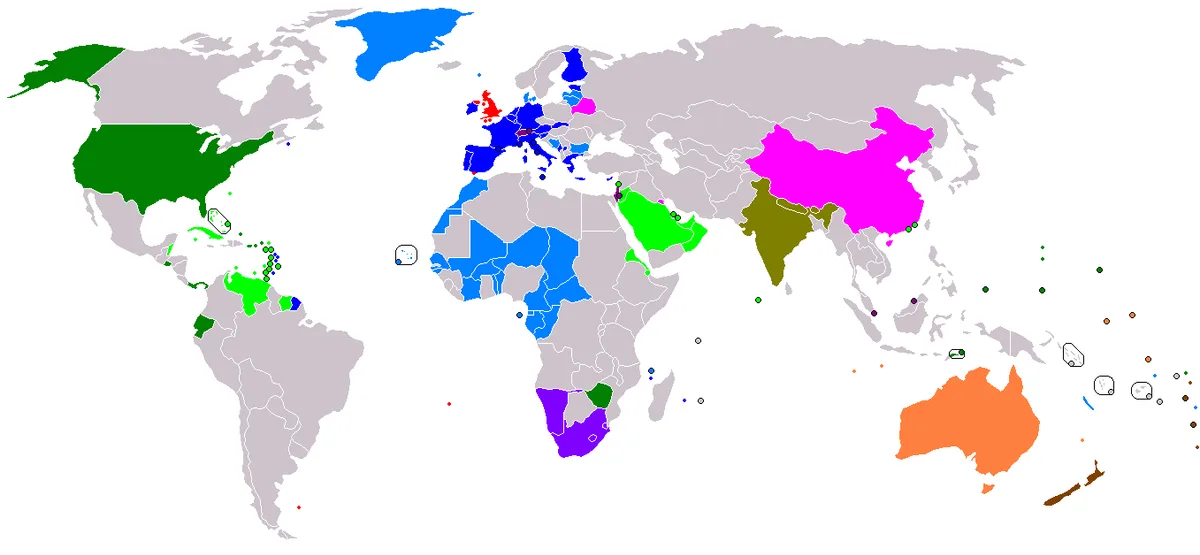
The Reserve Bank of Australia’s education explainer calls the rate a relative price: the value of one unit of a currency against another currency or a group of currencies. Regimes differ widely. Some economies float freely. Others peg to a single currency or to a basket, and a few adopt a foreign currency outright. We covered a connected angle in Why Currency Pegs Break: The Politics of Defending a Price.
Why Do Interest Rates Move Currencies?
Interest rate differentials are among the strongest single forces. The Reserve Bank of Australia states that the interest rate differential is a key driver of the demand for, and supply of, a currency, and an important driver of capital flows. When domestic rates rise relative to rates in the United States and other major economies, holding that currency simply pays more. Money tends to follow the return.
Expectations move faster than policy. A signal that a central bank may cut rates sends traders repositioning before any announcement arrives. That is why currencies often move on press conferences rather than on the decisions themselves.
How Big Is the Daily Market?
The Bank for International Settlements measures it every three years. Its survey of central banks counted $7.5 trillion of daily over-the-counter trading in April 2022, up 14 percent from $6.6 trillion three years earlier. Inter-dealer trading alone ran at $3.5 trillion, about 46 percent of the total. The figures come from more than 1,200 reporting banks and dealers.
Instruments tell their own story. FX swaps made up 51 percent of turnover, and spot trades 28 percent, per the same survey. The U.S. dollar appeared on one side of 88 percent of all trades. The euro’s share slipped to 31 percent.
Do Trade and Speculation Matter Too?
Trade sets the deeper current. The Reserve Bank of Australia points to a long-run relationship between the terms of trade, the ratio of export prices to import prices, and a currency’s value: as export prices climb, the currency tends to strengthen. Commodity exporters feel this acutely.
Speculation supplies the daily weather. Short-term traders react to data releases and official statements within seconds, so rates can jump on a single speech before any trade balance shifts. Positions unwind just as fast. The result is a market that reprices continuously around a slower, structural drift.
When Do Governments Step In?
Central bank intervention is the exception in major markets. An authority that dislikes the rate can sell foreign reserves to support its currency, or buy foreign currency to hold its own value down. The Reserve Bank of Australia’s explainer discusses the circumstances in which it might decide to intervene. Pegged regimes intervene by design.
A peg must be defended whenever the market drifts from the target, which is why defending a currency under pressure can drain reserves quickly. The arrangement cuts both ways: a credible peg steadies prices, while a broken one can be costly. Most large economies, including the United States, leave their rates to the market.
Conclusion: A Price Set in Public, Not by Decree
Exchange rates are neither mysterious nor fixed. They are prices, set in public by banks, funds, companies, and governments as money crosses borders. Interest differentials pull capital one way. Trade flows push currencies back, and speculation speeds both along.
Officials retain one strong lever, and pegged economies pull it often. For everyone else, the airport board is best read as a running vote, repriced each second, on how the world values one money against another. The vote is tallied in trillions, and nobody adjourns it.