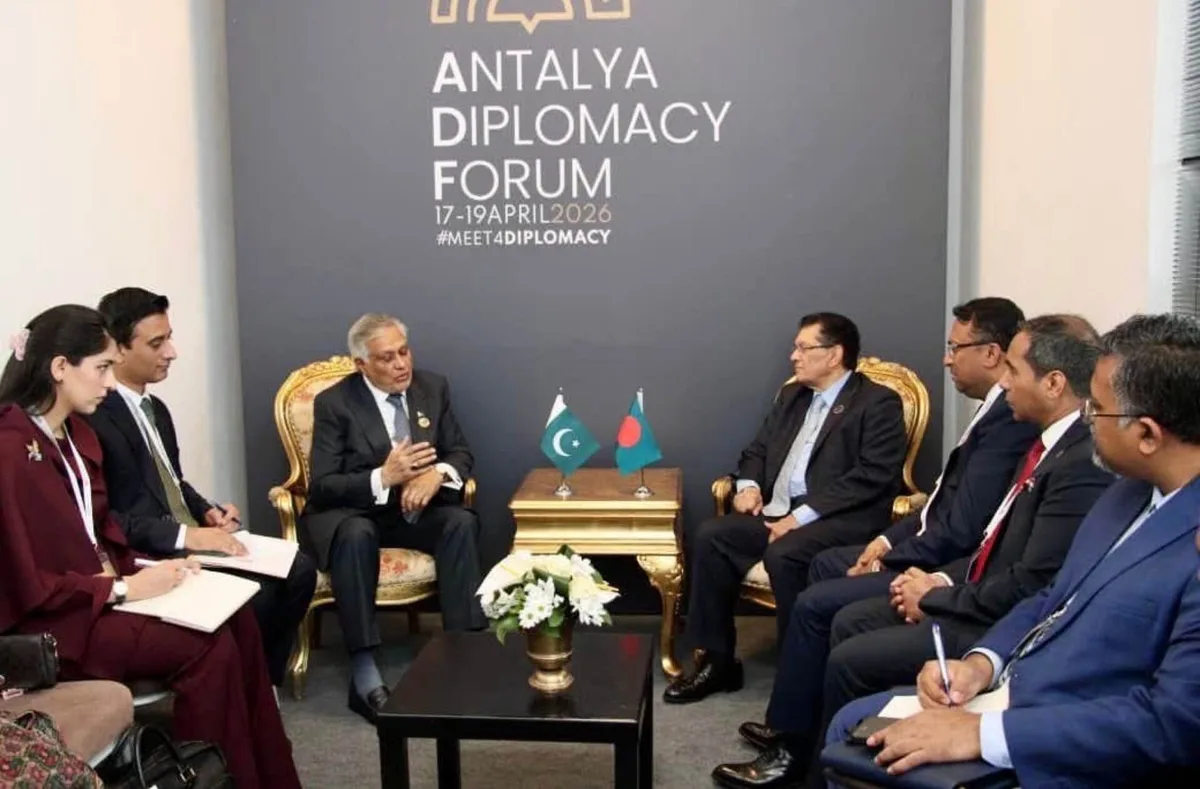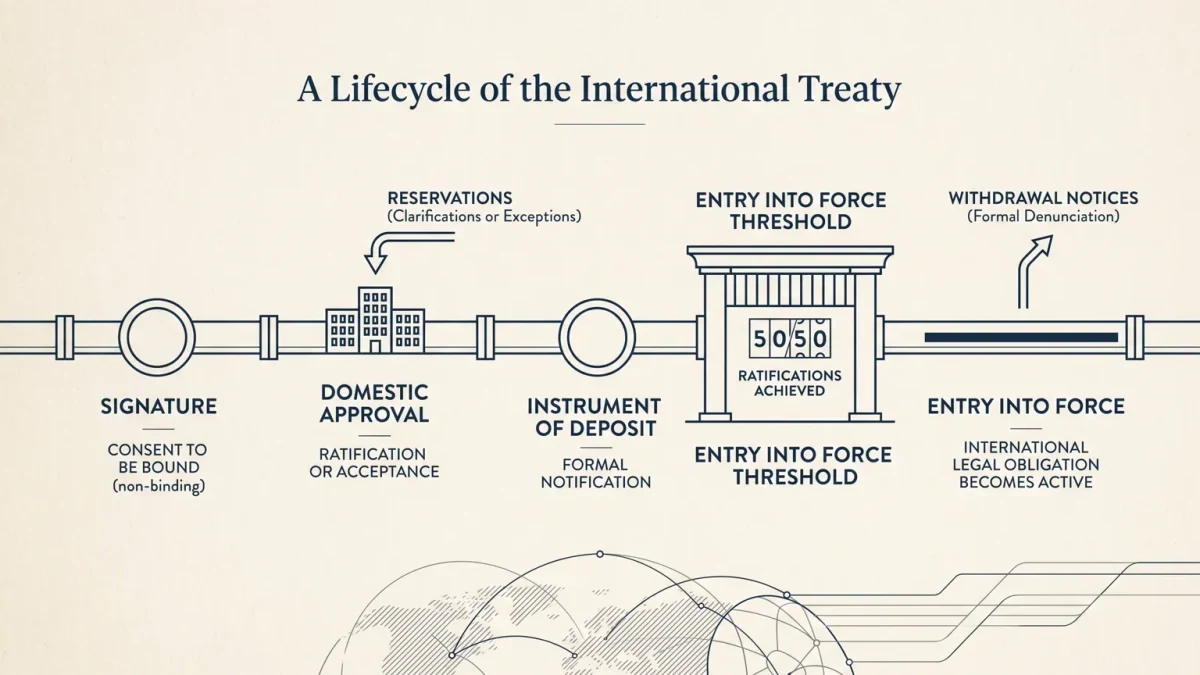
A treaty becomes binding not when it is signed but when it is ratified — when each state, after signature, completes its own domestic approval process and deposits an instrument of ratification with the treaty's designated custodian, usually the UN Secretary-General in New York. The 1969 Vienna Convention on the Law of Treaties governs the choreography: signature expresses consent to be bound only for executive-agreement classes of treaty or where the text says so; for the rest, signature obliges a state to refrain from defeating the treaty's object pending ratification, a duty lawyers call the interim obligation. The distance between the photo opportunity and the deposit is where most treaty dramas — and most treaty deaths — occur.
Why do states insist on this two-step at all?
Because negotiating executives cannot always deliver their legislatures, and everyone benefits from knowing that before the ink dries. Ratification is the domestic political market's veto point: the US Senate's requirement of a two-thirds vote for treaty consent is the famous case — of the hundreds of treaties signed by American presidents, a long queue, from the Law of the Sea Convention to the Kyoto Protocol, has languished unratified for decades. France requires parliamentary authorization for treaties modifying law or ceding sovereignty; Germany's Constitutional Court in 2024 conditioned ratification of the EU's comprehensive investment agreement with China-era analogues on advisory-opinion mechanisms. The two-step exists precisely so that the international commitment reflects a real domestic coalition rather than a negotiator's optimism.
What are reservations, and why do they matter so much?
A reservation is a unilateral statement modifying a state's legal obligations under a treaty, permitted unless the treaty prohibits reservations or the reservation is incompatible with the treaty's object and purpose, per Vienna Convention Article 19. Reservations are where ratification battles resurface internationally: the US reservation to the jurisdiction of the International Court of Justice under the Genocide Convention, entered in the 1980s, has shaped decades of litigation, and the cluster of reservations entered by various states against core provisions of the Convention on the Elimination of All Forms of Discrimination against Women has been the subject of sustained academic criticism. Other states may object to a reservation, accepting or rejecting treaty relations with the reserving state — a bespoke web of bilateral treaty-law inside a nominally multilateral instrument.
When does a treaty actually enter into force?
When the text's own conditions are met, which drafters use as policy levers. Many environmental treaties require a minimum number of ratifications and sometimes minimum shares of the regulated activity — the Paris Agreement's rapid 2016 entry into force, eleven months after signature, was engineered through a low threshold of 55 states covering 55 per cent of emissions that the US-China joint deposit of instruments triggered together. Arms control's bilateral treaties swap instruments and activate on a set date; nuclear frameworks add waiting periods for legislatures. And entry into force can arrive decades late: the Kyoto-style arc has nothing on the UN Convention on the Law of the Sea's decades or, more extreme, treaties that never cross the threshold at all and live on as soft-law baselines — signed, periodically praised, never quite law.
Can a state withdraw afterward, and how hard is it?
Withdrawal follows the treaty's own exit clause: notice periods — commonly one year for human-rights instruments under their denunciation articles — and, where a treaty is silent, the Vienna Convention's rule that withdrawal be notified to other parties. The politics dwarf the paperwork. North Korea's 1993-2003 withdrawal saga from the Nuclear Non-Proliferation Treaty, paused and completed, remains the canonical hard case; the US withdrawal from the Paris Agreement in 2020, reversed in 2021 and initiated again in 2025, showed exit and re-entry as electoral weather. What exit clauses cannot restore is trust: each high-profile withdrawal reprices every other state's willingness to invest in compliance with a regime whose membership can change with an election.
Why does the machinery matter more than the ceremonies?
Because the ratification queue is where intentions become commitments — or quietly stop. A state's signature tells you what its diplomats agreed; its ratification tells you what its institutions will actually do. The next time a summit ends with a signature page held aloft, the useful question is not what was signed but what majority the text must survive at home. The answer has decided the fate of more treaties than any negotiating session ever held.