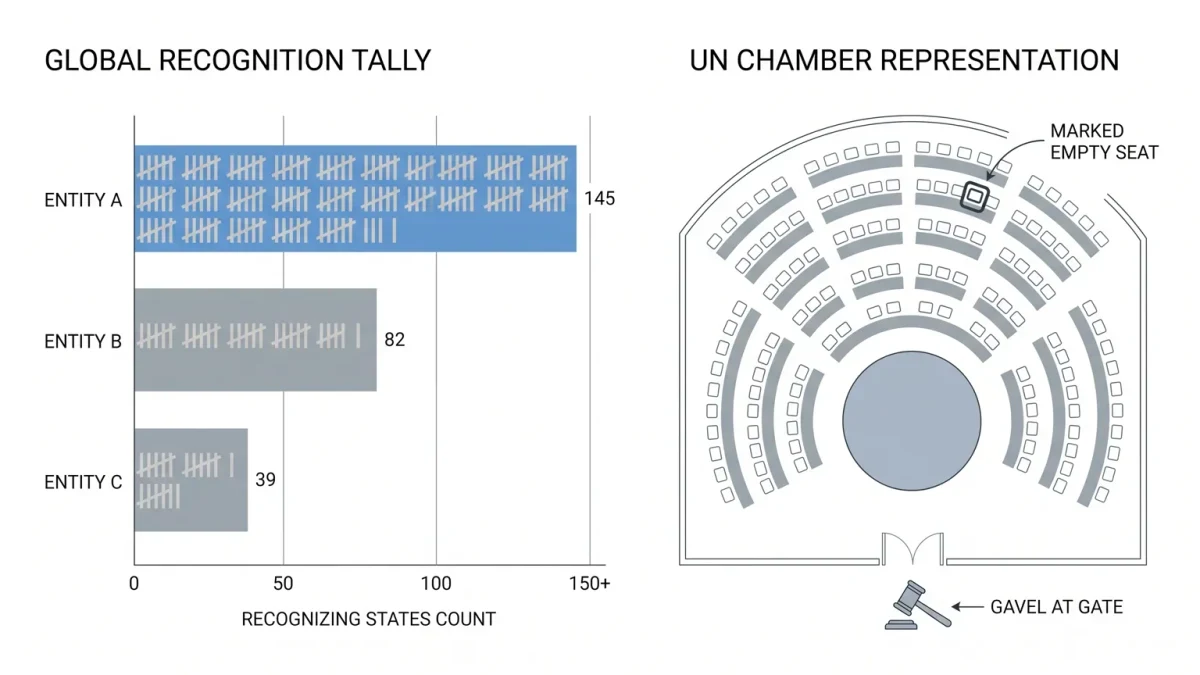
Statehood has no central authority: the Montevideo Convention's 1933 criteria — a permanent population, a defined territory, a government and the capacity to enter relations with other states — describe what a state is, but becoming one in practice requires recognition by other states, each deciding separately, with the UN's 193-member admission requiring a Security Council recommendation where the five permanent members hold vetoes. That is why Kosovo, recognized by over 100 states including the US, UK, France, Germany and most of the EU since its 2008 declaration, sits outside the UN: Russia and China do not recognize it, and Serbia's ally structure blocks the Council door. It is why Palestine, recognized by some 150 states and holding UN observer status since 2012, with a 2024-2025 General Assembly membership push following the US veto of its full admission, remains a non-member. And it is why Taiwan — a population of 23 million, a defined territory, a functioning government, diplomatic relations with a dozen states and debtpaper the world holds — sits in the system's most carefully unnamed place.
What does recognition actually mean?
Two doctrines divide the textbooks and barely matter in practice. The declaratory theory: statehood exists when the facts exist, and recognition merely acknowledges — the Montevideo convention's own Article 3. The constitutive theory: statehood is constituted by recognition, since without it the entity cannot treat or sue. Practice blends both into what the International Court of Justice's Kosovo advisory opinion of 2010 confirmed: declarations of independence are not, as such, illegal under international law, and the court carefully declined to say anything more — leaving recognition where it has always lived, in the political discretion of each recognizing state. That discretion is the system's engine: recognition is granted or withheld for reasons of alliance, law, precedent fear and domestic politics, and the same entity can be a state in one capital's law and a province in another's, simultaneously and indefinitely.
What are the modern precedents?
The twentieth century's sequencing: the 1990s Soviet and Yugoslav dissolutions produced twenty-plus new states through a mix of internal collapse and rapid recognition — Germany's early recognition of Croatia and Slovenia, over the objections of allies who feared the cascade, presaging the wars that followed; Eritrea's 1993 secession by referendum remains the rare clean case. The twenty-first century's harder ledger: Kosovo 2008, recognized by much of the West, never by Serbia, Russia, China, Spain — the latter three sharing an aversion to secessionist precedent — with the Serbia-Kosovo normalization process running through EU-facilitated dialogue ever since; South Sudan 2011, the UN's newest member, whose independence followed a referendum in the world's most-watched act of consensual secession; and the non-cases that define the system's edges — Somaliland, functional and unrecognized for over thirty years; Transnistria, Abkhazia and the Russian-annexed territories, recognized by a handful or a war's sponsor; and Western Sahara, whose recognition map splits Africa and the UN itself, with the US's 2020 recognition of Moroccan sovereignty over the territory trading one map for another.
Why is recognition so scarce now?
Because the precedents all cut against the recognizers. Every state with a restive region — China with Taiwan and Xinjiang, Spain with Catalonia, Russia with its republics, Ethiopia with its regions, India with its internal map — sees in each new recognition a template for its own dissolution, and the 2014-2022 era taught the additional lesson that recognition can be weaponized: Russia's recognition of Abkhazia and South Ossetia in 2008 and of the Donetsk and Luhansk 'republics' days before the 2022 invasion used the instrument as war preparation, and the General Assembly's March 2022 resolution — 141 states declaring the attempted annexations invalid — showed the system's majority rallying to territorial-integrity orthodoxy against recognition-as-aggression. The doctrinal balance has therefore tipped decisively: remedial secession remains a theorist's category, territorial integrity the practice's rule, and new states appear only with the parent's consent or the Council's acquiescence, which is to say: rarely.
Can an entity function without recognition?
Partially, through the workarounds the unrecognized have built. Somaliland issues its own currency, holds elections and governs its territory, trading stability for a seat nowhere; Taiwan participates in international bodies under elaborate name-formulas — 'Chinese Taipei' — and its exclusion from the WHO became a named controversy in the pandemic's first year; Kosovo competes at the Olympics under its flag and in no UN organ; the Palestinian Authority's treaty network grows recognition by recognition, each bilateral act a data point in the file the General Assembly keeps trying to open. The unrecognized world is not lawless — it is governed by everything except the one thing it seeks: the exchange of ambassadors, the immunity of full status, the addresses in the international directory.
What should readers watch?
The recognition ledger's movements — each new capital recognizing Palestine, each wavering on Kosovo, each shuffled by a war's outcome — and the Council's membership arithmetic, where any new member requires all five permanents' acquiescence. Statehood remains what it has been since 1933: facts on the ground, read by 193 separate pairs of eyes, each with its own map of the world and its own reasons for where it draws the borders of recognition and denial.