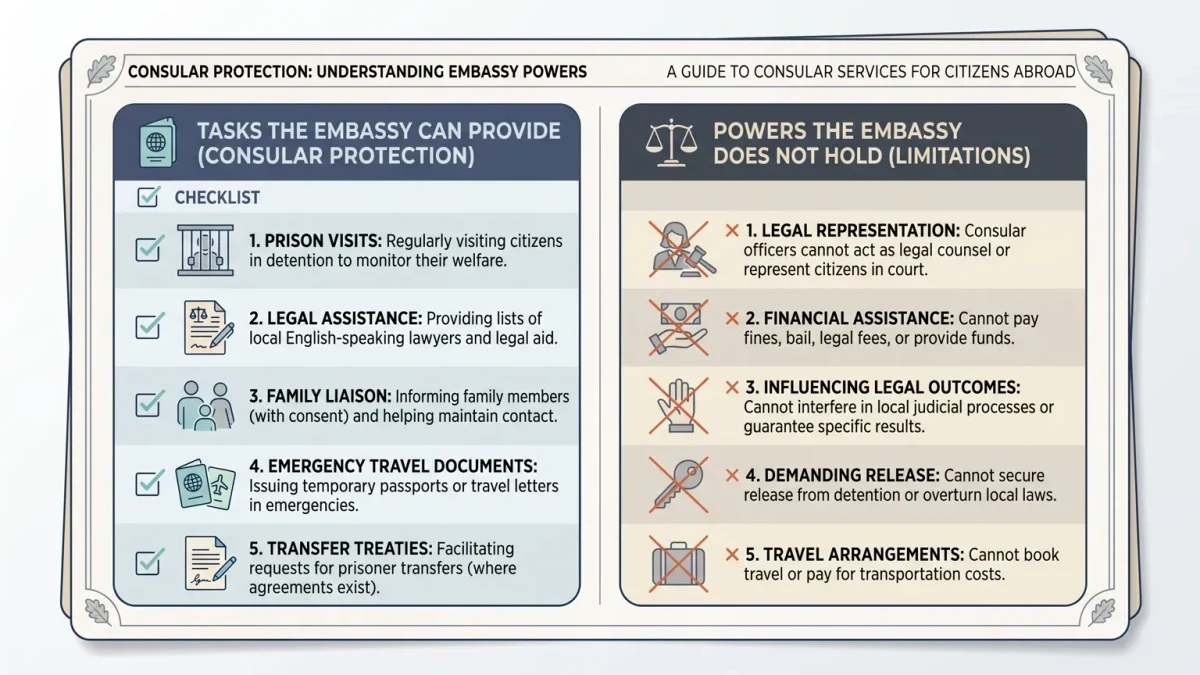
Consular protection is the set of services a state's consuls owe its nationals abroad — visits to detained citizens, lists of local lawyers, liaison with local authorities, welfare checks, emergency travel documents — anchored in the 1963 Vienna Convention on Consular Relations, and its most misunderstood boundary is the one everyone discovers at the worst moment: an embassy cannot get you out. Article 36 of the convention guarantees detained foreigners notification of their right to consular access and requires local authorities, upon request, to inform the consulate of the arrest — the provision the International Court of Justice ruled the United States violated in the LaGrand and Avena cases over Mexican nationals on death row, cases that made consular law death-penalty politics. But the consul's powers end at the prison gate: no intervention in the trial, no override of local law, no extradition by embassy.
What does a consul actually do for a detained national?
A defined list, performed with varying competence across the world's foreign services. A prompt visit — the core obligation — to check treatment and health; provision of a local lawyer list, never a lawyer paid for unless means-tested programs apply; attendance at trial as an observer whose presence signals that someone is watching; liaison with family; pressure on authorities over conditions, medical access and due-process timelines; and, at sentence stage, transfer treaties — the arrangements under which a prisoner may serve the sentence at home, subject to both states' consent. The UK's and Australia's published guidance, the US State Department's detention-notification pages and the EU's consular-protection directive, which since 2011 lets EU citizens seek help from any member state's embassy where their own has none, all describe the same craft: representation without interference, pressure without authority.
What are the famous violations of the system?
The US death-penalty docket — LaGrand (Germany, 2001), Avena (Mexico, 2004) — where the ICJ ordered review of convictions obtained without consular notification and Washington's states largely declined, producing the 2008 Medellín Supreme Court ruling that ICJ judgments are not automatically self-executing; the reciprocal arrests of consular officers themselves under espionage pretexts; and the modern hostage-diplomacy files, where detained nationals become bargaining chips and consular access is denied outright — cases documented by families and governments from Iran's dual nationals to arbitrary-detention files elsewhere. Denying consular access is among the cheapest escalations available to a detaining state, which is why its denial is read as a deliberate signal rather than an oversight.
Why can't embassies just demand release?
Because the convention's architecture respects territorial sovereignty absolutely: local criminal law governs, and the consul is a guest with a checklist. The practical levers are indirect — bilateral relationships, quiet demarches, public pressure where the detainee's government judges it helps rather than hardens — and the dual-national trap: many states, from Iran to China, decline to recognize consular rights over their own citizens who hold second passports, treating the detained person as solely theirs. The counter-instrument states have built is law rather than diplomacy: the arbitrary-detention designation frameworks the US, EU, Canada and UK adopted in 2019-2021, sanctioning officials who conduct hostage diplomacy, and the travel advisories that tell citizens the truth before they fly: this jurisdiction does not honor the rules your embassy will invoke.
What about non-detention consular work?
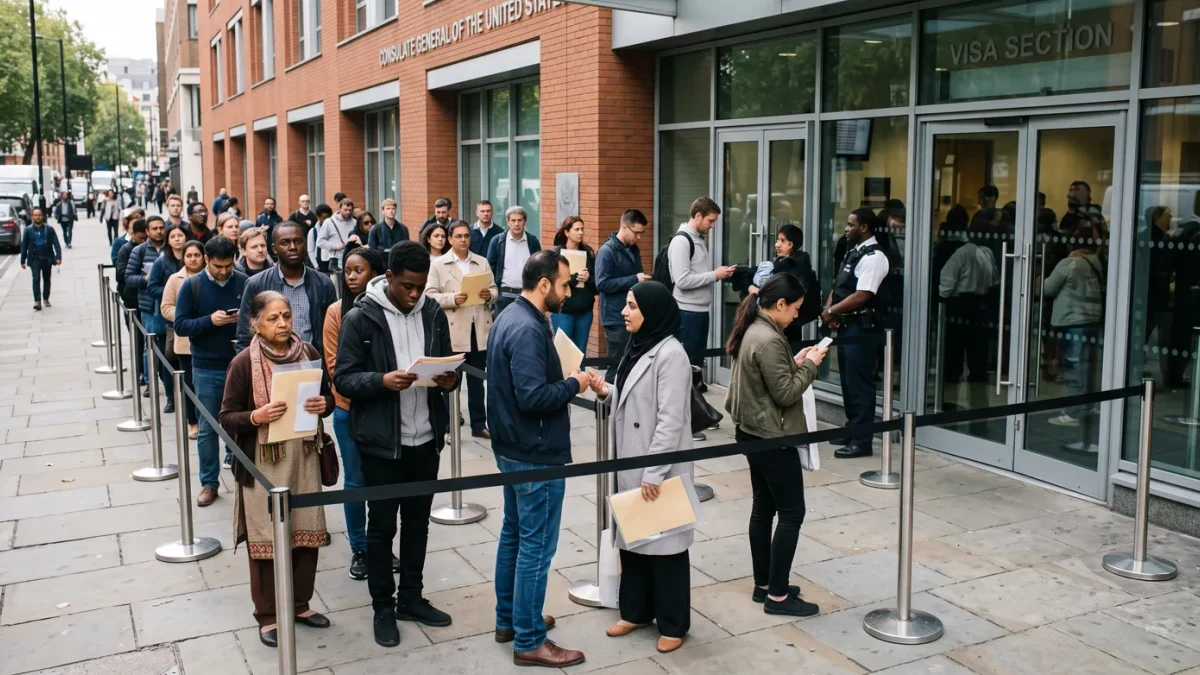
The daily bread, and the reason the system exists. Emergency passports issued in embassies worldwide by the hundreds of thousands; crisis evacuation — the 2023-2025 files from Sudan to Lebanon and Afghanistan's 2021 airlift, where consular crisis teams and military planners ran the largest operations in the genre's history; welfare checks on elderly emigrants and missing-persons inquiries; notarial acts that keep cross-border life legal; and assistance to victims of crime, which is distinct in law from assistance to suspects. The craft's professionalism is measured in the boring statistics — passports issued, visits made, cases closed — that no headline counts, done by officers whose careers alternate between visa windows and prison visiting rooms.
What should a traveler actually know?
Three sentences of fine print. Your right is access and advocacy, never immunity or extraction — the consul is your voice, not your escape. Insist, from the first police station, on consular notification, and say it in writing if you can: the notification right is the system's load-bearing wall, and it was built by cases where no one said it. And know your jurisdiction's particularity — dual nationality rules, arbitrary-detention advisories, transfer-treaty availability — because the world's consular system is one framework with 190 local weathers, and the traveler who knows the forecast is the consul's easiest case.