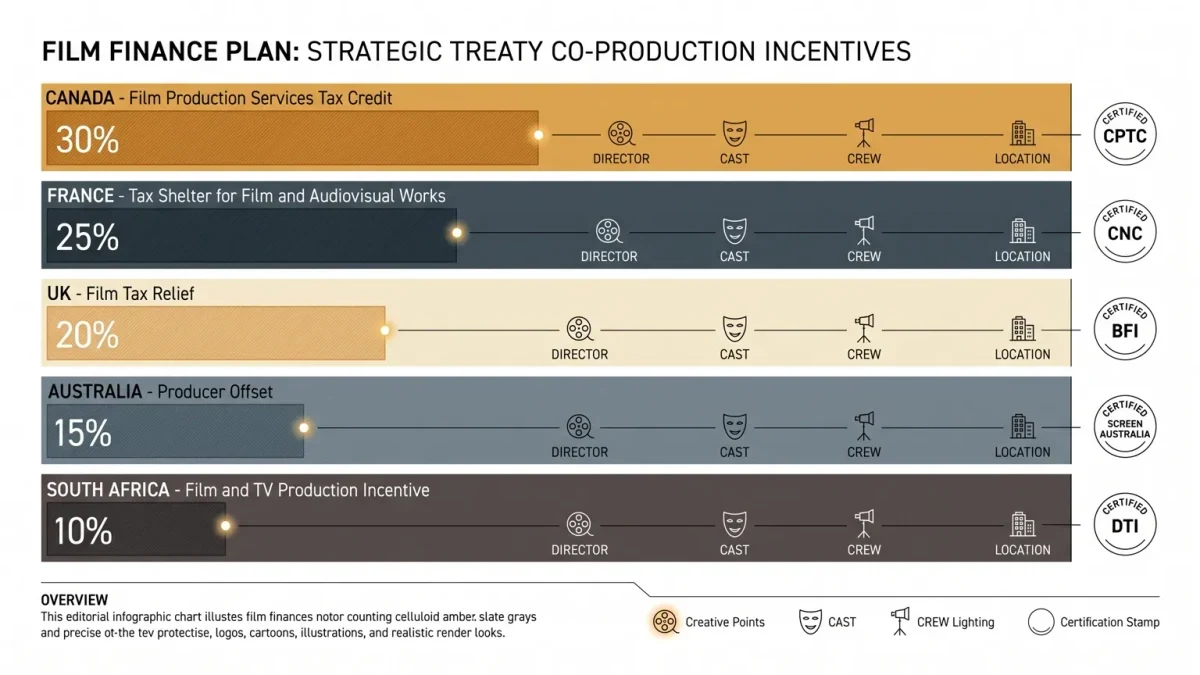
A film's nationality is decided less by its director's passport than by treaty math: bilateral coproduction agreements — the UK alone maintains pacts with over 50 partners under treaties administered through the British Film Institute — determine whether a multinational production counts as domestic in each participating country, unlocking national funding, tax reliefs, quota eligibility and awards categories. Under the Council of Europe's 1992 European Convention on Cinematographic Coproduction, ratified by most of the continent, a qualifying European coproduction is treated as a national film in every party state, which is why a French-German-Belgian feature can draw subsidies from all three cultural ministries while being counted as domestic for each country's cinema quotas. The system is obscure by design and enormous in consequence: it is industrial policy, cultural protection and soft power administered as contract law between foreign ministries.
How does a coproduction actually qualify?
By points, percentages and tests. Typical treaties require minimum financial participation from each partner — often 20 to 30 per cent — and creative participation measured through a points system tallying nationality of director, screenwriter, cast, crew and location spend. Administrative bodies — France's CNC, the BFI, Telefilm Canada, Germany's FFA — certify each project against the treaty terms before shooting, and certification is the passport to the incentives: the UK's audio-visual expenditure credit, France's advances and automatis de soutien, Canada's federal and provincial credits stack across borders precisely because the treaties make one film several domestic films at once. The 1992 Convention adds a European-content test for its convention-route films, balancing creative expenditure across parties.
What is the system for, originally?
Keeping national cinema alive in an American-dominated market. The postwar settlement — France's 1949 agreement with Italy being the genre's founding classic — built a legal architecture that lets European productions pool budgets to a scale that can compete with Hollywood while preserving each state's cultural policy tools: screen quotas, subsidy funds, broadcast-content requirements that streaming-era directives like the EU's 30-percent-European-content rule extended to platforms. The cultural-exception doctrine, defended by France in every trade negotiation since the 1990s GATT 'audiovisual' fight, keeps film outside ordinary free-trade rules so that these treaty instruments can exist at all. Coproduction treaties are the plumbing of that exception: without them, every multinational film would be an import in every market and ineligible for the supports that make non-Hollywood cinema financeable.
How has the streaming era strained it?
By changing where money and audiences live. Streamers commission across borders but are private multinationals with no treaty nationality — so European rules evolved: quota obligations on services operating in the EU, national incentives restructured as expenditure credits that any qualifying production company can access, and the odd spectacle of platforms incorporating in each jurisdiction to qualify. The treaties have kept pace unevenly: certification remains slow, territoriality requirements — release windows by country — collide with global day-and-date streaming, and Canada's and Australia's 2020s test disputes over what counts as domestic content for platforms reproduced the old film quarrels in new administrative forms. Meanwhile the incentive market has weaponized the treaties: productions are structured as treaty-qualified coproductions specifically to stack British, Irish, Belgian and Hungarian reliefs, with jurisdictions competing on rebate percentages — a race that funds films and alarms the cultural ministries who notice when 'national' cinema has an accountant's nationality.
Who wins and loses under the current regime?
Winners: producers fluent in the system, the crew hubs — London, Paris, Berlin, Montreal, Sydney — that attract treaty-qualified spend, and mid-budget cinema everywhere, which survives on stacked incentives where pure market finance has vanished. Losers: cinema from non-treaty states, which faces the import treatment the system exists to mitigate — African co-productions have grown through their own treaties, including the 1970s-era pan-African frameworks and newer bilateral deals, but the network's density is overwhelmingly European and North American; and small-nationality languages that must choose between treaty partnerships that dilute creative control and domestic budgets too thin for scale. The fairness critique writes itself: a system built to protect cultural diversity protects the cultures that signed first.
What is the system's quiet cultural effect?
Homogenization at the mid-budget tier and algorithm-proofing at the margins. Because finance plans require treaty points, casting and crewing decisions acquire a nationality arithmetic — the Portuguese coproducer's lead-actor suggestion is also a points decision — and scripts get written with territorial spend in mind. Against that, the same treaties are why ambitious cinema from smaller industries reaches scale at all: the Palme and Oscar winners of the past two decades were overwhelmingly certified coproductions, from 'Anatomy of a Fall' to 'Drive My Car' under Asia's treaty links to Europe. National cinema, in the treaty era, is not a birthright but a construction — built in contract clauses, certified before shooting, and no less loved by its audiences for knowing the paperwork exists.