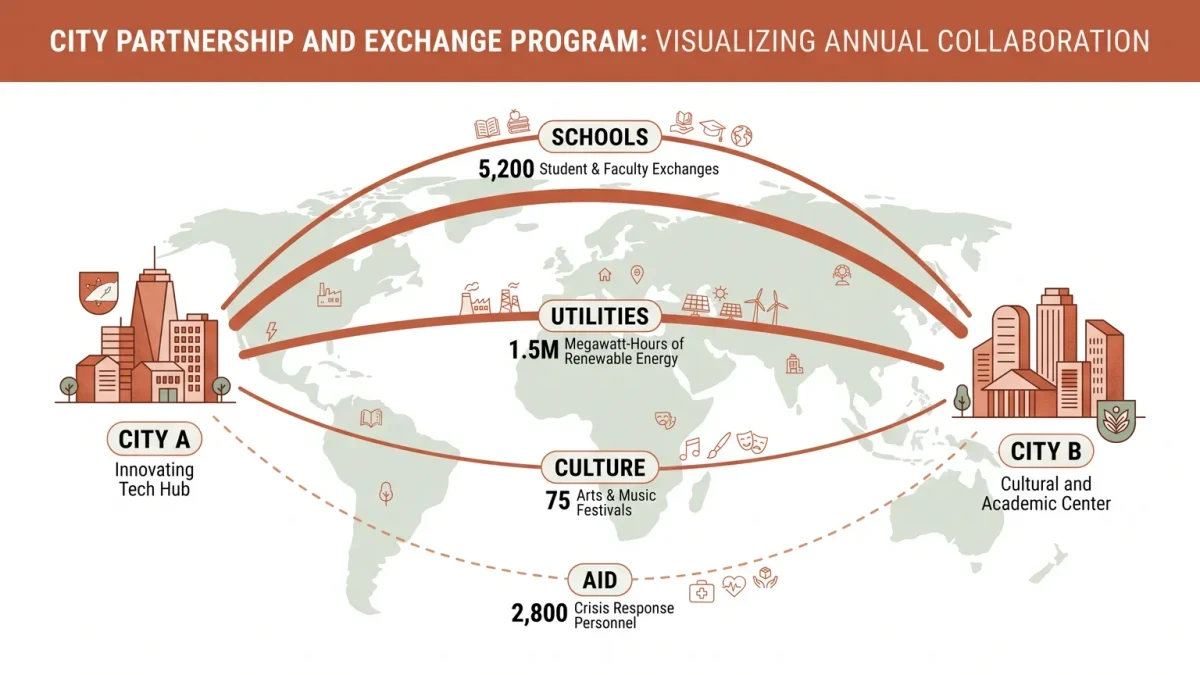
City twinning — sister-city agreements binding municipalities across borders in cultural, educational and technical exchange — is diplomacy's municipal tier, numbering tens of thousands of pairings worldwide: the EU alone supports over 20,000 town-twinning relationships through its Citizens, Equality, Rights and Values program, and the movement's founding documents are older than the UN — Coventry's 1947 twinning with Kiel and Dresden-in-ruins, Stalingrad's wartime bond with Coventry itself, the postwar Franco-German Élysée-era pairing wave that knitted thousands of communes across the Rhine as deliberately as any treaty. The genre's claim to significance is not power but persistence: municipal partnerships have continued through ruptures that suspended everything above them, and their history includes the odd moment when the town hall did what the foreign ministry would not.
What do twin cities actually do?
The bread-and-butter is exchange of the unglamorous kind: school visits and choir tours, sports fixtures, mayoral delegations at anniversaries, and — the professional core the genre's practitioners value most — technical cooperation between municipal officers: water-utility engineers comparing networks, fire services training together, procurement specialists, waste-management and public-health officers exchanging practice. Development twinning adds the north-south variant, where a European municipality partners an African or Asian counterpart for capacity projects. The volumes are real — thousands of exchanges per year across the EU programs alone, with modest grants administered through town twinning schemes — and the politics are correspondingly small: councils debate twinning budgets in the same meetings as parking rates, which is precisely the point. It is the one layer of international relations administered by people who face the voters at the bus stop.
When has twinning done actual diplomacy?
At the seams of conflict. The Coventry-Dresden-Stalingrad triangle — three cities bombed by each other's war effort, twinned amid the rubble — functioned for decades as reconciliation infrastructure while formal relations were frozen or hostile; US-Soviet town pairings in the 1980s nuclear freeze movement, coordinated through organizations like Sister Cities International, gave thousands of citizens a personal channel the White House and Kremlin did not control; and the pattern recurred at each thaw — Cuba-US municipal pairings sustaining contact through the embargo decades, Israeli-Palestinian and Serbian-Croatian municipal dialogues during and after their wars, the Japanese-Chinese friendship cities that survived every freeze in national relations. The honest assessment: twinning does not make foreign policy; it maintains human channel capacity that foreign policy occasionally needs to use, and it lowers the domestic cost of the next thaw by keeping some constituency of acquaintance alive through the frost.
Can twinning go wrong?
The genre's controversies are municipal politics wearing international costume. Partner choices are symbolic: councils have suspended twinnings over human-rights questions — the waves of European municipalities freezing Russian and Belarusian partnerships after 2022, reversing the Soviet-era and post-Soviet friendship networks — and choosing or refusing a Taiwanese, Palestinian or Jerusalem partner can turn a town council into an instrument of recognition politics it never asked to conduct. The Chinese friendship-city expansion of the 2010s drew national-security scrutiny in several capitals, with legislative proposals to vet municipal agreements — Australia's and the US's debates over sister-city and province agreements as soft-power infrastructure. And there is the chronic misuse of the category: the junket objection, twin-town travel as subsidized tourism, which every audit of the programs both confirms in individual cases and dismisses in aggregate, the grants being small and the measured outputs — school exchanges sustained, utility cooperation documented — correspondingly modest but real.
Why does this tier matter now?
Because diplomatic capacity is fragmenting downward. As national channels polarize, the municipal tier has become one of the few continuities: city networks — the C40 climate coalition, the migration and resilience networks, the direct city-to-city aid partnerships for Ukrainian municipalities, where hundreds of European towns paired Ukrainian counterparts for generators, ambulances and reconstruction expertise from 2022 — deliver cooperation that treaty politics currently struggles to sustain. City diplomacy's institutional literature, from the Barcelona-based city-diplomacy labs to the UCLG global network, argues that municipalities are now international actors in fact, with budgets and competences — climate, mobility, migration management — that make their cooperation load-bearing rather than ornamental.
What should readers watch?
The suspension lists and the new pairings: each freeze reflects national politics registering at municipal level, and each new north-south or wartime pairing — the Ukrainian municipal-twinning map being the genre's most live experiment — shows the tier doing what it does best: keeping channels open at the scale of water meters, schoolchildren and generator invoices, which is the scale at which, between capitals' quarrels, most of international life actually runs.