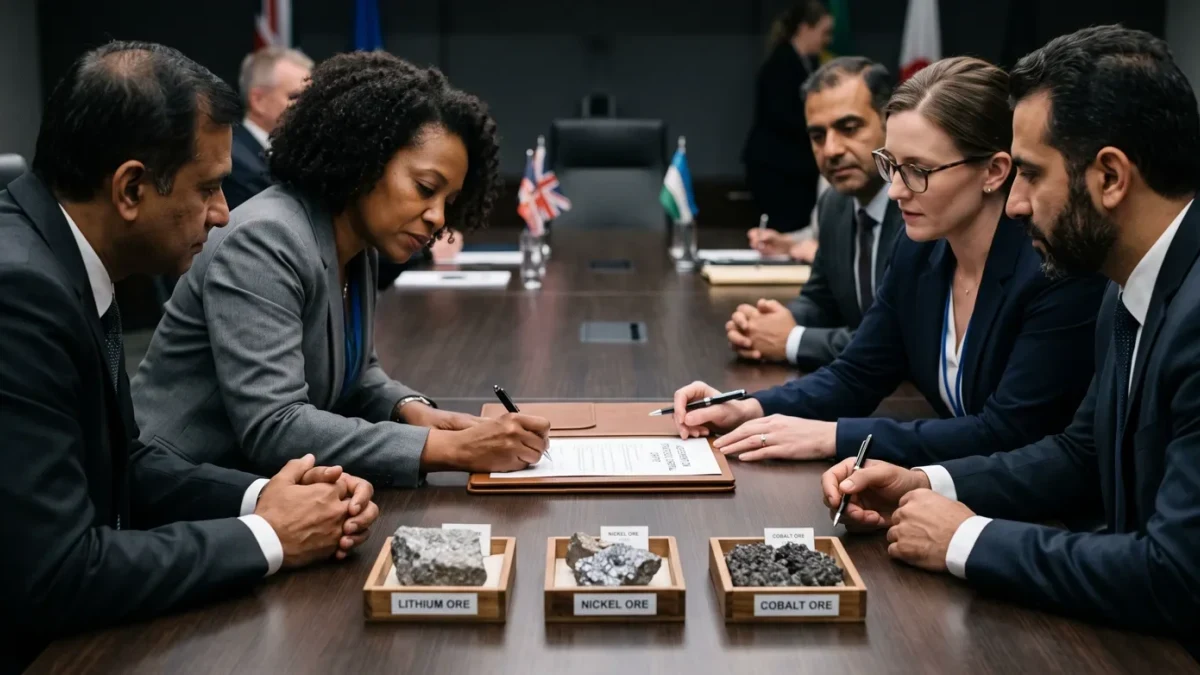
Critical-minerals agreements are now foreign policy instruments with appendices: the US-Ukraine reconstruction investment fund agreed in April 2025, granting Washington preferential rights over future Ukrainian mineral and hydrocarbon projects in exchange for reconstruction investment — per Reuters reporting on the final text — is the genre's most-watched specimen, alongside the Pentagon's 2025 arrangement with MpMaterials over American rare-earth processing and the EU's Critical Raw Materials Act benchmark of 2030 self-sufficiency targets. The underlying shift is documented in black and white: the International Energy Agency's periodic critical-minerals reviews show demand for lithium, cobalt, nickel and rare earths rising several-fold under announced climate targets, against supply chains whose processing stages concentrate overwhelmingly in a single country — China, which refines the majority of several key minerals and manufactures the dominant share of battery and magnet output.
What is a critical mineral, legally?
Whatever a government lists. The US Geological Survey and the Department of Energy maintain overlapping criticality lists — dozens of minerals whose supply disruption would carry strategic or economic consequence — updated on a cycle; the EU publishes its equivalent benchmark list; Japan, Korea, Australia and India maintain their own. There is no international standard, which is the point: criticality is a security judgment, and the lists function as planning documents that trigger stockpiling mandates, permitting fast-tracks, export-credit support and, in the American case, Defense Production Act funding. The lists keep growing — gallium and germanium drew their fame when China imposed export licensing on both in 2023, followed by graphite restrictions and, in 2025, tighter rare-earth controls including on several heavy rare earths where its processing share approaches monopoly.
How are the deals actually structured?
Four recurring templates, each with distinct politics. Offtake-first: buyers guarantee volumes to finance new mines, as Western automakers and governments have done with lithium developers in Chile, Argentina and Australia — fast, commercial, and vulnerable to price cycles. Equity-plus-infrastructure: the Chinese model in the Democratic Republic of Congo and Latin America, where loans, rails and ports bundle with mining stakes, trading asset control for development capital. Framework-partnership: the US and EU minerals agreements with Japan, the UK and each other — mostly alignment of standards, sourcing commitments and friend-shoring definitions under instruments like the Minerals Security Partnership, which convenes producer and consumer states to derisk specific projects. And the newest template, the sovereign-fund joint venture the Ukraine agreement exemplifies: a producing state contributes resource rights, a consumer state contributes capital and technology, and both share upside through a jointly governed fund — reconstruction finance wearing a mining license.
Why did the Ukraine deal take the shape it did?
Because each side priced its constraints honestly. Kyiv needed reconstruction capital without adding sovereign-debt burden or granting outright ownership of subsoil, which Ukrainian law reserves to the state; Washington needed a mechanism that framed aid as investment and anchored long-term American interest in Ukraine's economy without open-ended commitments. The April 2025 final text — after earlier drafts that reportedly proposed revenue rights Washington later dropped, per Reuters and BBC accounts — created a joint investment fund with preferential terms for US partners in future licenses and no explicit security guarantee, a structure both sides could ratify. Analysts noted the genre lesson: resource-backed funds bind allies at a different depth than treaties, because they create constituencies — shareholders, agencies, treasuries — with standing interests in the relationship's continuation.
Can buyers simply replace concentrated supply?
Slowly, expensively, and rarely ahead of demand. Mine development timelines run seven to fifteen years from discovery to output; processing capacity, the true bottleneck, is capital-intensive and technically hard — gallium, for instance, is mostly a by-product of aluminum and zinc refining, so building dedicated capacity outside existing smelter networks takes years and flat economics. The IEA's assessments consistently flag a widening gap between announced projects and 2030 demand for several minerals, and the mid-2020s price busts in lithium and nickel — which shelved Western projects exactly when governments were subsidizing them — showed the market's cruel joke: the policies that derisk supply also inflate it, crashing prices and idling the marginal, higher-cost Western mines the policies were meant to launch.
What should readers watch next?
Three indicators. Export-control announcements from Beijing — each new licensing regime reprices Western supply chains faster than any subsidy responds. The investment funds' first license awards — whether Ukraine-style JVs become the standard template for resource states with security needs, from Central Asia to Africa. And recycling and substitution technology, the quiet variables: if magnet and battery recycling scales in the 2030s the way steel scrap did in the twentieth century, today's mine maps will matter far less than the waste streams of the cars being built this year.