Two numbers that rise together do not prove that one makes the other move. A link between two trends is a clue, not a verdict. Causation demands a mechanism, plus evidence that the link survives once rival explanations are tested and removed.
The stakes of that distinction are not academic. In 1964 the U.S. Surgeon General released a landmark report on smoking after a committee reviewed more than 7,000 scientific articles, per the U.S. National Library of Medicine. The distance between the first alarming data and that final verdict shows why careful analysts treat every link as a claim to test. This connects to our earlier piece, The Mechanism That Forces a Debate After Every UN Veto.
What Does a Correlation Actually Show?
A correlation measures how tightly two variables travel together, and nothing more. It does not say which variable moves the other. A third factor may drive both. The two series may share a trend by chance alone, or the arrow may run backwards, from the outcome to the supposed cause. For related coverage, see How Sanctions Actually Bind: The Quiet Bureaucracy of Economic Pressure.
In debates over correlation vs causation, this gap is the entire dispute. Statisticians sum up the error in a Latin tag, cum hoc ergo propter hoc, meaning "with this, therefore because of this." As a standard reference describes the fallacy, two events occurring together are wrongly taken to have established a cause-and-effect relationship. The label sounds antique. The habit of thought it names appears in fresh headlines every week.
Why Did Ice Cream Seem to Cause Drownings?
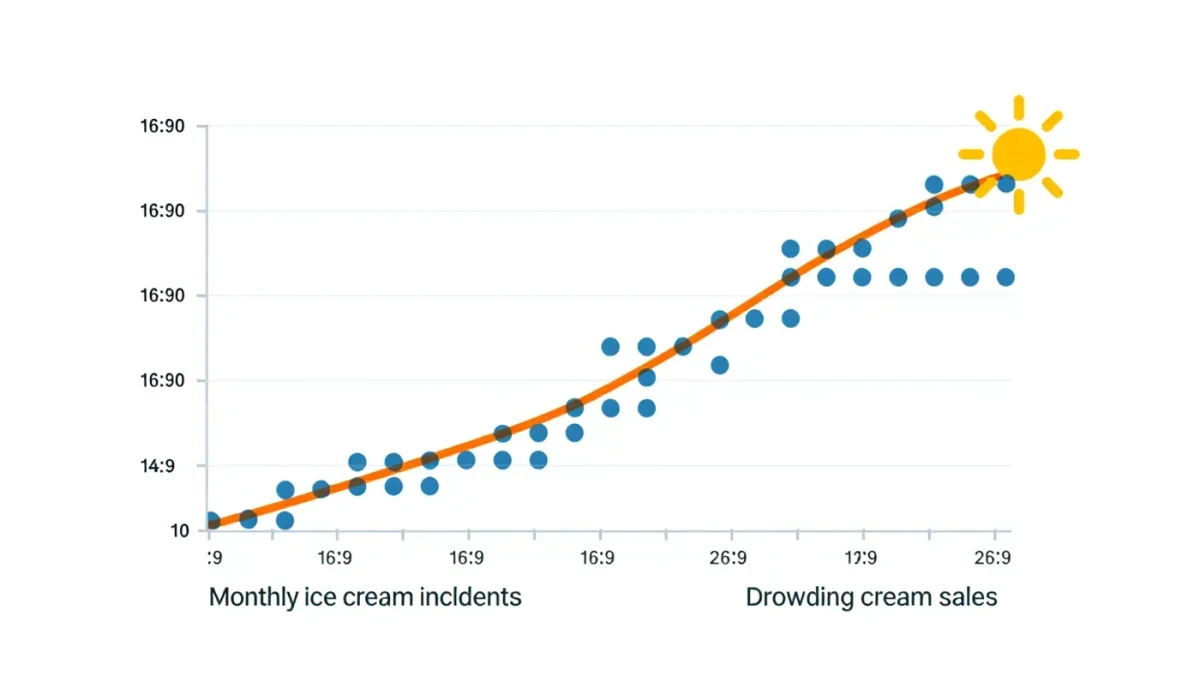
The drowning link was a season in disguise. Ice cream sales and drowning deaths both peak in summer, so the two series rise and fall together year after year. Heat drives both numbers. It sends people to freezers and to open water, and the tight correlation between the two follows.
The textbook example states the claim, then breaks it: as ice cream sales increase, drowning deaths rise sharply, and the reasoning fails because it ignores "the importance of time of year and temperature." Neither product influences swimming. Summer influences both. Once the season is held steady, the causal reading collapses.
How Did a Health Study Overturn Its Own Evidence?
Observational studies once hinted that hormone therapy protected older women's hearts. Then the Women's Health Initiative tested the idea directly, and the protection did not survive. Per the National Heart, Lung, and Blood Institute, the trial found that hormone replacement "did not prevent heart disease in post-menopausal women as was once thought."
The scale of the check was large. More than 161,000 women enrolled at 40 clinical centers, per the institute's study description, and its randomized trial enrolled more than 68,000 women between the ages of 50 and 79. Randomization assigns people to groups by chance, which strips out the hidden differences that voluntary choices create. The institute credits the hormone trials with helping save about $35.2 billion in direct medical costs in the United States.
When Does a Link Finally Count as Proof?
When the rivals die, and the pattern holds under pressure. Smoking and lung cancer traced that road. Surveys in the 1940s and 1950s tied the era's sharp rise in lung cancer deaths to smoking, while other suspects, including air pollution and asbestos, were examined and fell away, per the National Library of Medicine's record of the debate.
On June 12, 1957, Surgeon General Leroy E. Burney declared it the official position of the U.S. Public Health Service that the evidence pointed to a causal relationship. The landmark report followed on January 11, 1964, issued on a Saturday, as the archive notes, to soften the stock market impact. A link had become a verdict, and only after rival explanations had been tested and set aside.
Conclusion: Treat a Pattern as a Question
Correlation is where inquiry starts, not where it stops. The ice cream pattern hid a season. The hormone story hid the difference between women who chose a therapy and women who did not. Each puzzle turned on the same move: asking what else could produce the same pattern, and then checking.
That habit costs little. It catches confident errors before they shape public budgets and medical practice. The next time two lines on a chart climb in step, the honest response is neither belief nor dismissal. The honest response is a question: what else could be moving both lines?