Nuclear verification is performed by the International Atomic Energy Agency's safeguards inspectors — roughly 2,000 staff verifying declared nuclear material at over 1,300 facilities in more than 180 states under agreements that let them count, seal, swab and surveil uranium and plutonium through every stage of the fuel cycle. The legal spine is the Non-Proliferation Treaty of 1968, whose non-nuclear-weapon members accept IAEA verification of the pledge not to divert material to weapons; the Additional Protocol of 1997, now in force for well over 140 states, widened the lens from declared sites to a state's whole nuclear program, granting inspectors complementary access to undeclared locations and environmental sampling that can detect undeclared activities from particles gathered off surfaces. The system's paradox is its power source: everything depends on the watched state's cooperation, and the regime's history is the story of what happens when that cooperation narrows.
What do inspectors physically do?
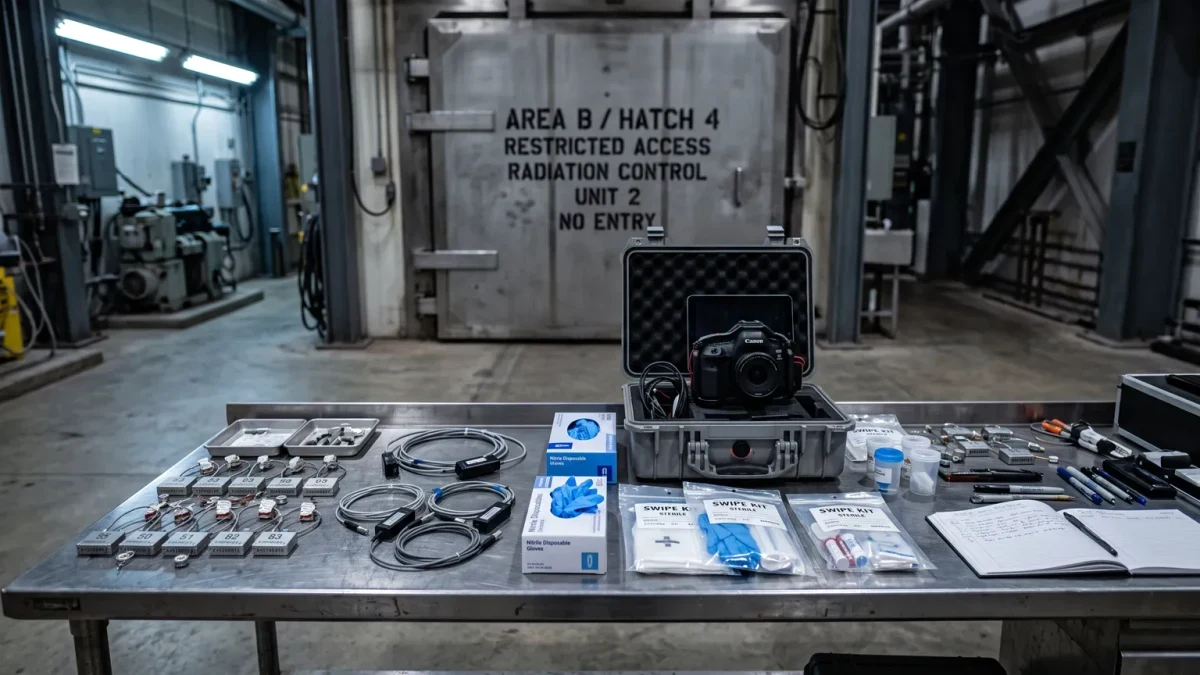
Mundane things with extreme rigor. Material accounting: weigh, measure and sample nuclear material — the input-output balance of a plant must close, with any statistically significant gap investigated. Containment and surveillance: tamper-indicating seals on containers and doors — from metal caps to electronic fiber-optic seals — plus cameras that record every movement at verified angles, with footage reviewed at Vienna headquarters. Environmental sampling: swipes taken inside facilities whose isotopic signatures, analyzed at microscopic levels, reveal histories of enrichment or reprocessing the operator did not declare — the technique that exposed Iran's enrichment trajectory in the 2003-2005 files. And remote monitoring: unattended systems streaming data continuously. The craft's premise is that nuclear material is hard to move without traces, and thirty years of environmental-sampling casework have largely vindicated it.
How did Iran test the system?
As its most rigorous adversary. The 2015 Joint Comprehensive Plan of Action gave the agency the most intrusive access ever accepted by a state: continuous surveillance of centrifuge production, enrichment monitoring at Natanz and Fordow, and a snapback of UN sanctions written into the Security Council resolution. The agency's quarterly reporting tracked compliance and, after the US withdrawal in 2018 and Iran's escalating enrichment to 60 percent uranium-235 — a level with no civilian requirement short of the 90-plus percent weapons grade — documented the stockpile growth that defines the file. Through 2021-2025 the unresolved safeguards issues — traces at undeclared sites, the agency's censure resolutions, Iran's de-designation of veteran inspectors in 2023 and its withdrawal of camera footage access — kept the inspection regime partially blinded even as negotiations over the program's future continued. The Iran file is the verification system's stress test running in public: what inspectors can prove, what cooperation they cannot compel, and what the Board of Governors does with the difference.
What about the weapons states and the un-signed?
The regime's asymmetries. The five NPT nuclear-weapon states accept only voluntary safeguards on selected material — the UK, France and the US invite agency verification on civilian programs as transparency theater with real teeth; Russia and China less so. India, Israel and Pakistan never joined the NPT and run weapons programs outside any IAEA access, though India's 2008 safeguards agreement covers its civilian reactors as the price of its nuclear-suppliers' exception. North Korea withdrew, expelled inspectors in 2002-2003, tested weapons, and in 2023-2025 the IAEA's monitoring of Yongbyon continued only by satellite — the agency's open-source imagery unit reporting reactor activity to the Board with no inspector on the ground, a preview of verification without access that the Ukraine war also forced: after March 2022, the IAEA rotated teams into Chernobyl and Zaporizhzhia under fire, keeping safeguards alive in a war zone — the genre's most dangerous fieldwork.
Can the system survive its politics?
It has survived worse, and its future is being stretched in three directions at once. AUKUS and similar arrangements test the naval-reactor loophole — highly enriched uranium propulsion outside safeguards, a category Australia's 2023-2025 negotiations with the agency are defining precedent for. New technologies — laser enrichment, small modular reactors, fusion-adjacent materials — demand safeguards-by-design so that facilities are inspectable before they are built. And the A-bank of trust is finite: each unresolved file teaches member states that cooperation is optional and that the agency's findings travel to the Board only as censure, not consequence. The inspectors will keep counting the world's plutonium, changing seals and reading swipes — the quiet audit of the species' most dangerous inventory, performed by people whose greatest professional achievement is that nothing has ever happened.