Famine is declared not by governments or headline writers but by the Integrated Food Security Phase Classification — the IPC, a consensus analytical system used by UN agencies, NGOs and governments, in which a Famine Review Committee of independent specialists confirms that an area meets the three thresholds: at least 20 per cent of households facing extreme food gaps, at least 30 per cent of children acutely malnourished, and hunger-related deaths at a rate of two per 10,000 people per day. The system was built precisely to remove the incentive to exaggerate and the temptation to minimize: famine classification triggers legal and political obligations — it is the threshold international law associates with the most serious humanitarian alarm — and it was designed, after the contested Somalia estimates of the early 1990s, so that the declaration would rest on measurable survey data rather than advocacy or denial. Somalia's 2011 famine, formally classified retroactively as having killed roughly 260,000 people, half of them children, remains the system's founding trauma: the declaration came late, and lateness was measured in lives.
How does the IPC actually work?
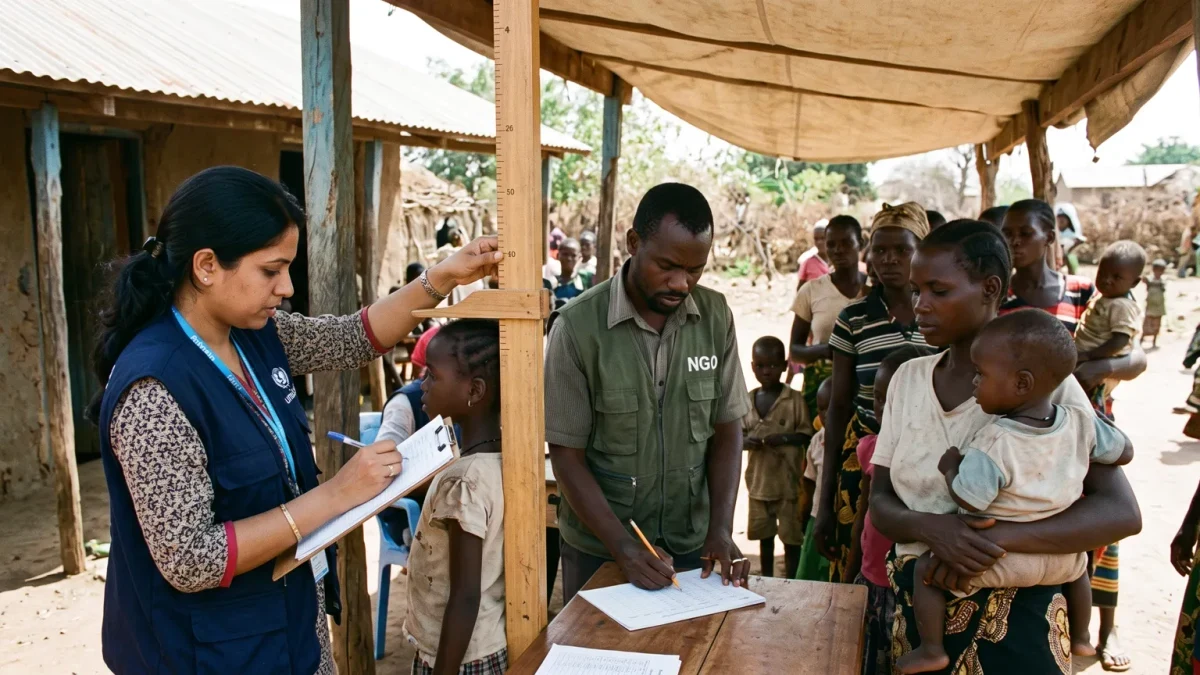
In cycles. Surveys — household questionnaires, nutrition measurements of children, mortality estimates — are collected by humanitarian agencies on the ground; analysts classify areas into the IPC's five phases, from minimal to catastrophic, with population counts at each; and where Phase 5 evidence emerges, the Famine Review Committee — senior independent food-security and nutrition experts — validates the classification before publication. The committee's role is the system's quality gate: it can confirm famine, classify 'risk of famine', or reject classification where evidence falls short — and in 2024's Gaza analyses it did the most-watched work in the system's history, confirming famine conditions in the north and projecting famine trajectories while repeatedly noting that conflict-constrained surveys limited what could be measured. The IPC publishes projections too — the near-term forecasts that drive the appeals system's calendar — making the classification both a verdict on the present and a bet on the next quarter.
Why is the word so political?
Because the declaration assigns something adjacent to responsibility. Famine in the modern world is almost never a harvest failure alone — the famine studies consensus, from Amartya Sen's entitlement analysis onward, is that famines are political: war, siege, market destruction and policy choices turn scarcity into mass death. An IPC famine classification therefore indicts somebody — the party controlling the territory, the parties blockading it, or the international system that funded late — and the affected parties respond accordingly: the documented cases of governments contesting classifications, pressuring analysts and delaying survey access are numerous; Sudan's war-time data gaps and the 2024-2025 disputes over its famine classifications in El Fasher and the Zamzam camp — where the IPC confirmed famine while access constraints kept data thin — showed the pattern in real time. The word is rare not because the events are rare but because every actor at the table has reasons to prefer the softer adjacent vocabulary: 'risk of famine', 'catastrophic', 'Phase 5' — each technically precise and each lighter than the noun.
Does the declaration change outcomes?
At the margin of funding and access, which is where the system's designers aimed. Post-declaration aid surges follow the historical record — Somalia 2011's late declaration and the funding response became the lesson the 2016-2017 Somalia near-famine response applied, with earlier appeals and larger early funding credibly linked to avoiding classification; the Yemen files of 2018-2021, where famine was projected and preempted by aid at scale, demonstrated the same. The counterfactual discipline is the IPC's quiet achievement: by making the thresholds technical, it converted 'is it famine?' from a political debate into a data question — and the political debate moved to the data's collection, which is at least a debate with rules.
What are the system's honest limits?
Three. Access: surveys require presence, and the gravest crises occur exactly where presence is most denied — the IPC's own 'lack of data' classifications mark the shadow of war. The evidence standard itself: the thresholds are conservative by design, so hunger far short of famine kills massively in the Phase 3-4 ranges that headlines skip. And the response gap: classification creates no legal obligation to act — the obligation architecture of international law runs through political bodies that can decline — so the meter can read famine while the machinery behind it idles. The system's wager is that measurement is the precondition of response, which the twentieth century's unmeasured famines did not have the chance to test.
What should readers watch?
The IPC's published cycle for the live crises — Sudan, Gaza, the Sahel, Yemen — where each quarterly classification moves populations across phase boundaries. The Famine Review Committee's confirmations, each a rare and consequential noun. And, behind them, the access negotiations that decide whether the world is looking — because the meter only works where someone is allowed to hold it.