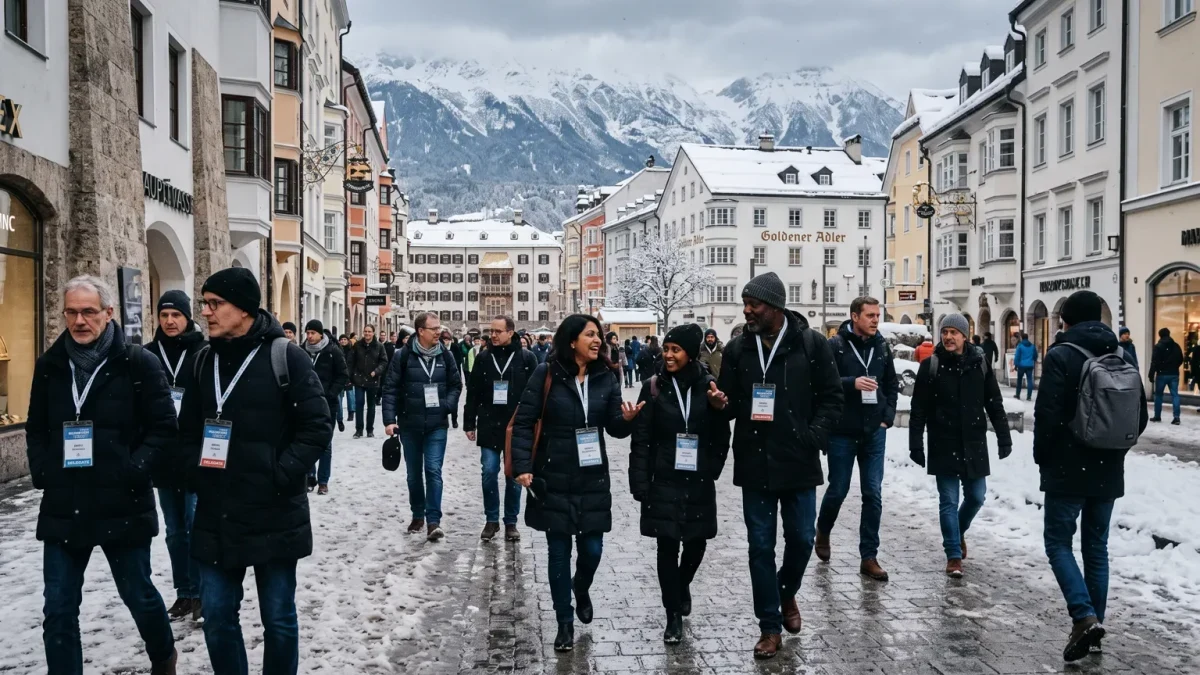
The World Economic Forum's annual meeting in Davos matters because roughly 2,500 people who rarely share a room — heads of state, central bankers, chief executives, campaigner and philanthropists — do share one, in a Swiss ski town, for four days each January, and the resulting density of contact sets the season's agenda more reliably than any institution with actual authority. The forum is a foundation, not a government. Its budget comes from membership fees that large corporations pay for access and brand proximity, and its signature product is convening power: per the WEF's own published participant figures, the January 2025 meeting drew around 2,700 participants from over 130 countries, including more than 60 heads of state and government — the highest concentration of political leadership anywhere outside a UN general assembly week, and considerably more comfortable than one.
What is the WEF, formally, and who pays for it?
Founded in 1971 by Klaus Schwab as a European management symposium, the forum became an international not-for-profit foundation in 1976 and built its calendar around the annual meeting each January. Funding rests on some 1,000 partner companies that pay fees scaled to their tier; access is stratified accordingly, from badge types that open specific zones to the Davos staple of corridor meetings that no badge can schedule. Schwab stepped down as executive chairman in 2025, handing the operational reins onward while retaining a foundation role — a succession watched closely for what it signals about the institution's next fifty years.
Why does a meeting with no votes produce so much news?
Because Davos is a synchronization device. Panels rarely announce decisions; they calibrate expectations. When a central bank president hints at a rate path, or two rival ministers share a stage in Munich's warmer cousin, the news is the posture, not the communiqué — there is no communiqué. Journalists cover Davos the way markets cover it: as a reading of consensus. The forum's own research output, from the Global Risks Report published each January to competitiveness and gender-gap indices, supplies the meeting's intellectual scaffolding, and the risks report has a reasonable track record of surfacing concerns — cyber, debt, polarized politics — that formal bodies absorb a season later.
What do critics say, and what is the strongest defense?
The critique has two prongs, one material and one cultural. Materially, Davos concentrates the global elite behind paywalled access, and its optimistic panels have aged badly — the forum's own 2024 acknowledgment of a 'polycrisis' era was widely read as an apology for two decades of cheerleading. Culturally, the meeting has become shorthand for out-of-touch elite consensus, a target that unites populists of left and right more effectively than any of its initiatives unite anyone. The best version of the defense is straightforward: the forum makes existing power structures legible and lightly accountable. A CEO who skips Davos still shapes the global economy — minus the recorders. The four-day concentration of interviews, sidewalk stand-ups and impromptu press availability extracts more public statements from private actors in a week than a quarter of ordinary news cycles.
Has Davos ever produced anything concrete?
A few threads trace directly to the mountain. The GCC-predecessor diplomacy of the late 1980s is the canonical example: South African negotiating teams met apartheid-government delegations at Davos in private sessions before the formal transition, an episode Schwab cited as proof of concept. The foundation's health initiatives, pandemic-era supply-chain coordination and the 2020-launched Trillion Tree platform each have measurable outputs, if modest ones next to their branding. The honest ledger: Davos rarely originates action, but it has occasionally incubated relationships that later did — which is exactly what a convening institution should claim, and all it can honestly claim.
Is the January meeting's influence rising or fading?
Both, in the way of most legacy institutions. Attendance by Western political leadership dipped in the mid-2020s as leaders chose domestic stages, while participation from Gulf, Asian and Latin American delegations grew — a compositional shift that mirrors the economy the forum claims to track. The annual meeting now competes with a denser calendar of rival convocations, from Munich Security Conference regulars to Gulf-hosted investment forums that offer the same cocktail of dealmaking and skiing with fewer snowless-winter jokes. What has not emerged is a replacement for its specific gravity: the week in late January when a critical mass of the people who run things are, verifiably, in the same postcode.
The forum will convene again, critics will write the same columns, and thousands of schedules will still bend around a town of 11,000 residents. Authority was never the product. Proximity was, and it still sells out.