The Olympic Truce — ekecheiria, the ancient Greek cessation of hostilities during the Games — was revived in 1993 as a UN General Assembly resolution that every host now requests: a symbolic demand that war stop from seven days before the opening ceremony to seven days after the closing, passed by consensus at each Olympiad including the Paris 2024 resolution adopted a year in advance. Its modern record is the point: the truce has coincided with fighting in Bosnia during the 1994 Lillehammer-Atlanta cycle, Russia's invasion of Georgia in the 2008 Beijing window, the Crimea annexation weeks after Sochi 2014, and the full-scale invasion of Ukraine in the same year as Beijing 2022 — a historical irony, since the 2022 Games were hosted by a state then preparing the war that broke days after the closing ceremony. The truce's failure rate would embarrass any other instrument, and yet the ritual persists, because its purpose was never really to stop wars.
What was the ancient truce actually for?
Travel, not pacifism. The classical ekecheiria — whose existence is documented in inscriptions and ancient accounts, though archaeologists debate its enforcement — suspended hostilities so athletes and spectators could cross war-torn Greece to Olympia and back; wars generally continued, armies merely paused their marching seasons' interference with the festival traffic. The mythic charter attributed to Iphitos of Elis and the Spartan lawgiver Lycurgus gave the truce sacred sanction: violators offended Zeus and faced exclusion. The honest classical scholarship is measured — the truce protected pilgrims, referees and the sacred month, not the battlefield — which makes the modern revival historically faithful in an unintended way: it, too, mainly protects the Games' logistics rather than the world's peace.
Why does the UN keep passing it?
Because the resolution is doing diplomatic work no peace demand could. Cosponsoring the truce resolution is a low-cost, universally available signal of support for the Olympic movement — the 2024 text attracted over 180 cosponsors — and the resolution's annual-adjacent passage creates a standing venue where sports diplomacy and peace rhetoric coexist: the International Olympic Committee's observer status at the UN, the Olympic Refuge Foundation's work with refugee athletes, the refugee team fielded since Rio 2016. The truce resolution also functions as a census of hypocrisy: states at war sign it without embarrassment, which teaches the valuable, if deflating, lesson that the UN's symbolic register and its operational register are different instruments. The strongest defense of the ritual is precisely its cheapness — a world that cannot agree to stop wars can at least annually agree that stopping them would be good.
What happened when the truce met real wars?
The genre's grim casebook. 1994: the Sarajevo siege continued through Lillehammer, and the IOC's response — a notice honoring Sarajevo, the 1984 host — became the template for sympathetic gesture over effect. 2008: Russia and Georgia fought across the truce window itself. 2014: Sochi closed, and Crimea followed within weeks. 2022: Beijing closed on February 20; the invasion began February 24. And 2024 requested its truce amid two full-scale wars; Ukraine's government pointedly noted the resolution's emptiness as Paris opened. Each episode sharpened the IOC's exclusion politics instead — Russia's state symbols banned since 2016-2018 for doping and then the war, athletes competing as neutrals through Paris 2024, Belarus the same — making the Games themselves the truce's only reliably enforced zone: inside the stadium, the rules hold absolutely; outside it, they hold nowhere.
Can sports diplomacy do more than gesture?
At the margins, and the margins are real. The two Koreas' joint delegations and unified teams at Pyeongchang 2018 opened a diplomatic year that produced two summits — the genre's best modern case of Games-adjacent thaw, even if the thaw itself later froze. Ping-pong's 1971 prelude to Nixon's China opening remains the founding proof that athletic contact can pre-stage political contact. Cricket diplomacy between India and Pakistan, the 1995 Rugby World Cup's role in South African reconciliation, and the arduous negotiation of exactly which flags, anthems and neutral designations wars permit — the Paris 2024 Ukrainian and Russian files — are the working end of a trade that gestures more than it achieves and achieves more than its critics concede. The truce resolution is the field's ceremonial outer wall; the visa lists, the neutral-uniform rules and the Refugee Team are where its actual politics live.
What should readers watch at each Games?
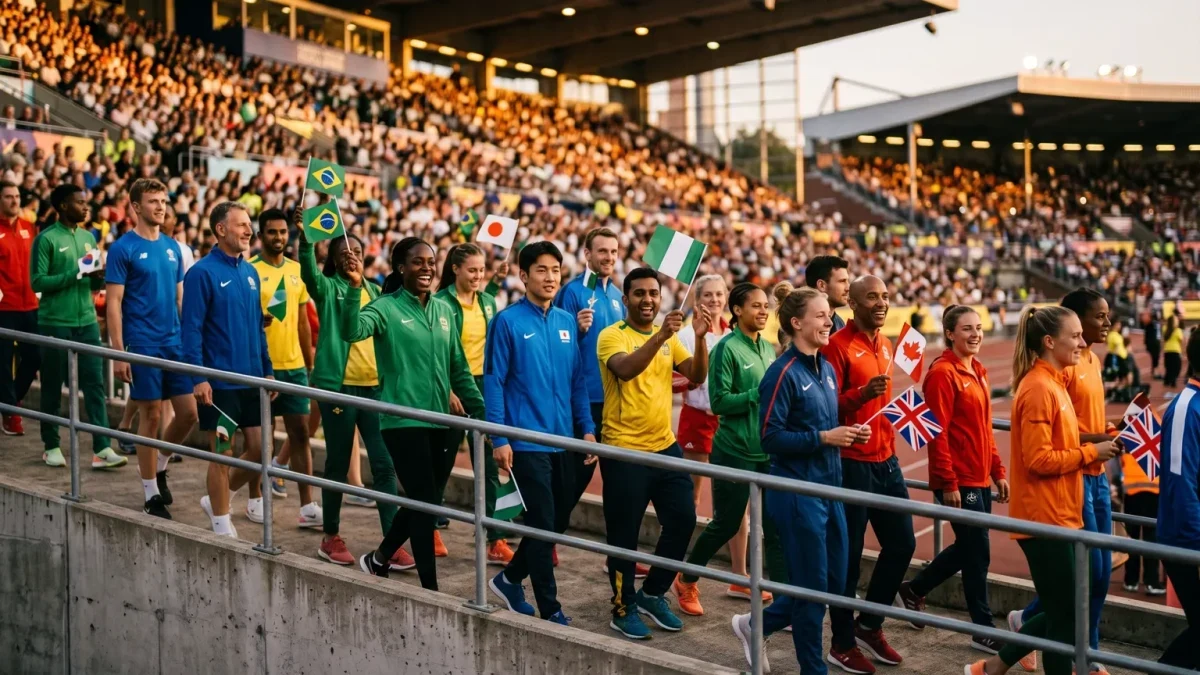
The vote, the violations and the flags. The resolution's cosponsor count and any abstentions measure the Olympic movement's diplomatic weather; the wars that continue through each window measure the world's; and the parade-of-nations compromises — neutrals, refugees, merged delegations — are the truce's honest ledger, updated every four years. Three millennia in, the world still gathers for the festival, still asks the gods for a pause, and still declines to grant one. The truce endures because the asking is the tradition — and, faintly, because every four years the reminder that wars could stop for a fortnight plants the question of why they do not.