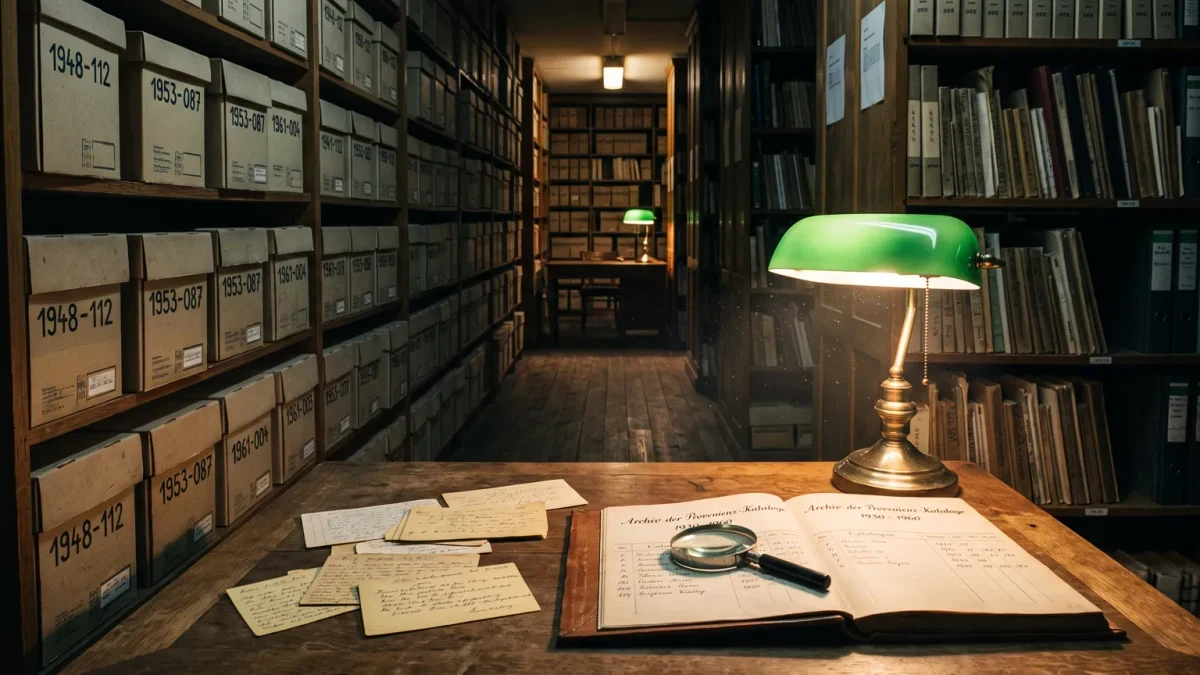
Behind every restitution headline stands a database: Germany's Lost Art Internet Database, run by the German Lost Art Foundation in Magdeburg, publishing found-reports and search-requests covering cultural property displaced in the Nazi era, Soviet occupation and the postwar movements; Interpol's Stolen Works of Art database, holding records of over 52,000 objects as of the mid-2020s; the Art Loss Register, the private London registry with hundreds of thousands of items on file; and national portals from the FBI's art-theft program to the Italian carabinieri's Leonardo database, the world's oldest cultural-property force. These registries are the bureaucracy of memory: without them, a looted object's reappearance at an auction house is just a sale, and with them it is a claim. The 1998 Washington Principles' mandate that archives be opened and claims published found its machine-room precisely here — in searchable, public, permanent records.
What is the German Lost Art database, exactly?
The public face of the post-Washington-Principles settlement. Germany's 1998 federal-state joint declaration committed public institutions to provenance research and to publishing suspected Nazi-era seizures; the foundation's database — with its English and German portals — lists both sides of the market: owners' heirs searching for objects, and institutions reporting holdings with tainted gaps. Its companion institution, the Advisory Commission chaired successively by senior jurists, issues non-binding recommendations in contested cases — the body that told German museums to return Gurlitt-adjacent and other collections in its most-watched opinions. The model exported: Austria's Art Restitution Board binding since 2009, the Netherlands' and France's restitution committees, the UK's Spoliation Advisory Panel — each a database-adjacent tribunal turning records into returns.
How does a claim actually use these records?
By triangulation, and the craft is detective work with footnotes. A claimant's search-request names an object from a family inventory, insurance schedule or deportation-era photograph; researchers match it against museum catalogues, dealer ledgers — the Parisian and Lucerne archives of the 1940s trade are themselves databases — auction records and the registries' found-reports; provenance gaps between 1933 and 1945 get closed or documented; and the claim proceeds to a panel, a negotiated settlement, or — where a private holder refuses — occasionally a court, where statutes of limitation have usually been the claimant's enemy. The Gurlitt case showed the system's power and limits: the 2012 discovery of over 1,200 works in a Munich apartment ran through Taskforce Schwabinger Kunstfund, then the Gurlitt Provenance Research Project, identifying looted works for return while most of the trove's legal ambiguities died with the collector's bequest to Bern and its German museum partnership.
Why do records matter more than rights?
Because the rights exist only where the records reach. A 1938 seizure is actionable in 2026 only if someone can prove the 1938 ownership — the reason elderly heirs comb insurance schedules and the reason Germany funds provenance-research positions in museums as its restitution-era labor market. The digital turn multiplied reach: digitized dealer books, museum archives published online, the ERR's own looting inventories — the Nazis catalogued their thefts with bureaucratic diligence that now convicts them — and facial-recognition-style image matching that has connected family photographs to auction lots. The counter-trend is equally digital: laundering through private sales, freeports and, at the margin, NFT-era title games that the registries are only beginning to police. The databases grow because the trade's obligation to check them — due-diligence standards codified in the 1970 UNESCO and 1995 UNIDROIT conventions' chain-of-title norms — keeps hardening.
Do the databases catch thieves, or only history?
Both, with different hit rates. The Nazi-era files are history's accounting — slow, archival, panel-adjudicated. The theft files are police work: Interpol's database and the carabinieri's recoveries — Italy's force recovers tens of thousands of objects annually, the 2020s' major sting operations from Palmyra-piece seizures to the museum-raids of Naples and the Antiquities Coalition-documented Gulf and US prosecutions — run on registry matches, undercover inquiries and the museum world's tip lines. The British Museum's own 2023 revelation that a curator had stolen from its collection for years — the genre's most embarrassing file — was closed by registry-style internal auditing and police work, with recovered items tracked through the antiquities market. The lesson generalizes: documentation is the only instrument that works on both the century-old theft and last year's, which is why the world keeps building registries even as the headlines celebrate the returns they enable.
What should readers watch?
The registries' growth curves and the panels' dockets. Each new national committee — several European states created or expanded restitution bodies through the 2020s — converts more archive into more claims; each database partnership, like Interpol's with national forces on cultural property, widens the match net. The lost-art databases will keep their quiet dominance over restitution for a simple reason: an object with a paper trail can go home, and an object without one can only be argued about. Memory, in this trade, is a filing system.