Eurovision is simultaneously a glitter-drenched variety show and a working model of European politics, because the European Broadcasting Union's annual contest awards its points through a system that makes interstate sentiment visible: national juries and television publics award marks to other countries, and the resulting patterns — Nordic solidarity, Balkan clusters, the perennial arithmetic of neighbors — have been studied by political scientists more often than most actual elections. Founded in 1956 with seven countries and staged annually since, the contest now routinely draws participation from nearly forty broadcasters and a television audience the EBU has reported above 160 million, making it the largest recurring live music event on earth and, by accident of format, the continent's most candid popularity contest between states.
Who is actually allowed to compete?
Membership, not geography, is the gate. The contest belongs to the EBU's member broadcasters, which is why Israel and Australia compete — one by regional broadcasting-area eligibility, the other by decades of association through SBS — while Kosovo, lacking EBU membership anchored in recognized statehood and ITU coordination, has remained outside. That asymmetry is the contest's sharpest political edge: participation implies a kind of institutional recognition that exceeds what some aspiring states have achieved in any other forum. When Ukraine won in 2022 with Kalush Orchestra's 'Stefania', the victory was received across the continent as a political event; when the EBU ruled that the 2023 contest could not be held in Ukraine for security reasons and moved it to Liverpool, that decision was read the same way.
Is the voting really political?
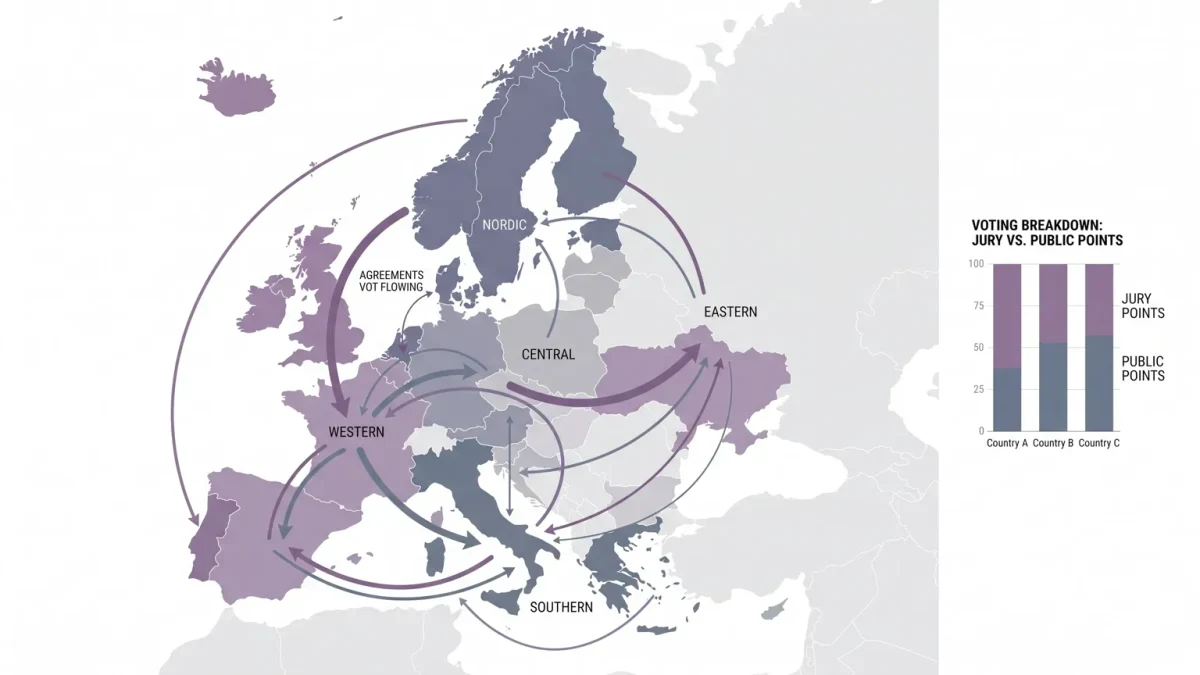
The honest answer is: partly, and less than the folklore says. Academic studies of televoting patterns have found persistent geographic clusters — reciprocal marks among Nordic, Balkan and former-Soviet cohorts — but also that song quality and performance order explain most of the variance. The 2016 reform split the vote into separate jury and public tallies precisely to dilute bloc effects; it instead made them more visible, since the public vote is now revealed last, in a single dramatic aggregate that can overwhelm the juries. Ireland's 2024 entry, Israel's successive top-three public finishes in 2024 and 2025, and Croatia's 2024 runner-up result each generated weeks of argument about what the tally 'meant' — a reminder that the scoreboard is a mirror, and mirrors get blamed for the face.
What has the contest survived?
Boycotts, censorship, an on-stage protest, and at least one invasion's aftermath. Lebanon withdrew in 2005 rather than broadcast Israel's entry; Belarus was suspended from EBU events in 2021 over broadcaster independence; Russia's broadcasters were excluded in 2022, ending three decades of participation. The contest has also been an inadvertent index of social change: Ukraine's 2014 victory, drag queen Conchita Wurst's 2014 win for Austria, and the string of queer and diaspora-fronted winners since have made Eurovision a stage where cultural battles arrive a season before parliaments take them up. Ari Olafsson, Netta, Måneskin — the winners' list doubles as a chronicle of what European audiences were ready to celebrate, and when.
Why do countries take it seriously enough to fight over?
Because hosting is nation-branding at bargain rates. The winning broadcaster stages the next year's final, a production seen by nine figures of viewers, and cities compete to host it the way they compete for Olympics — with considerably better cost statistics. Studies of tourism and national-brand metrics after victories show short-lived but real bumps, and for states with complicated international images — Ukraine in 2016 and 2022, Azerbaijan in 2012 — hosting has functioned as a bid for normalcy and visibility that diplomatic channels could not purchase. The counterweight is scrutiny: host countries inherit a media circus that also covers the things the tourism brochure omits, as Baku discovered in 2012 when reporters covering the contest wrote about evictions and political prisoners.
What does the scoreboard say about Europe now?
That its cultural map and its political map rhyme without matching. The 2020s have produced winners from Switzerland, Italy, Ukraine and Israel in a single five-year stretch — a spread no bloc theory predicts. The public vote keeps rewarding performances that juries underrate and vice versa, which is as clean a metaphor for elite-versus-popular politics as Europe exports. And the contest keeps expanding its reach into exactly the places European diplomacy finds hardest, from the Caucasus to the Levant to, through Australia's outstretched antenna, the Pacific. It remains what it was in 1956: a technical solution to the problem of sharing one television signal across many nations. It just happens to have become the most watchable diplomacy Europe runs.