Water treaties are among the most durable instruments in international law: states that exchange fire across a border routinely keep exchanging hydrological data across it, because a river gives downstream neighbors no choice but cooperation. The Indus Waters Treaty, signed in 1960 and brokered by the World Bank, survived the 1965 and 1971 wars, the Kargil conflict of 1999 and every rupture since between India and Pakistan — surviving, that is, until India announced in April 2025 that it was holding the treaty 'in abeyance' after the Pahalgam attack, per Reuters reporting, the gravest challenge yet to a document that had outlasted everything else the two states had signed. The Nile and the Mekong carry slower crises: a dam race and a data standoff that treaties were built to manage and politics keeps refusing to settle.
Why do water treaties survive when other agreements collapse?
Three reasons, each structural. First, the alternative to cooperation is not victory but drought and flood on both banks — a hydrological interdependence that military superiority cannot repeal. Research drawing on the Oregon State transboundary water events database has found that cooperative water interactions outnumber conflictive ones by a wide margin even between hostile states. Second, most treaties create standing technical commissions that meet on a schedule, insulated from ambassadorial withdrawals; engineers keep meeting after envoys go home. Third, the issues are divisible in ways territory is not: timing of releases, depth of navigation, data sharing can be adjusted without either state conceding sovereignty. The strongest objection to this optimism is that it describes the past: climate change is shrinking the resource base while the treaties were written for stationary hydrology — rivers that behave next century the way they behaved last century. They no longer do.
What is happening on the Nile?
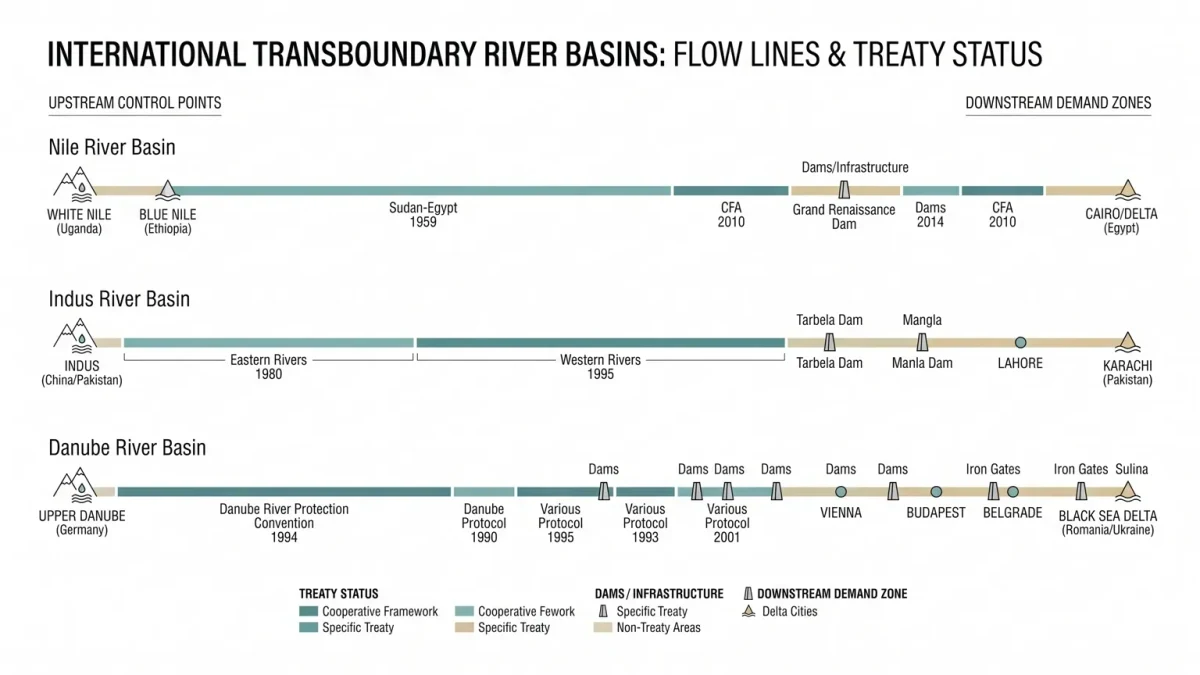
The Grand Ethiopian Renaissance Dam, Africa's largest hydropower project, filling since 2020 on the Blue Nile, supplies the river's headwater state with electricity and its downstream neighbors with anxiety. Egypt, which receives the overwhelming majority of its water from the Nile and considers a reduction an existential threat, spent a decade demanding a binding legal framework on dam operation; Ethiopia, insisting that upstream development is a sovereign right, signed a declaration of principles in 2015 and filled the reservoir without one. Talks mediated variously by the United States, the African Union and others have produced frameworks, not treaties — a slow-motion standoff in which every actor's worst outcome is plausible and no actor's preferred outcome is available. The Nile basin's 1929 and 1959 colonial-era allocations, which assigned Egypt and Sudan the river's flow with no Ethiopian role, remain the legal backdrop that makes any compromise read as historic loss in Cairo and any status quo as historic theft in Addis Ababa.
And the Mekong?
The Mekong River Commission — Cambodia, Laos, Thailand and Vietnam, with China and Myanmar as dialogue partners rather than members — runs the region's consultation process for mainstream dams, and the process's signature feature is that consultation is not consent. Laos built the Xayaburi dam after neighbors' objections in 2012 and the Don Sahong over similar objections; upstream, China's cascade of eleven operating dams on the Lancang gives it operational control of the dry-season flow that Vietnamese delta agriculture depends on. Since 2020 China has shared year-round hydrological data with the commission, a genuine step, while the delta salinizes and fisheries decline. The treaty layer is thin by design: the 1995 Mekong Agreement binds four states that control mostly the lower river, and the state that controls the upper river participates voluntarily.
What happens when a treaty is suspended outright?
The Indus case is the live experiment. India's April 2025 'abeyance' declaration followed decades in which the treaty's Permanent Indus Commission had survived wars and crises, and it moves the dispute from engineering into the realm where water meets statecraft. Under the treaty's terms, modification requires mutual consent or the prescribed arbitration path; a unilateral suspension has no settled legal meaning, which is precisely why the declaration was made that way. Pakistan has called any interference in the western rivers an act of war. The precedent worry is general: if the world's most war-proof treaty can be switched off by announcement, every downstream state from the Mekong to the Tigris has just repriced its water security.
Can treaty design catch up with climate reality?
The emerging answer is adaptive treaties: agreements built on percentages of flow rather than fixed volumes, with drought triggers, joint modeling and review conferences on a clock rather than on a crisis. The 2018 global framework conventions on boundary waters and the UN Watercourses Convention of 1997 offer templates few basins have yet adopted. The direction is clear even where adoption lags: the rivers will keep enforcing interdependence long after the current crises, and states will keep rediscovering what the Indus commissioners knew in 1965 — the water must be shared, because it cannot be unshared.