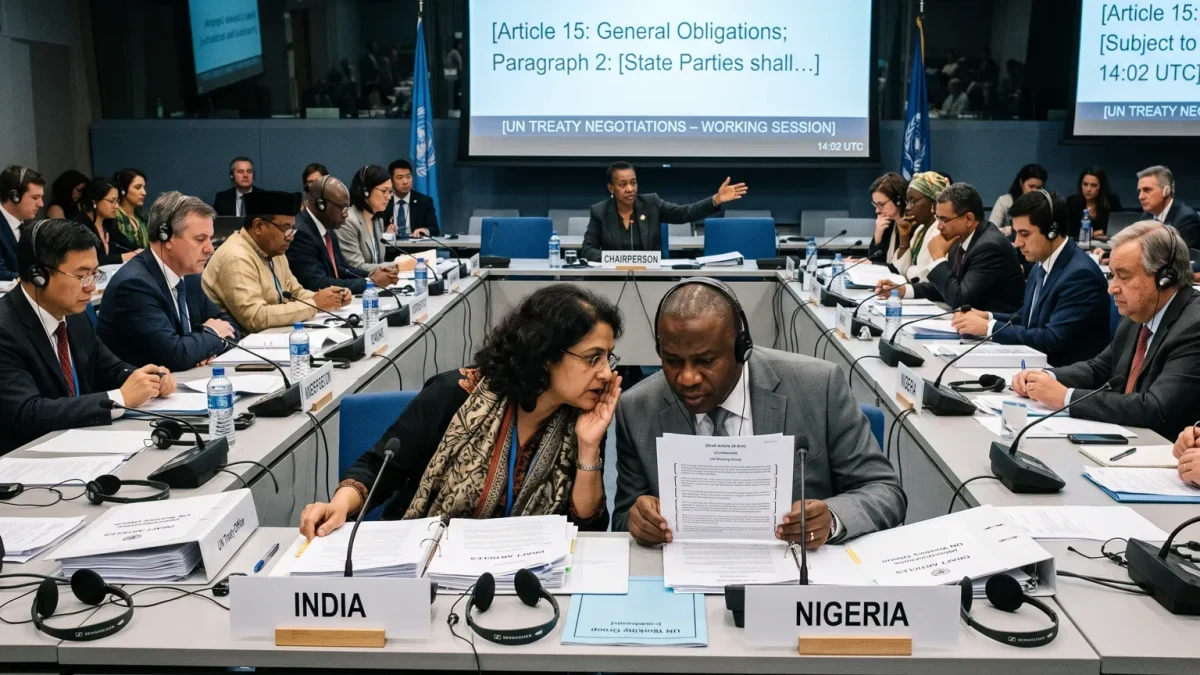
The Non-Proliferation Treaty's review conferences — the five-yearly gatherings of the 191-member treaty that are the nuclear order's constitutional convention — have adopted a consensus final document only twice since 1995, in 2000 and 2010; every other cycle, including 2015's and the delayed 2022 New York session, ended without agreement, broken on the same reef: the Article VI obligation of the nuclear-weapon states to pursue disarmament, which the non-nuclear majority reads as a promise overdue and the weapon states read as a process without deadlines. The 2022 conference failed over Russia's opposition to language on Zaporizhzhia and Ukraine, a war invading even the treaty's diplomatic grammar; the 2026 cycle approaches with the structure unchanged and the arms-control architecture that used to anchor it — the treaty's own bilateral satellites — expired or expiring. The review conference's failure pattern is not bad luck. It is the treaty's bargain, aging in public.
What is the bargain, and why is it aging badly?
Three trades, made in 1968 and extended indefinitely in 1995. The non-nuclear states forswore weapons in exchange for peaceful nuclear cooperation; they accepted the weapon states' temporary retention of arsenals in exchange for Article VI's pursuit of disarmament; and the weapon states' retention was to be matched by the NPT's verification regime preventing new members of the club. The trades have aged unevenly. Proliferation has been slower than feared — the club gained few members since 1968, with the holdouts India, Israel and Pakistan joined by North Korea's withdrawal — but cooperation and disarmament have aged worse: the peaceful-cooperation promise now includes the AUKUS naval-reactor dispute, and Article VI's ledger shows the New START treaty, the last US-Russia strategic limit, expiring in February 2026 with no successor negotiated, Chinese expansion proceeding, and the weapon states' modernization programs running at Cold-War budgets without Cold-War treaties.
Why do the same paragraphs break every conference?
Because they are where the bargain's asymmetry is legible, and consensus procedure gives the aggrieved a veto. The Middle East zone — mandated by the 1995 resolution that bought the treaty's indefinite extension, and stalled ever since over how to convene a conference Israel would attend — killed 2015 and shadows every cycle. Disarmament timelines — the non-aligned bloc's demand for a nuclear-weapons convention with dates, against the weapon states' step-by-step process — produce draft language that one side or the other brackets. And risk-reduction language — de-alerting, no-first-use, security assurances to non-nuclear states — tests the weapon states' doctrines at the table. Consensus means a single delegation's objection deletes the final document; the 2022 Russian objection over Ukraine did exactly that, and the lesson delegates drew was procedural as much as political: a treaty whose review process requires unanimity has given its most aggrieved member a triennial hostage.
What has the non-nuclear majority done instead?
Built a parallel track. The Treaty on the Prohibition of Nuclear Weapons — negotiated in 2017 by 120-plus states over the weapon states' explicit boycott, in force since 2021 with 70-plus parties — bans the weapons outright for its members and establishes victim-assistance and norm-building machinery: the humanitarian-initiative conferences, the banking-and-finance divestment campaigns, the stigma strategy that produced the antipersonnel-mine and cluster-munition bans before it. The weapon states and their allies reject its logic — deterrence-dependent members from NATO to the Pacific argue prohibition without the possessors changes nothing but the sign-hanging — and the two tracks coexist in visible tension: the same states that defend the NPT's step-by-step in New York boycott the ban conferences in Vienna, and the disarmament caucus cites the boycott as the old bargain's proof of bad faith. The review conference's failures feed the ban treaty's legitimacy, and the ban treaty's growth feeds the review conference's polarization — a single nuclear order running on two legal clocks.
Can the 2026 cycle succeed?
Not in the sense of a transformative final document, and the professional community's expectations are calibrated accordingly. What a successful failure looks like: a presidency's text that preserves the disarmament-action program's language without dates, a Middle East formulation that convenes nothing but offends no one, agreed reporting language on the humanitarian consequences that the weapon states abstain on rather than veto — plus, on the edges, the working papers on verification, fissile-material and risk-reduction that survive every collapse and quietly constitute the regime's real R&D. The greater stakes sit outside the hall: whether New START's expiry passes without crisis, whether the P5 process resumes anything resembling negotiation, and whether the treaty's next stress — a new proliferator, a Article-X withdrawal, a naval-reactor precedent — finds an order with any scaffolding left to absorb it.
What should readers watch?
Three texts. The final document's fate — adoption, bracketed silence, or another Russian-style single objection. The disarmament caucus's language — whether the ban treaty's vocabulary migrates into NPT text as it has been doing. And the February 2026 New START expiry — because the review conference's failure theater matters least where it meets the treaty's real test: five weapon states, one expired limit, and a nonproliferation regime waiting to see whether the promise at its center was ever serious.