The European Union operates the world's largest single translation system because equality among languages is treaty law, not courtesy: Regulation 1/1958, still in force as amended, makes all 24 official languages equally authentic versions of every regulation and directive, meaning a farmer reading a subsidy rule in Irish and a commissioner reading it in Maltese hold equally valid legal texts. The European Parliament's translation and interpretation service — several thousand permanent staff augmented by contractors — processes well over two million pages a year, while plenary sessions run on simultaneous interpretation in hundreds of daily language pairs routed through pivot languages. The system's annual direct cost runs to roughly one billion euros across institutions, a figure the EU's own auditors and budget documents have published and defended — about two euros per citizen per year for the legal guarantee that no member state's language is subordinate in law.
Why is equal authenticity a legal principle rather than a service?
Because of what happens without it. In monolingual legal orders, the authoritative text is one language and everyone else reads a courtesy translation — fine for citizens fluent in the authoritative language, and a structural disadvantage for everyone else: courts, companies, parliaments. The EU's founding choice after the 1958 regulation was that a Dutch court and an Italian court must be able to apply 'the same' law without either operating at a legal remove, so equality of authenticity is what makes supranational law legitimate in 24 legal communities at once. The costs of the principle surface in courtrooms: when language versions diverge, the Court of Justice of the EU has developed a canonical method — interpret by comparing versions, in light of purpose — and its case law includes celebrated divergences resolved by finding the meaning common to all texts, a jurisprudence that exists only because Europe legislates in parallel.
How does the machinery actually work?
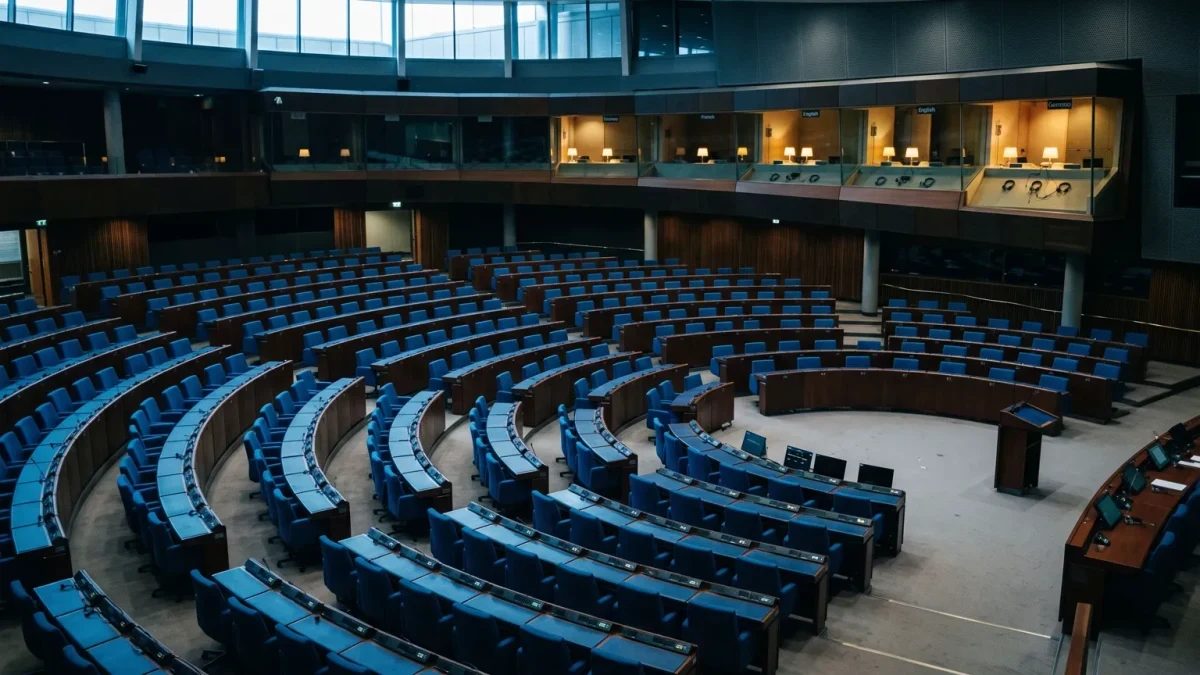
With heavy industrial process. Translation units draft-map every document; interpreter booths staff plenary sessions and committee meetings with relay interpretation through pivot languages — Maltese to Finnish via English — a chain where error compounds and the strongest argument for trimming the system lives. The Parliament's own statistics show translation output measured in millions of pages, with machine translation now handling a growing share of internal working documents — the EU's eTranslation platform processes tens of millions of pages annually — while the legally binding texts retain human translation and revision by law. Canada's federal bilingual statute books, Switzerland's four-language codes and South Africa's eleven-official-language regime all run smaller versions of the same machinery, each balancing cost against the constitutional meaning of linguistic equality.
What does the multilingual order get wrong, honestly?
Three chronic grievances. Working-language gravity: internal drafting, late-night negotiation and staff careers concentrate in English — with French as the institutional counterweight — so the equality that exists on the published page is thin on the corridor floor, a gap documented by the EU's own court reports and by academic sociolinguists studying Brussels practice. Cost creep: interpretation into languages used thinly at committee stage is expensive per listener, and periodic austerity rounds trim 'partial' interpretation, reopening the equality question by budget line. And machine translation's quiet hierarchy: as automated drafting grows, the versions humans actually check concentrate further in the working languages, making equality of authenticity progressively more formal and less real. Defenders answer with the per-citizen cost — the price of a coffee for a year of legal equality — and with the counterfactual: a monolingual EU would save a billion and spend the savings on legitimacy crises.
Is the model expanding or shrinking?
Both directions at once. Croatia's 2013 accession added the last new official language to date, and each future enlargement adds pairs multiplicatively — Ukraine's candidate status alone would mean translation capacity scaled for another state's full legal order. Meanwhile the internal machinery automates, with the institutions' stated strategy shifting from translating everything to translating what is legally required plus what citizens request, within standing rights of reply and petition in any official language. The likely steady state is a two-tier system wearing one-tier law: equal authenticity preserved at the binding-text layer, pragmatic concentration everywhere else. It is an imperfect settlement for an imperfect union — but as a working answer to the question 'whose language is the law', it remains the most serious attempt any political order has ever made.