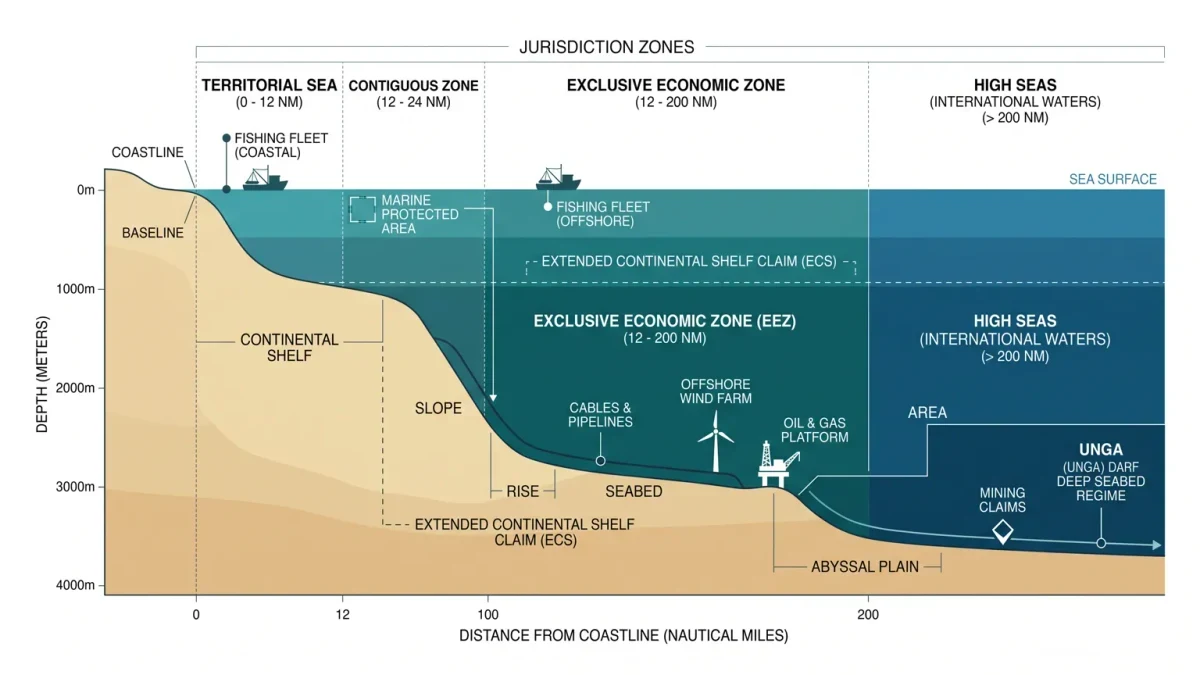
The 'blue economy' — everything from fisheries and shipping to seabed mining, offshore energy and marine biotechnology — is valued by the OECD at over 2.5 trillion dollars annually with projections of doubling by mid-century, and its contested core is a legal architecture most readers have never heard of: the UN Convention on the Law of the Sea, the 1982 'constitution for the oceans' that divides waters into territorial seas, exclusive economic zones extending 200 nautical miles, and the high seas beyond, where a 2023 treaty — the High Seas Biodiversity Treaty, agreed after two decades of negotiation and now moving through ratification toward its 60-party entry-into-force threshold — finally creates a framework for marine protected areas in the two-fifths of the planet that no state owns. The ocean frontier is contested precisely because its property regime is young, incomplete and suddenly valuable.
What are the actual contests?
Four overlapping ones. Fisheries: roughly a third of global stocks are overfished per the UN Food and Agriculture Organization's periodic assessments, and the fights — South China Sea gray-zone fishing fleets, Western Africa's illegal-catch losses measured by sea-monitoring groups in the billions, the 2023-2025 tuna and mackerel quota wars in the Northeast Atlantic — are about the last wild harvest on earth. Seabed minerals: the International Seabed Authority, the Kingston-based body that administers deep-sea mining in international waters, has spent a decade drafting a mining code without finishing, while Nauru's sponsoring of the Metals Company's plans triggered a de facto two-year clock in 2023 and a growing list of states — from France to Palau — now campaigns for a moratorium. Cables and corridors: over 95 per cent of intercontinental data runs through submarine cables whose landing rights, repair regimes and espionage vulnerabilities have become security policy. And continental shelves: states file extended-shelf claims to the seabed beyond 200 miles with the Commission on the Limits of the Continental Shelf, whose queue of submissions reads like an atlas of future disputes — the Arctic's Lomonosov Ridge filings among the most geopolitically loaded paperwork in existence.
Why is the South China Sea the genre's masterpiece?
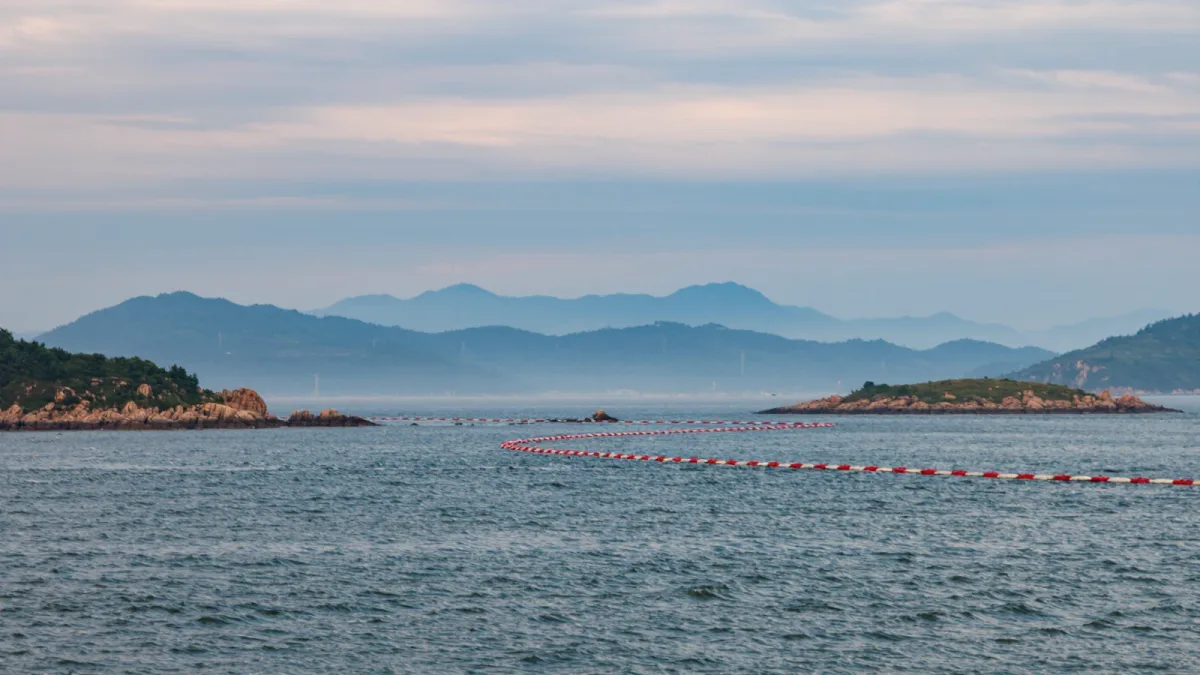
Because it compresses every ocean-law question into one basin. China's nine-dash-line claim was rejected by the 2016 arbitral award in the Philippines' case under UNCLOS's Annex VII procedure — a ruling Beijing dismissed as null and void — and the years since have featured precisely the gray-zone contest the law struggles to name: maritime-militia boats at Whitsun Reef, water-cannon incidents against resupply missions to Second Thomas Shoal documented through 2023-2025, coast-guard law enforcement as sovereignty theater. UNCLOS allocates zones but its enforcement mechanism is arbitration states can ignore, and the South China Sea shows the system working exactly as designed — jurisdiction established, ruling delivered — and failing exactly where power declines to comply. Every other maritime dispute, from the Eastern Mediterranean's gas blocs to the Aegean's continental shelf, runs on smaller versions of the same mechanics.
Can the high seas be governed at all?
The 2023 treaty is the test. Its two central mechanisms — environmental-impact assessments for high-seas activities and a conference-of-parties process to designate marine protected areas — require the cooperation of fishing states, mining sponsors and the sequencing of interests that sank previous rounds. Its ratification campaign, championed by a coalition of small-island states and the EU, crossed into the forties by 2025 with entry into force plausible within the decade. The countervailing force is the same one visible in every ocean file: the states with the largest distant-water fleets and the deepest-sea mining ambitions participate in the regime while testing it, and the ocean's tragedy-of-the-commons arithmetic — each actor's individual incentive to take, all actors' collective interest in restraint — has not been repealed by treaty text. The Biodiversity Beyond National Jurisdiction agreement, as its formal name runs, is the strongest evidence that high-seas governance is possible; the ISA's unfinished mining code is the strongest evidence that it is not finished.
Who are the rising powers of the blue economy?
Not only states. The flag-of-convenience shipping registries — Liberia, Panama, the Marshall Islands — exercise quasi-sovereign regulatory power over most of world tonnage, a privatized jurisdiction the industry runs through. The fishing companies and their state backers whose subsidies, targeted by the 2022 WTO agreement that finally entered into force after two decades, keep fleets at sea beyond economic sense. The cable consortiums and the platform companies building offshore data infrastructure. And the navies, whose freedom-of-navigation operations are the ocean regime's enforcement arm — the US program of FONOPs being the standing American answer to excessive maritime claims, conducted against friends and rivals alike by doctrine rather than by alignment. Ocean power in the 2020s is a portfolio: registry, fleet, cable, claim, court filing, warship — and the states that hold the full set are writing the map of the century's quietest scramble.
What should readers watch?
Three dockets. The ISA assembly's annual sessions — the mining-code votes and moratorium tallies decide whether the deep seabed opens this decade. The BBNJ ratification count toward sixty. And the arbitral and judicial queue — the ITLOS advisory opinion on climate change delivered in 2024 marked the courts' arrival in ocean-climate politics, and every new filing extends the law's reach one basin at a time. The ocean was the last commons. It is becoming the most carefully lawyered space on earth, which is what happens to frontiers the moment everyone wants a piece.