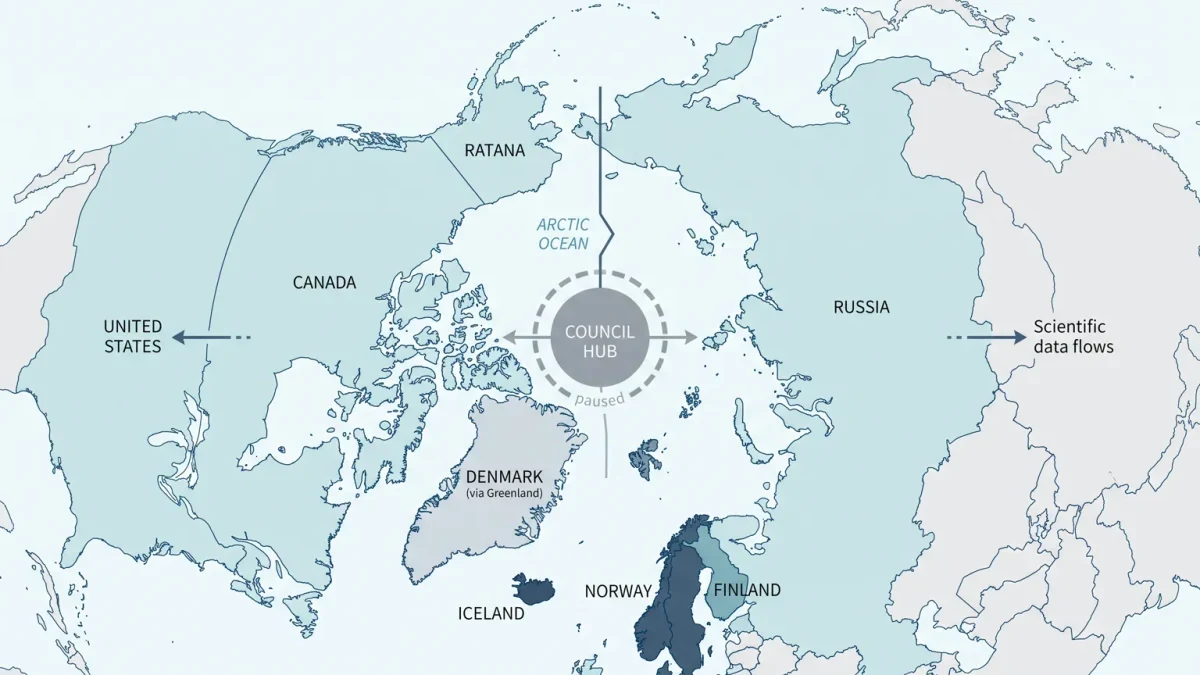
The Arctic Council, the forum of the eight Arctic states — Canada, Denmark, Finland, Iceland, Norway, Russia, Sweden and the United States plus six permanent Indigenous participant organizations — has been functionally suspended since March 2022, when the seven Western members paused participation in any body Russia chairs, and it held the rotating chairmanship at the time. Russia's two-year chair, planned around sustainable development in Yakutsk, became a two-year vacuum; the handover to Norway in May 2023 was negotiated without a leaders' summit, and Norway's caretaker term and the subsequent US chairmanship from 2025 — under an administration whose declared interest in Greenland raised its own Arctic weather — have kept the council alive in maintenance mode: working-group webinars without Russian attendance, projects frozen, the odd statement affirming commitment. The council has no security mandate by founding design, and it is precisely that self-denial that made it work — until the war made even science political.
What did the council actually do before 2022?
Technical governance of real consequence, much of it legally binding. The 2011 search-and-rescue agreement and the 2013 marine-oil-pollution preparedness agreement — the council's two binding treaties — were negotiated among all eight including Russia and remain in force. Its working groups produced the scientific baseline of the melting Arctic: the Arctic Monitoring and Assessment Programme's climate reports, the Conservation of Arctic Flora and Fauna biodiversity assessments, the Arctic Contaminants reports that built the case for global mercury controls later codified in the 2013 Minamata Convention. The council's assessments were the shared factual floor on which shipping rules, fisheries science and the 2018 Central Arctic Ocean fishing moratorium's research agenda rested — and that floor is what the pause cracked: datasets gap where Russian territory covers half the Arctic coastline, and climate science without Siberian observations is measurably poorer.
Why can't the council simply expel or sideline Russia?
Because geography outranks outrage. Russia holds roughly half the Arctic's coastline and population; any regime for shipping lanes, spill response, fisheries and science that excludes it governs half a region. The Western seven tried selective workarounds — the non-Russia Arctic science bodies, coast-guard-level forums like the Arctic Coast Guard Forum that maintained some contact, and the 2023-2024 pattern of resuming some working-group sessions with virtual or absent Russian participation on a case-by-case basis, as Norway's chairmanship carefully engineered. Moscow, for its part, declared the council's Western form obsolete and promoted alternatives — the Arctic Circle assembly's openness notwithstanding, Russian policy turned to bilateral channels with China, whose self-declared 'near-Arctic state' status and Polar Silk Route ambitions grew through the freeze. The honest summary: no one can govern the Arctic without Russia, and no one currently wishes to sit with it, so nobody governs.
What filled the vacuum?
Militarization and Chinese positioning. Nordic accession to NATO — Finland in 2023, Sweden in 2024 — completed the alliance's Arctic encirclement of Russia's western flank, and the high north now hosts more exercises, more patrol tempo and reopened Cold-War-era listening posts on both sides. China deepened its Arctic science presence, its investment in Russian Arctic liquefied-natural-gas projects — sanctioned but advancing — and its icebreaker fleet, doubling its polar diplomacy spending across forums. And functional cooperation migrated to narrower channels: the Barents Euro-Arctic structures, bilateral coast-guard shiprider agreements, and the International Maritime Organization's Polar Code — the shipping-safety regime that keeps functioning precisely because it is not consensual politics. The council's fate illustrates a general law of institutional diplomacy: when a body built on consensus loses its consensus, the work does not stop; it moves to venues with fewer chairs.
Can the council be revived?
Technically it never died — it paused, and its small secretariat in Tromsø continued administering dormant programs. Revival scenarios circulated through Norway's chairmanship: a suspended-animation protocol keeping the treaties alive, limited-format science resumption, or a formal bifurcation into a Western council plus a Russian-adjacent parallel process that would end the pretense. The binding treaties' continuity — SAR and oil-spill response still legally connect all eight — is the thread a future thaw could pull. But the conditions are structural, not procedural: the council froze because consensus with Russia became impossible for the seven, and it will thaw only when that changes or when the seven accept a lesser, partitioned institution. Nobody in the region expects either soon.
What should readers watch?
Three indicators. The working-group meeting calendars — each resumed session with Russian participation, however technical, is a thaw signal. The shipping data — trans-Arctic transit volumes and the Polar Code enforcement statistics measure whether governance by default is holding. And the chairmanship's statements from Washington, whose Greenland rhetoric has already re-securitized the council's western flank in ways even the 2022 pause did not. The Arctic taught the world that shared science can substitute for trust. The freeze is teaching the harder lesson about what happens when it cannot.